Central Hudson Net Metering and the CBC Charge
Central Hudson serves the mid-Hudson Valley and carries the state's highest 2026 CBC rate. Here is how its net metering works and what the charge costs a real system.
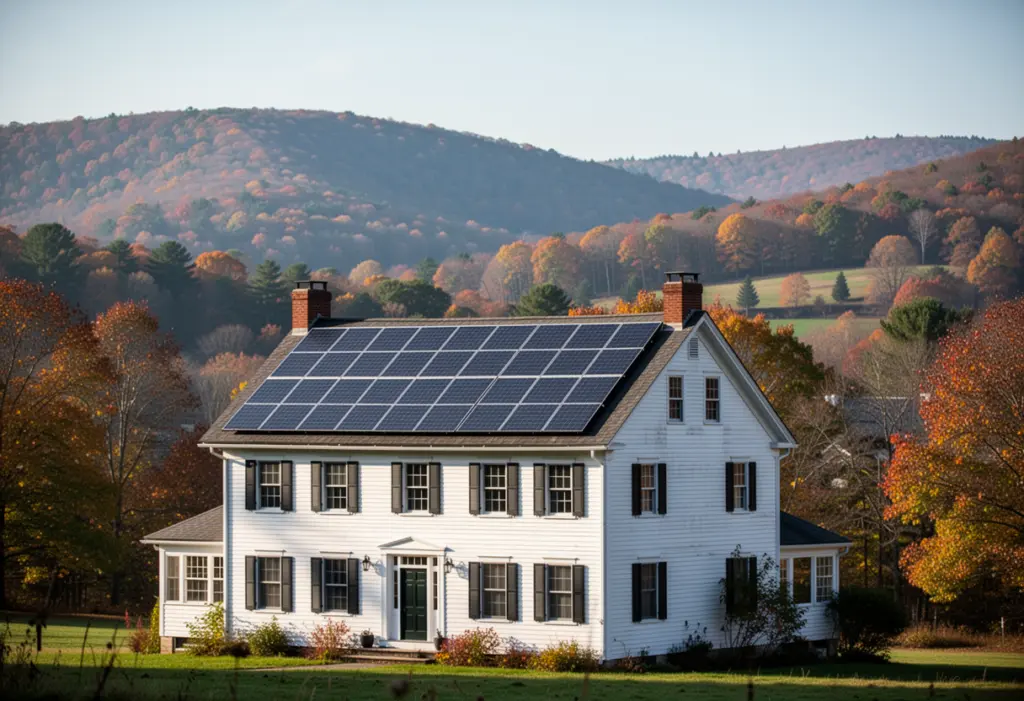
Central Hudson Gas & Electric serves the mid-Hudson Valley — Dutchess, Ulster, most of Orange, and parts of Columbia, Greene, Putnam and Sullivan. It is the smallest of the major New York investor-owned utilities and it carries the state’s highest residential solar CBC rate, which makes it the territory where that particular number is most worth understanding before you sign.
How the credit works
Production is consumed in the house first; the surplus is exported and metered. Under Phase One net metering each exported kilowatt-hour is credited at the full retail rate, and a system interconnected today holds that structure for 20 years.
Because the Hudson Valley has real seasonal swing and a lot of tree cover, the credit balance built between March and September is what pays for December through February. Sizing is done against the annual figure, and a shading assessment is not optional here — mature hardwoods are the single most common reason a Hudson Valley system underperforms its estimate.
The Customer Benefit Contribution: the highest in the state
Residential customers who interconnected on or after 1 January 2022 pay a monthly Customer Benefit Contribution, charged on the DC size of the system. Central Hudson’s final 2026 residential rate for net-metered PV is $1.67 per kW-month.
- A 6 kW system: 6 × $1.67 = $10.02 a month, about $120 a year.
- An 8 kW system: 8 × $1.67 = $13.36 a month, about $160 a year.
- A 12 kW system: 12 × $1.67 = $20.04 a month, about $240 a year.
The same 8 kW system pays $7.76 a month on National Grid and $10.32 on Con Edison. Over twenty years the Central Hudson premium on that system is on the order of a thousand dollars against National Grid territory — not decisive, but not nothing, and it never appears in a sales proposal.
The Value Stack residential rate on Central Hudson for 2026 is $0.84 per kW-month, also the highest in the state on that route.
Three standing facts about the charge: it is billed on capacity every month regardless of production; it is recalculated annually and is not locked in at interconnection; and it does not apply to systems interconnected before 1 January 2022, to community solar subscriptions, or to commercial accounts carrying a demand charge.
Interconnection in the mid-Hudson
The sequence is the standard one — application, approval to install, installation, municipal electrical inspection, meter exchange, permission to operate — and the system may not run before permission is granted.
What is distinctive about Central Hudson territory is the built environment. Kingston, Rhinebeck, New Paltz, Hyde Park and much of Ulster and Dutchess carry significant historic districts and local architectural review. That review is a municipal step, not a utility one, and it happens before anything reaches Central Hudson. If your house sits in a historic district, ask about that review at the quoting stage rather than after the contract.
Property tax is the local variable
RPTL 487 exempts the added value of a solar system from property tax for 15 years, but a county, city, town or village may opt out by local law, and a school district by resolution. The RPTL 487 exemption is not automatic: file form RP-487 with your assessor by the taxable status date (March 1 in most towns; January 2 in Nassau towns; May 1 or June 1 in Westchester towns; set by charter in cities; usually January 1 in villages), and the system must be built before January 1, 2030 (RP-487 instructions). The exemption has to be checked for your town, your county and your school district separately, because an opt-out by any one of them applies to that levy alone. This is genuinely local homework and no statewide page can answer it for you.
What stays on the bill
The basic service charge and the fixed part of delivery remain for as long as the house is connected. Solar reduces the volumetric component. Expect a small bill, plus the CBC line, and treat a promise of a zero bill as a claim to be put in writing.
2026 incentives
The 30% federal residential credit under section 25D ended for expenditures made after 31 December 2025 — an expenditure being treated as made when the original installation is completed. New York’s 25% credit capped at $5,000 on Form IT-255 remains, along with the state sales tax exemption. The NY-Sun contractor incentive does not: as of September 2026 NYSERDA has no open NY-Sun block for homes in any utility territory; check NYSERDA’s NY-Sun dashboard for a new one.
Frequently Asked Questions
Why is the Central Hudson solar charge higher than other utilities?
The Customer Benefit Contribution is calculated by each utility so that a solar customer's annual contribution to public benefit programmes is the same as it would have been without solar. Central Hudson's rate structure produces the highest residential figure in the state, $1.67 per kW-month for 2026.
How much does the Central Hudson CBC cost per year?
About $120 a year for a 6 kW system, $160 for 8 kW and $240 for 12 kW at the 2026 residential rate. The charge is billed on system size, not on how much the system produces.
Which counties does Central Hudson serve?
The mid-Hudson Valley: Dutchess, Ulster, most of Orange, and parts of Columbia, Greene, Putnam and Sullivan. Boundaries are irregular, so confirm against the name on your own bill.
Do Hudson Valley historic districts affect solar permits?
Yes, in towns such as Kingston, Rhinebeck, New Paltz and Hyde Park, local architectural or historic review can apply before the utility is involved at all. Raise it at the quoting stage, not after signing.
This article is general information, not tax, legal or financial advice. Incentive amounts, eligibility rules and deadlines change and depend on your utility, your tax situation and your property. Confirm current terms with NYSERDA, your utility and a qualified tax professional before making a decision.
NY Solar Incentives
Independent New York solar research. We summarise NYSERDA, NY-Sun and federal programme rules from published sources and state plainly when a figure is an estimate. We are not a government agency and do not sell equipment.
Run the arithmetic on your own system
Check the dated program table and your arrangement before counting an incentive. Standard residential NY-Sun blocks are closed; Long Island Affordable Solar has a conditional income-verification route. The NY credit depends on qualified costs and tax liability, while the NYC abatement reduces future property-tax bills. The estimator keeps those timings separate.