What Solar Panels Cost in Buffalo, New York
Buffalo quotes vary more than most because of roof stock, lake-effect snow and National Grid territory. Here is what moves the number, and which incentives are still live in 2026.
On this page 8 sections
- 01System size, which is set by your bill and not by your roof
- 02Buffalo sun is better than people expect, and worse in the way that matters
- 03Snow load and roof structure
- 04Roof age is the quiet budget item
- 05What is still available in 2026, and what is not
- 06The National Grid line on your bill
- 07Comparing Buffalo quotes without getting lost
- 08Frequently Asked Questions
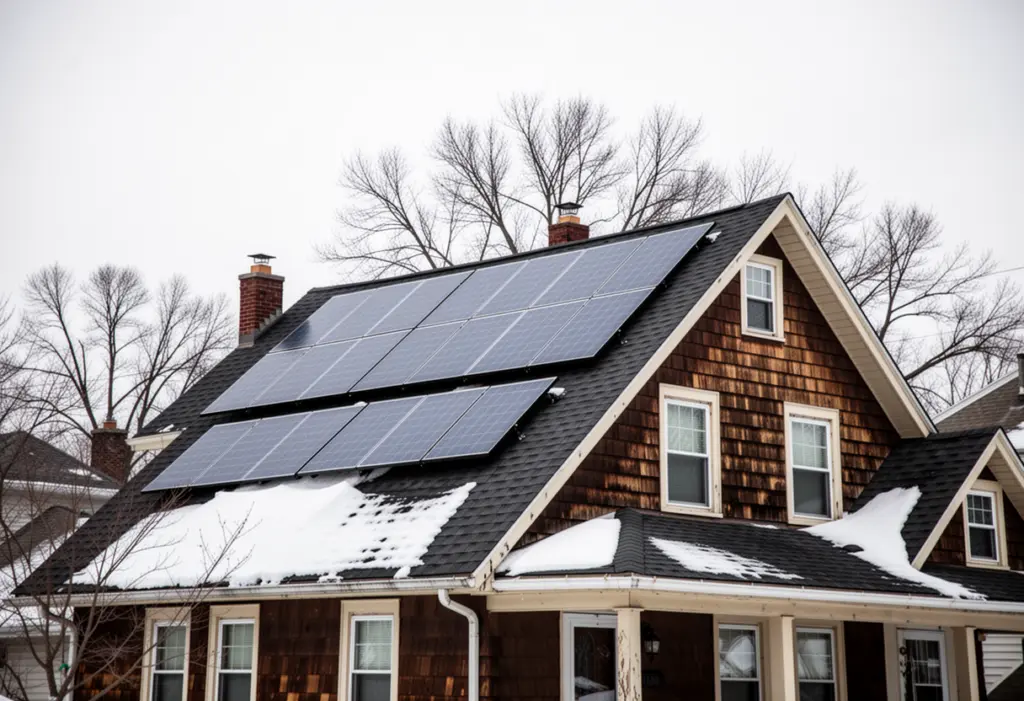
There is no single price for solar in Buffalo, and any page that gives you one is guessing. What there is, is a short list of variables that between them explain almost all of the spread between two quotes on the same street — and in Buffalo those variables behave differently than they do downstate.
This is what actually moves the number, in roughly the order it moves it.
System size, which is set by your bill and not by your roof
The single largest driver is how many kilowatts you install, and that is decided by your annual consumption, not by how much roof you have. A household using 7,000 kWh a year needs a very different system from one using 14,000, and in Western New York the difference is usually heating and hot water: a gas-heated house and an electrically heated one on the same block are not the same solar customer.
Ask for your last twelve months of usage from National Grid before you take any quote seriously. A proposal built on an estimate rather than your own consumption history is a proposal built on a guess.
Buffalo sun is better than people expect, and worse in the way that matters
Western New York gets meaningfully less usable sunlight than the Southwest, but the gap to downstate New York is smaller than most people assume. The real Buffalo variable is not annual total, it is distribution: production is heavily concentrated in the months from March to September, and the winter trough is deeper and longer than in the Hudson Valley.
That matters because it changes sizing. Under net metering the summer surplus banks as a credit and pays for winter, so a Buffalo system is generally sized to run a genuine annual surplus in summer. Undersize it and the credit balance runs out in January and February — the two months the bill is highest.
Snow load and roof structure
Erie County roofs are engineered for snow that Long Island roofs are not, and the racking specification follows. A steeper pitch sheds snow faster, and Buffalo housing stock leans steep, which helps. But a system on a roof that already carries a heavy design load can require a structural letter, and older wood-frame houses sometimes need it.
The practical cost consequences:
- A structural engineer’s letter, when the building department wants one, is a real line item.
- Racking has to be specified and mounted for the local snow and wind load. This is not a place to accept the cheapest bid without asking what load it was designed to.
- Snow guards are sometimes needed where panels shed onto an entry, a walkway or a neighbour’s property.
Roof age is the quiet budget item
Panels last far longer than an asphalt roof. If your shingles have under about ten years left, the honest sequence is to replace the roof first, because taking a system down and reinstalling it later costs a great deal more than doing the roof while the roof is bare. Installers will fit panels to an old roof if you ask them to. It is rarely the cheaper path once you count the second visit.
What is still available in 2026, and what is not
This is the part where a lot of Buffalo quotes are now simply wrong.
The 30% federal credit is gone. Section 25D was terminated by the One Big Beautiful Bill Act for expenditures made after 31 December 2025. The statute treats the expenditure as made when the original installation is completed, so a system finished in December 2025 still qualifies even if it was energised in 2026 — but a household buying today claims nothing federally. If a quote shows a 30% federal line, it is overstating your net cost by thousands of dollars.
New York’s own credit is live. 25% of qualified expenditure, capped at $5,000, claimed on Form IT-255 for your principal residence. It is not refundable, but unused credit carries forward for up to five years. It reaches leases and PPAs of ten years or more as well as purchases, which the federal credit never did.
NY-Sun is closed for homes. When a block is open, NYSERDA’s incentive is paid through your contractor as a reduction in price rather than to you. The last standard Upstate residential block (Block 14, $0.15/W), which covered Buffalo, closed on 17 December 2025, and the Upstate Affordable Solar block for income-qualified homes closed on 9 March 2026. As of September 2026 NYSERDA has no open NY-Sun block for homes in any utility territory; check NYSERDA’s NY-Sun dashboard for a new one. If a quote subtracts a NY-Sun incentive, ask which open block it is claiming.
Sales tax. New York exempts residential solar equipment from state sales tax, and localities may separately exempt their share.
Property tax. Under RPTL 487 the added value of the system is exempt for 15 years — but municipalities are allowed to opt out, and some have. The RPTL 487 exemption is not automatic: file form RP-487 with your assessor by the taxable status date (March 1 in most towns; January 2 in Nassau towns; May 1 or June 1 in Westchester towns; set by charter in cities; usually January 1 in villages), and the system must be built before January 1, 2030 (RP-487 instructions). Check your city, town, county and school district separately, because an opt-out by any one of them applies to that levy. This is a Buffalo-specific piece of homework, not a statewide answer.
The National Grid line on your bill
Buffalo is National Grid territory, and that determines two numbers. The interconnection application and the permission-to-operate wait are National Grid’s process. And the Customer Benefit Contribution — the monthly charge on solar customers who interconnected on or after 1 January 2022 — is $0.97 per kW-month on National Grid for 2026.
That is the lowest residential CBC rate of any major New York utility. An 8 kW system pays 8 × $0.97 = $7.76 a month, about $93 a year. The same system in Central Hudson territory would pay $13.36 a month. It is a small number either way, but it belongs in your arithmetic and it is almost never in a sales proposal.
Comparing Buffalo quotes without getting lost
- Insist every quote states DC system size in kW and estimated annual production in kWh. Price per watt is only comparable between quotes once you have both.
- Check what production estimate each installer used and what it assumed about shading. Two quotes with the same hardware and a materially different production estimate are really one quote and one sales pitch.
- Ask what snow and wind load the racking is specified for.
- Ask whether the roof needs work first, and get that answered by someone who is not selling you the panels.
- Confirm no federal credit appears anywhere in the net-cost calculation.
A Buffalo quote that survives all five questions is a quote you can compare. One that does not is a number without a basis.
Frequently Asked Questions
Is solar worth it in Buffalo with the snow?
Snow costs some winter production, but it is not the deciding factor. Buffalo systems are sized so that the March-to-September surplus banks as a net-metering credit and carries the winter. The deciding factors are your annual consumption, your roof, and whether the system was sized honestly.
Do I still get the 30% federal tax credit in Buffalo?
No. Section 25D ended for expenditures made after 31 December 2025, and an expenditure counts as made when the original installation is completed. A system completed in December 2025 still qualifies; one bought and installed now does not.
What incentives can a Buffalo homeowner still claim?
New York's 25% solar credit capped at $5,000 on Form IT-255, the state sales tax exemption on residential solar equipment, and the RPTL 487 property tax exemption where your municipality has not opted out. NYSERDA has no open NY-Sun block for homes as of September 2026.
Which utility handles solar in Buffalo?
National Grid. It processes the interconnection application and grants permission to operate, and its 2026 residential Customer Benefit Contribution rate is $0.97 per kW-month, the lowest of the major New York utilities.
Should I replace my roof before installing solar?
If the shingles have under roughly ten years of life left, yes. Removing and reinstalling a system later to re-roof costs considerably more than doing the roof while it is bare.
This article is general information, not tax, legal or financial advice. Incentive amounts, eligibility rules and deadlines change and depend on your utility, your tax situation and your property. Confirm current terms with NYSERDA, your utility and a qualified tax professional before making a decision.
NY Solar Incentives
Independent New York solar research. We summarise NYSERDA, NY-Sun and federal programme rules from published sources and state plainly when a figure is an estimate. We are not a government agency and do not sell equipment.
Run the arithmetic on your own system
Check the dated program table and your arrangement before counting an incentive. Standard residential NY-Sun blocks are closed; Long Island Affordable Solar has a conditional income-verification route. The NY credit depends on qualified costs and tax liability, while the NYC abatement reduces future property-tax bills. The estimator keeps those timings separate.