Choosing a Solar Company in Brooklyn
Brooklyn roofs are mostly flat, often shared, and sometimes landmarked. Those three facts narrow the field of installers more than any national brand ranking does.
On this page 8 sections
- 01Flat roofs change the whole design
- 02Con Edison interconnection is its own skill
- 03Who actually owns the roof
- 04Landmarks and historic districts add an approval layer
- 05The NYC-specific money is a property tax abatement
- 06The federal credit no longer applies to buyers
- 07Brand size is a weak predictor here
- 08Frequently asked questions
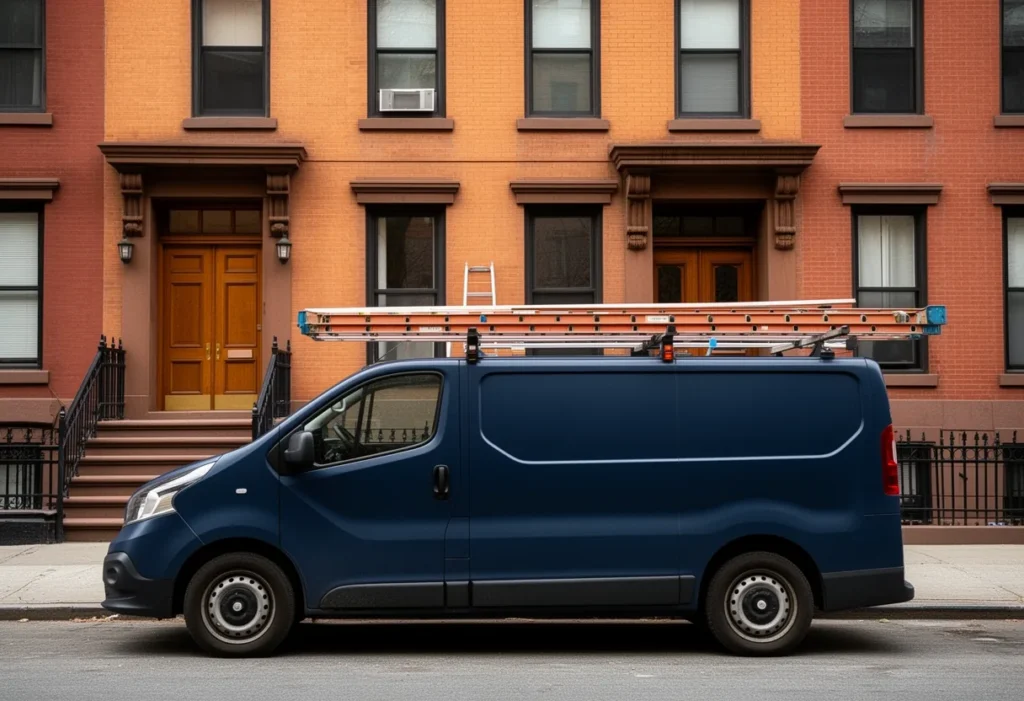
The building stock in Brooklyn does not resemble the roofs most solar marketing is written for. Row houses and brownstones with flat roofs, shared parapet walls, party walls between neighbours, bulkheads and water tanks, and blocks where a taller building next door decides how much sun the south side of your roof gets.
That is why choosing a brooklyn solar company is less about brand recognition than about whether the company has done this specific kind of job before. A firm with a large national marketing budget and a portfolio of suburban pitched roofs is not automatically equipped for a Bedford-Stuyvesant row house with a landmarked facade.
Flat roofs change the whole design
A pitched suburban roof gives a solar designer tilt and orientation for free. A flat Brooklyn roof gives neither, and the design has to create both.
That means a ballasted or mechanically attached racking system, tilt frames set at a chosen angle, and row spacing calculated so panels do not shade each other in low winter sun. Get the row spacing wrong and the array loses production for the entire life of the system, in the season when production is already lowest.
Flat roofs also carry weight and drainage considerations that pitched roofs do not. A ballasted system adds load, and on an older building the structural capacity is a real question rather than a formality. Drainage paths have to stay clear or water pools where it previously ran off.
The relevant question for an installer is not whether they can do flat roofs but how many they have done in the neighbourhood, and what racking approach they use. Our overview of solar on flat roofs in NYC covers the design constraints in more detail.
Ask about the roof membrane first
Most flat Brooklyn roofs have a membrane with its own warranty, and penetrating or loading it incorrectly can void that warranty. Ask how the installer coordinates with the roofing membrane manufacturer, and whether the roof’s remaining life was assessed. Putting a twenty-five-year array on a roof with five years left is an expensive sequencing mistake.
Con Edison interconnection is its own skill
Every grid-connected system in Brooklyn needs interconnection approval from Con Edison. This is a distinct process from the building permit and it runs on Con Edison’s own procedures, forms and timelines.
An installer who works constantly in Con Edison territory knows the submission sequence, the common causes of rejection, and roughly how long each stage takes. One who mostly works upstate in National Grid or NYSEG territory is competent but is learning a different process on your project.
There is also a physical dimension specific to dense urban areas. Some Brooklyn blocks have distribution constraints that affect how much distributed generation can be added, and some buildings have electrical service that needs upgrading before an array can be connected at the size proposed.
Ask directly: how many Con Edison interconnections has this company completed, and has it encountered a hosting capacity or service upgrade issue in this neighbourhood? A vague answer is a signal.
Who actually owns the roof
Roof ownership in Brooklyn is not always what it looks like from the street.
In a co-op, the roof is typically owned by the corporation, and a shareholder cannot authorise an installation on it. In a condominium, the roof is often common element, sometimes with limited common element rights assigned to a top-floor unit — which is a right to use, not necessarily a right to build. In a two- or three-family house, the owner controls the roof but may have a shared party wall or a neighbour’s fire escape complicating access.
A company experienced in Brooklyn asks about ownership structure early because it determines whether the project is possible at all. One that goes straight to a proposal without establishing it has skipped a step that can end the project after the deposit.
For residents who cannot install — renters, most co-op and condo shareholders, anyone with an unsuitable or shaded roof — the alternative is subscribing to an offsite array. Community solar in Brooklyn covers how that works without any rooftop involvement.
| Brooklyn condition | What it affects | What to ask the installer |
|---|---|---|
| Flat roof | Racking type, tilt, row spacing, added load | How many flat roofs completed locally, and which racking system |
| Roof membrane warranty | Whether attachment voids existing roof coverage | How they coordinate with the membrane manufacturer |
| Neighbouring building height | Shading, especially in winter | Whether a physical shade study was done, not just satellite imagery |
| Landmark or historic district | Visibility rules and additional approvals | Prior experience with Landmarks Preservation Commission review |
| Con Edison territory | Interconnection process and timeline | Number of Con Edison interconnections completed |
| Co-op or condo | Who can legally authorise the work | Whether they have worked with a board approval process before |
| Older electrical service | Whether a panel or service upgrade is needed | Whether an upgrade is included in the quoted price or excluded |
Landmarks and historic districts add an approval layer
Brooklyn has a large number of historic districts — parts of Brooklyn Heights, Park Slope, Fort Greene, Clinton Hill, Crown Heights and others. If a building sits in one, or is an individually designated landmark, work affecting the exterior may require review by the Landmarks Preservation Commission.
For rooftop solar the practical issue is usually visibility from the street. Flat roofs behind parapets often help here, since a low-profile array set back from the parapet may not be visible from the public way. But this is a question to establish before design, not after, because it constrains tilt and placement.
An installer who works in Brooklyn regularly will know whether an address falls in a historic district and what the review has looked like on comparable projects. One who has never encountered it will discover the requirement partway through permitting.
Confirm designation status yourself
Historic district boundaries are not obvious from the street, and a block can be split down the middle. Check the address against the Landmarks Preservation Commission’s own records before assuming either way, and ask any installer to confirm in writing that the approvals needed are reflected in their timeline and price.
The NYC-specific money is a property tax abatement
Brooklyn homeowners have an incentive that upstate homeowners do not: the New York City solar property tax abatement.
Structurally, it is an abatement against property tax rather than an income tax credit or a cash rebate. It is applied for through the Department of Buildings, and it is taken in four annual instalments rather than all at once. The application has to be filed correctly and on time relative to the installation, which is a reason the installer’s familiarity with the process matters.
Ask whether the company files the abatement application, assists with it, or leaves it entirely to the homeowner — all three arrangements exist. The filing steps are covered in how to apply for the NYC abatement and the structure in our abatement overview.
Alongside that, NY-Sun no longer adds a per-watt incentive for a Brooklyn home: as of September 2026 NYSERDA has no open NY-Sun block for homes in any utility territory; check NYSERDA’s NY-Sun dashboard for a new one. New York State’s credit for solar energy system equipment is a percentage of system cost up to a statutory cap, claimed by the homeowner on Form IT-255.
The federal credit no longer applies to buyers
This changes the arithmetic for Brooklyn homeowners currently comparing options, and some local sales material has not caught up.
The 30% federal residential clean energy credit under section 25D of the Internal Revenue Code was terminated for expenditures made after 31 December 2025 by the One Big Beautiful Bill Act, signed 4 July 2025. An expenditure counts as made when the original installation is completed, so a system finished in December 2025 but switched on in January 2026 still falls under the old rules. A Brooklyn homeowner buying a system with cash or a loan, whose installation was completed in 2026, receives no federal credit on their own return. There is no phase-down and no transition rule.
A system whose installation was completed in 2025 was under the old rules, and unused credit from that year can generally be carried forward.
A separate business-side federal credit still applies to the company that owns a leased or PPA system. The homeowner never claims it, but it is a real incentive to the owner, and it is part of why third-party ownership and community solar now compare differently against buying than they did before 2026 in pure tax terms.
The practical effect for a Brooklyn buyer: the incentives that remain directly available are the state credit on Form IT-255, the city property tax abatement, no sales tax on residential solar equipment and its installation (New York City provides the local exemption as well as the state one, Publication 718-S Part 2), the RPTL 487 exemption where it has not been opted out, and bill credits for exported power minus the monthly Customer Benefit Contribution. The RPTL 487 exemption is not automatic: file form RP-487 with your assessor by the taxable status date (March 1 in most towns; January 2 in Nassau towns; May 1 or June 1 in Westchester towns; set by charter in cities; usually January 1 in villages), and the system must be built before January 1, 2030 (RP-487 instructions). Any proposal showing a federal line for a 2026 purchase is overstating the net cost benefit.
Ask for three local references
Not testimonials — addresses or at least block-level locations of completed Brooklyn installations, ideally on similar buildings. A company that works in the borough regularly can produce them. One selling into Brooklyn from elsewhere generally cannot, which is itself the answer.
Brand size is a weak predictor here
National solar brands advertise heavily in New York City, and some do good work. But size correlates with volume, not with fluency in a specific building type and a specific utility’s interconnection queue.
The relevant questions are the same regardless of company size: is the firm a NYSERDA participating contractor, who employs the crew, how many Con Edison interconnections have they completed, how many flat Brooklyn roofs have they done, and what does the workmanship warranty cover. The general framework is in how to vet a solar installer in New York.
One Brooklyn-specific consideration on the warranty: the workmanship warranty covering roof penetrations matters more on a flat membrane roof than on an asphalt-shingled pitched roof, because a flat roof holds water and a bad penetration finds it. Weight that term accordingly.
Frequently asked questions
Can panels go on a flat Brooklyn roof?
Yes, using tilt frames on a ballasted or mechanically attached racking system that creates the angle a pitched roof provides naturally. The design questions are row spacing to prevent self-shading in low winter sun, the load the roof can carry, drainage, and whether the attachment method affects the roof membrane warranty. Ask how many flat roofs the installer has completed locally.
Do I need Landmarks approval for solar in a Brooklyn historic district?
Possibly. Work affecting the exterior of a building in a designated historic district or an individually landmarked building may require Landmarks Preservation Commission review, with street visibility usually the central issue. Check the address against the Commission’s own records before design begins, since the outcome constrains array placement and tilt.
What incentives are available to a Brooklyn homeowner buying solar now?
The New York State credit for solar energy system equipment claimed on Form IT-255 up to a statutory cap, and the New York City property tax abatement filed with the Department of Buildings in four annual instalments. NYSERDA has no open NY-Sun block for homes as of September 2026. The federal residential credit under section 25D ended for expenditures made after 31 December 2025, so a 2026 purchaser claims nothing federally.
Does it matter whether my installer has worked in Con Edison territory?
It matters for the timeline and for avoidable rejections. Con Edison’s interconnection process differs from National Grid’s and NYSEG’s, with its own forms and sequence. A company that submits Con Edison applications regularly knows where projects stall and whether a service upgrade will be required, which affects both schedule and cost.
Verify current figures locally
Abatement rules and deadlines change, as do NY-Sun block rates and state credit caps. Confirm abatement details with the NYC Department of Buildings, incentive levels with NYSERDA, state credit rules with the New York State Department of Taxation and Finance, and interconnection requirements with Con Edison. This site is independent and is not affiliated with NYSERDA, Con Edison or any government agency.
NY Solar Incentives
Independent New York solar research. We summarise NYSERDA, NY-Sun and federal programme rules from published sources and state plainly when a figure is an estimate. We are not a government agency and do not sell equipment.
Run the arithmetic on your own system
Check the dated program table and your arrangement before counting an incentive. Standard residential NY-Sun blocks are closed; Long Island Affordable Solar has a conditional income-verification route. The NY credit depends on qualified costs and tax liability, while the NYC abatement reduces future property-tax bills. The estimator keeps those timings separate.