Battery fan noise level: what a home battery really sounds like
The decibel figure on a home battery datasheet is measured in a room nothing like your basement. What actually makes noise, when it runs, and how siting changes what you hear.
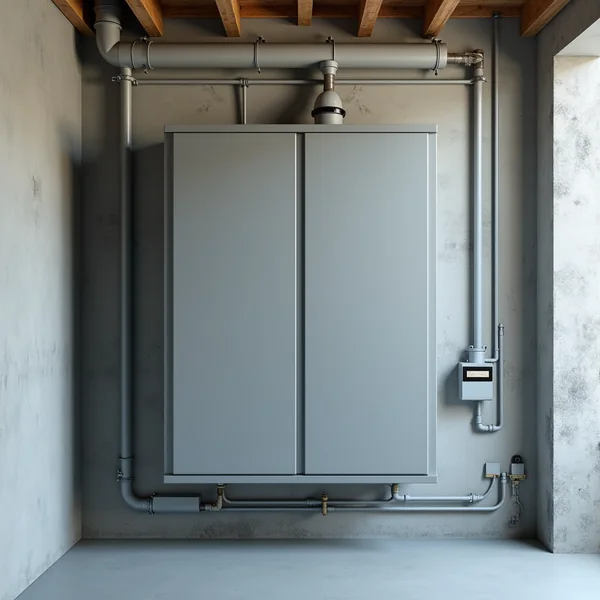
What a datasheet decibel figure does and does not tell you about living with a home battery, and how siting changes the answer.
A home battery spends most of its life silent. Then the sun comes out, or an off-peak window opens, and the cabinet starts moving several kilowatts of power in or out. A small fraction of that power never makes it through — it turns into heat inside the cells, the wiring and the power electronics — and that heat has to leave the box. On most residential units it leaves on moving air.
Which is why the battery fan noise level is a siting decision rather than a footnote on a datasheet. Bolted to a detached garage wall, nobody will ever hear it. Bolted to the other side of a stud wall from a bedroom, it becomes the sound you notice at two in the morning while the battery fills up on an overnight schedule.
What the battery fan noise level tells you, and what it hides
The figure on a specification sheet is one number produced under controlled conditions: a stated distance, usually a metre, in a room chosen to avoid reflections, with the unit held at a stated operating point. It is useful for comparing two cabinets against each other, and a poor predictor of what you will hear at home, because almost nothing about your basement matches the test room.
The fan is one of several sound sources
People shopping for storage tend to treat the fan as the whole story. In practice a working system produces at least four different sounds, and they behave differently from each other:
- Cabinet cooling fans. Broadband air noise — a rush rather than a tone. This is the sound most datasheets quote, and the one that rises and falls with how hard the battery is working.
- The inverter’s own fan. A hybrid inverter, or a separate string inverter, has its own thermal problem and its own fan. It is often louder than the battery’s and frequently mounted on the same wall. Two boxes means two fans.
- Magnetic hum. Transformers, inductors and chokes vibrate at twice the line frequency and its harmonics — a steady low buzz that carries through a wall considerably better than fan rush does.
- Relays and contactors. A single sharp click when the system transfers between grid-tied and backup operation, or wakes from standby. Brief, but audible in a quiet house.
Some cabinets, particularly larger ones and those rated for outdoor mounting through a New York winter, add a refrigerant circuit for active thermal management. That brings a compressor, which is a lower-pitched and more intrusive noise than a fan, and it does not disappear when fan speed drops.
Decibels do not add the way most people expect
The decibel scale is logarithmic, which produces two results that feel wrong the first time you meet them. Two identical sources running together are not twice the number on the scale — they add roughly three decibels. And an increase of about ten decibels is what most listeners describe as twice as loud, not a doubling of the figure.
The stated distance is half of the figure
Sound pressure falls off with distance. In free air, doubling the distance from a small source drops the level by roughly six decibels. A rating quoted at one metre is therefore not comparable with a rating quoted at three metres by a different manufacturer, and neither one describes what arrives in a bedroom two rooms away through a floor assembly. Before concluding that one product is quieter, check that both numbers were taken at the same distance and in the same state.
The fan does not run all the time
Most of the annoyance in real installations comes from when the fan runs rather than how loud it is at full speed. A battery at rest, holding its charge, is usually silent or close to it. Fan speed tracks power throughput and ambient temperature, so the same cabinet is a different neighbour in different months.
| Operating state | What is running | What it sounds like | What reduces it |
|---|---|---|---|
| Idle, holding charge | Standby electronics only | Silence, or a faint hum from the inverter | Nothing needed |
| Slow charge or discharge | Fans at low speed | Soft, steady air movement | Charge-rate limits in the app |
| Full-rate charge from the grid | Fans near maximum, inverter fan as well | Noticeable rush plus hum | Scheduling, rate caps, distance |
| Backup, carrying the house | Everything, often for hours | The loudest sustained state | Little — site the cabinet for it |
| Hot garage in August | Fans working against ambient heat | Runs longer and at higher speed | Ventilation, shade, indoor siting |
| Cold snap | Cell heaters, then fans to circulate | Intermittent cycling | An insulated or conditioned space |
That last row is the one New York homeowners tend to miss. A battery that has to warm its cells before it can accept a charge will run its thermal system in the cold, so an unheated garage generates sound in January that a conditioned utility room does not. The same behaviour that governs cold weather battery performance in New York also governs when the fans cycle in winter.
Where the cabinet sits matters more than the number on the page
Airborne and structure-borne noise are separate problems
Airborne noise is the rush of air you hear standing in front of the unit. Distance defeats it, a closed door defeats a lot of it, and mass in the wall defeats more. Structure-borne noise is vibration handed into the building through the mounting bracket, and it ignores all of that, travelling along studs and joists to re-radiate from a drywall surface elsewhere in the house. This is why a quieter cabinet on a shared bedroom wall can be more intrusive than a louder one bolted to a foundation wall.
Reducing structure-borne transmission is a mounting question, not a product question. Prefer masonry or a foundation wall over a light stud wall the bedroom shares, follow the manufacturer’s bracket instructions rather than improvising, and avoid running rigid conduit straight from the cabinet into the quiet room. None of this appears in a noise rating.
New York fire rules already push the cabinet somewhere specific
Residential energy storage in New York is governed by the state’s adopted fire code, which constrains where a cabinet may go, how much energy may sit in one space, and what separation is required from habitable rooms. The practical outcome is usually a garage, an exterior wall, or a utility room that is not a sleeping area — a safety rule rather than an acoustic one, but it often settles the noise question as a side effect. Read the constraints in the home battery fire code rules for New York before you plan around a wall you picked for quiet, because the code may take that wall away from you. The same constraints shape what your building department will ask for, which is covered in the battery storage permit requirements.
Off-peak charging can move the noise to the middle of the night
A battery on a time-varying rate is normally set to charge when energy costs least, and on residential time-of-use structures in New York that window generally falls overnight. The acoustic consequence is that the loudest sustained state — a full-rate charge from the grid — gets scheduled for the hours when the house is quietest.
Two levers change this without giving up the benefit: most systems let you cap the charge rate, trading a longer charge for a slower fan, and most let you shift the start of the window within the off-peak period. Rate structures and their hours are revised periodically, so confirm the current schedule on your utility’s own tariff pages rather than assuming, and read how the interaction works in battery storage on a time of use rate in New York.
Questions worth asking before you sign
- What is the rated sound level, at what distance, and in which operating state?
- Does the inverter mount on the same wall, and what is its own rating?
- What room is on the other side of that wall?
Where to check the real figure
The number you want lives in the manufacturer’s installation manual rather than the sales brochure. Manuals state the test distance and often give levels at more than one operating point. Ask your installer for the manual before the contract is signed rather than after. And if quiet matters more than anything else on your list, ask to stand beside a working unit during a full-rate charge — ten seconds of listening settles what a page of specifications cannot.
Frequently Asked Questions
Is a home battery loud enough to hear from another room?
Usually not through a closed door and a normal wall, in the states where the fan runs at low speed. The cases where people do hear it from another room are a full-rate grid charge, extended backup operation, and vibration carried through a shared stud wall rather than through the air. The mounting surface matters as much as the rating.
Do all home batteries have fans?
Almost all residential units use forced air for cooling, because the power electronics and the cells both generate heat that has to leave the enclosure. Some larger or outdoor-rated cabinets add a refrigerant circuit for active thermal management, which introduces a compressor as well as a fan. A small number of low-power units rely on passive convection only.
Does the battery fan noise level change in winter?
Yes, and often in the direction people do not expect. Lithium cells cannot accept a fast charge when they are very cold, so many systems warm the pack first and then circulate air. In an unheated New York garage that means intermittent cycling on cold nights even when the battery is not doing useful work. A conditioned space removes most of that behaviour.
Can I put a home battery in a bedroom closet to keep it quiet?
No. New York’s adopted fire code restricts residential energy storage near sleeping areas and sets separation and space requirements that a bedroom closet cannot meet. The permissible locations are typically a garage, an exterior wall, a utility room or a basement that satisfies the code. Confirm the specifics with your local building department before designing around a location.
Will capping the charge rate make the fan quieter?
Generally yes. Fan speed tracks how much heat the system is producing, and heat rises steeply with power throughput, so a lower charge rate means a slower fan for longer. The trade-off is that the battery takes more time to fill, which matters if your off-peak window is short. Whether the setting is available depends on the system’s software.
How do I compare noise ratings between two batteries fairly?
Check that both figures were measured at the same distance and in the same operating state, since a rating at one metre is roughly six decibels higher than the same source measured at two metres. Then remember the scale is logarithmic: a difference of about ten decibels is what sounds twice as loud, so a gap of two or three decibels is a small perceptual difference.
NY Solar Incentives
Independent New York solar research. We summarise NYSERDA, NY-Sun and federal programme rules from published sources and state plainly when a figure is an estimate. We are not a government agency and do not sell equipment.
Run the arithmetic on your own system
Check the dated program table and your arrangement before counting an incentive. Standard residential NY-Sun blocks are closed; Long Island Affordable Solar has a conditional income-verification route. The NY credit depends on qualified costs and tax liability, while the NYC abatement reduces future property-tax bills. The estimator keeps those timings separate.