How to Estimate Your New York Solar Cost
You can produce a defensible cost estimate in about twenty minutes using your own utility bill and two free tools. Here is the sequence and the places it goes wrong.
On this page 7 sections
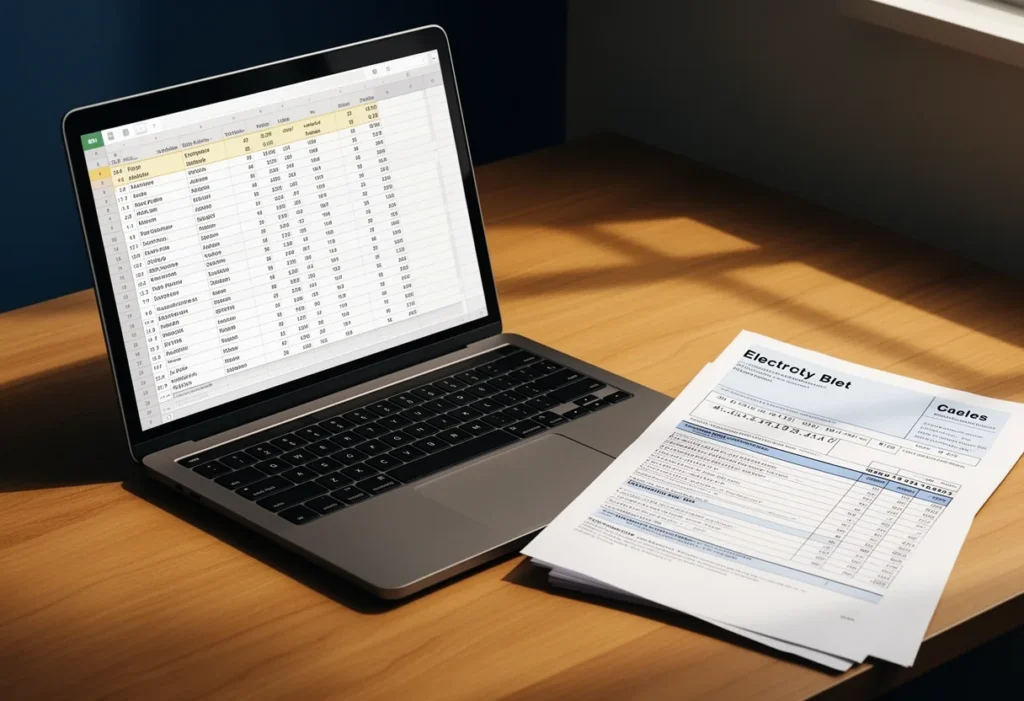
Almost every solar panel cost calculator New York homeowners find online is a lead capture form. It asks for an address and a phone number, returns a wide range, and passes the details to installers.
You can do better in about twenty minutes with your utility bill, a free production model and a clear view of which incentives apply to you. The result will not be a quote, but it will be close enough to tell whether a quote is reasonable.
Start with kilowatt-hours, not with dollars
Find your annual electricity consumption in kilowatt-hours. Most New York utilities show a twelve-month history in the online account, and the bill itself usually carries a usage graph.
Use a full twelve months. A single summer bill overstates a household with air conditioning; a single spring bill understates almost everyone. If you have added an electric vehicle or a heat pump recently, weight the more recent months accordingly.
Note the rate you pay as well, in cents per kilowatt-hour, including delivery charges rather than supply alone. Delivery is a substantial part of a New York bill and it is part of what self-consumed solar avoids.
Turn usage into a system size
The link between capacity and output is how many kilowatt-hours each installed kilowatt produces per year at your address, which depends on latitude, roof orientation, pitch, shading and local weather patterns.
Do not use a national rule of thumb for this. Run your own address through PVWatts, the free calculator published by the National Renewable Energy Laboratory. It lets you set tilt, azimuth and system losses and returns modelled annual production for a nominated capacity.
Divide your annual consumption by the modelled annual output per kilowatt and you have the capacity that covers your usage. That is your target system size, before roof constraints.
Two shading facts worth checking first
A chimney, a neighbouring building or a mature tree on the south side changes production far more than panel brand does. Look at the roof at mid-morning and mid-afternoon, not only at noon, and note anything casting shade across the array area.
Check the roof will physically hold it
Rather than using an area-per-kilowatt rule, work from real module dimensions. Pick a module you have seen quoted, note its length, width and rated wattage from the manufacturer’s datasheet, and calculate how many fit on the usable roof plane once you allow for setbacks, obstructions and access paths.
Multiply that count by the rated wattage and you have what the roof can actually carry. If it is well below your target size, the roof is your constraint and the design conversation changes.
In New York City, fire access requirements and clearance rules reduce usable roof area further, particularly on flat roofs. That is covered on the page about flat roof installations in the boroughs.
Apply a price per watt, then the incentives in order
Gross price is capacity in watts multiplied by a price per watt. You will not know a realistic price per watt until you have at least one local quote, which is the one input you genuinely cannot model. Get one quote, extract its price per watt, and use that to sanity-check the rest.
Then apply the incentives in the order they occur. NY-Sun would come off the contract first, applied per watt by your contractor, but as of September 2026 NYSERDA has no open NY-Sun block for homes in any utility territory, so enter it as $0 unless NYSERDA’s NY-Sun dashboard shows a new one. New York’s state income tax credit comes later on Form IT-255, as a percentage of qualified expenditure up to a statutory cap. In New York City, a property tax abatement follows over four annual instalments.
Do not include a federal residential credit. Section 25D ended for expenditures made after 31 December 2025, so a 2026 purchase produces none. An expenditure counts as made when the original installation is completed, so a system finished in December 2025 but switched on in January 2026 still falls under the old rules. Any calculator that still adds 30% to your savings is producing a number that cannot be claimed.
| Input you need | Where to get it | Common mistake |
|---|---|---|
| Annual kWh used | Twelve-month history in your utility account | Extrapolating from one seasonal bill |
| Your all-in rate per kWh | Total bill divided by kWh used, including delivery | Using the supply rate only |
| Annual output per installed kW | PVWatts, run at your own address and roof angle | Applying a national average to a shaded roof |
| Usable roof area | Module datasheet dimensions and a measured roof plane | Ignoring setbacks, vents and access paths |
| Price per watt | One real local quote | Taking a national figure from an online calculator |
| NY-Sun rate | NYSERDA’s NY-Sun dashboard; no residential block is open as of September 2026, so use $0 | Using a rate from an older article |
Where online calculators go wrong for New York
The first failure is stale federal assumptions, which inflate every net cost and payback figure they produce.
The second is geography. New York’s incentive landscape is regional. NY-Sun blocks run separately for Upstate, Con Edison territory and Long Island (none of the three has a residential block open as of September 2026), and the NYC property tax abatement exists nowhere else in the state. A national calculator handles none of this.
The third is that most tools model production from a postcode rather than from a roof. Two houses on the same street can differ by a wide margin because one has a clear south plane and the other faces east and west around a ridge.
Build a three-column sheet
Columns for conservative, expected and optimistic. Vary only three inputs across them: price per watt, annual production, and the electricity rate you avoid. If the conservative column still works for you, the project is robust; if only the optimistic one does, the estimate is doing the persuading. The payback period article covers how those three assumptions interact.
What an estimate cannot tell you
Site-specific work is invisible to any model. Whether your service panel needs upgrading, whether the roof needs replacing first, whether the framing will carry ballast on a flat roof, and whether a long conduit run is required are all determined by a site survey.
Those items are also the most common reason a real quote exceeds a self-built estimate. Treat your estimate as a test of whether the quotes are in the right neighbourhood, not as a target the installer has failed to meet. The notes on choosing an installer cover what to ask during the survey.
Frequently asked questions
Where do I find my annual kilowatt-hour usage?
In your utility’s online account, which normally shows a rolling twelve-month history, or on the usage graph printed on a recent bill. If you have changed heating systems or added an electric vehicle in the past year, weight the recent months more heavily. Twelve months of data is the minimum for a usable estimate.
Are online solar calculators accurate for New York?
Most are not, for three reasons: many still assume a federal tax credit that ended for expenditures made after 31 December 2025, few reflect NY-Sun’s current block status (no residential block is open as of September 2026), and almost none account for the NYC property tax abatement. They also model production from a postcode rather than a roof. Use PVWatts for production and a real local quote for price per watt instead.
How do I estimate how many panels my roof will fit?
Take the dimensions and rated wattage of a specific module from its manufacturer datasheet, then measure the usable roof plane and subtract setbacks, vents, skylights and any required access paths. The number of modules that fit, multiplied by their wattage, is your roof-limited capacity. In New York City, fire access clearances reduce usable area noticeably.
Should I include the federal tax credit in my estimate?
Not if you are buying a system now. The section 25D residential credit terminated for expenditures made after 31 December 2025, with no phase-down for 2026. A system whose installation was completed in 2025 is a different case, and unused credit from that year can generally be carried forward, which is worth checking with a tax preparer.
Check the inputs before you trust the output
NY-Sun has no residential block open as of September 2026, and the state credit percentage and cap are statutory. Verify NY-Sun block status with NYSERDA, the credit with the New York State Department of Taxation and Finance, and the abatement with the NYC Department of Buildings before treating your estimate as final.
NY Solar Incentives
Independent New York solar research. We summarise NYSERDA, NY-Sun and federal programme rules from published sources and state plainly when a figure is an estimate. We are not a government agency and do not sell equipment.
Run the arithmetic on your own system
Check the dated program table and your arrangement before counting an incentive. Standard residential NY-Sun blocks are closed; Long Island Affordable Solar has a conditional income-verification route. The NY credit depends on qualified costs and tax liability, while the NYC abatement reduces future property-tax bills. The estimator keeps those timings separate.