Smart Thermostats That Actually Work With a Heat Pump
Smart thermostat compatibility with a heat pump depends entirely on whether the system is ducted 24V or ductless inverter. Get that wrong and you force a modulating machine to cycle.
On this page 6 sections
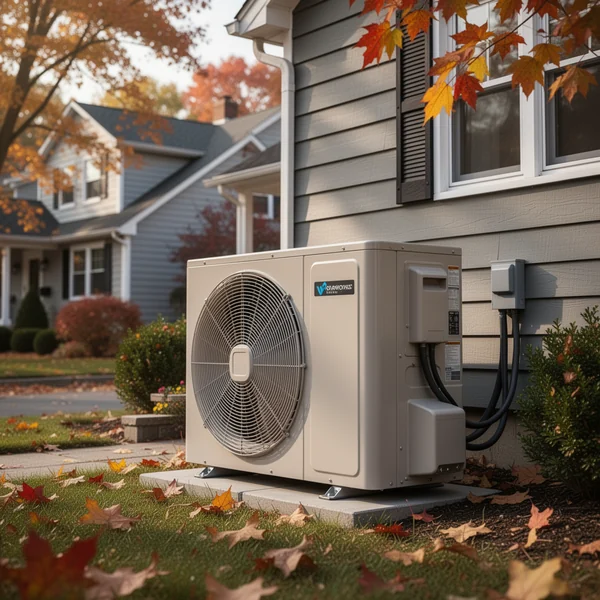
Smart thermostat and heat pump compatibility splits into two completely different questions, and most buying advice online answers only the first. If you have a ducted heat pump on conventional 24-volt controls, a smart thermostat is a straightforward swap as long as it handles the reversing valve and your backup heat properly. If you have ductless mini splits, there is usually no wall thermostat in the system at all, and putting one in can make the equipment worse.
Work out which system you have before you buy anything. Everything else follows from that.
Ducted systems: the terminals that decide compatibility
A heat pump is not a furnace, and the wiring reflects that. Three things matter more than the app:
- The reversing valve terminal — O or B. A heat pump switches between heating and cooling by reversing refrigerant flow, and the thermostat energises that valve. Some manufacturers energise it in cooling (O), others in heating (B). Set it wrong and the system delivers cold air when you ask for heat. Any thermostat sold as heat-pump-compatible will have an O/B terminal and a configuration setting; the correct choice comes from the equipment’s installation manual, not from a default.
- Auxiliary and emergency heat staging. If your system has electric resistance backup or a furnace behind it, the thermostat controls when that fires. This is the single most expensive setting in the house. A thermostat that brings on the strips too eagerly turns an efficient heat pump into an electric baseboard for hours at a time — on New York electric rates, that is money leaving in real time.
- The C wire. Most smart thermostats want a common wire for continuous power. Older New York houses often do not have one run to the thermostat location. An adapter at the air handler is usually the fix, but confirm it before purchase rather than after.
The terminal table in the equipment’s own installation manual is the compatibility check. A manufacturer’s online “will this work with my system” tool is a starting point, not an answer — it does not know what a previous owner’s contractor did behind the wall.
Ductless mini splits: why a wall thermostat is usually the wrong idea
Inverter-driven ductless systems do not run on simple on/off signals. The indoor unit talks to the outdoor unit over a proprietary communication bus, and modulates compressor speed continuously to match the load. That modulation is the entire reason the system is efficient.
Manufacturers therefore sell their own controls — a wall-mounted controller wired into the same bus, plus a cloud service and app. Those keep the modulation intact. Third-party control generally comes in one of two forms, and they behave differently:
| Approach | What it does | Efficiency effect |
|---|---|---|
| Manufacturer’s own wired controller and app | Speaks the equipment’s native protocol | None — full modulation preserved |
| Infrared bridge (a device that mimics the handheld remote) | Sends the same commands the remote does, from an app | Usually fine, but the device is guessing at room temperature from its own sensor, not the unit’s |
| Third-party thermostat wired to force on/off | Cuts the unit on and off at a setpoint | Bad. Forces a modulating machine to cycle, which is the operating mode it is worst at |
If someone proposes the third option so that your whole house can be on one thermostat brand, the tidiness is costing you the efficiency you paid for. There is a real case for infrared bridges — scheduling, remote access, and getting a mini split into the same app as the rest of the house — but treat them as remote controls with a schedule, not as thermostats with authority over the compressor.
What a smart thermostat is actually good for on a heat pump
Not what most people buy it for. A heat pump does not respond to deep temperature setbacks the way a furnace does — recovering from a large setback demands maximum capacity at the coldest part of the morning, which on a ducted system is exactly when the backup strips come on. The genuine wins are different:
- Visibility. Runtime history tells you how many hours the compressor ran versus how many hours auxiliary heat ran. That second number is the one worth watching all winter.
- Aux heat lockout. Being able to set an outdoor temperature below which the strips are allowed, and above which they are not, is worth more than every other feature combined.
- Time-of-use shaping. If you are on a time-of-use rate, pre-heating or pre-cooling before the peak window and coasting through it is a real strategy — and it is the opposite of a setback.
- Remote access on a second home. For an Adirondack or Catskills house that sits empty midweek, a thermostat you can see from Brooklyn is not a luxury; it is freeze protection.
The New York angle: utility programmes and rates
New York utilities run demand response and thermostat-linked programmes that pay customers to allow brief adjustments during system peaks, and which models qualify is set by a list that changes. Con Edison, National Grid, NYSEG, RG&E, Central Hudson and Orange & Rockland each publish their own current offerings; PSEG Long Island runs separate programmes for Nassau and Suffolk. Check your own utility’s page for the eligible device list before you buy on the strength of an enrolment bonus you read about elsewhere.
Time-of-use rates matter more with a heat pump than with anything else in the house, because heating is a large, shiftable, thermally-buffered load. If your utility offers a residential TOU rate, look at your own hourly usage data on your account portal before switching — a house with a heat pump and an EV charger often benefits, a house that is occupied all day often does not.
Reading the bill properly is the prerequisite for any of this. Our walkthrough of how a Con Edison bill reads after solar covers the supply-versus-delivery split that catches people out, and how net metering credits work in New York explains why a solar house on a heat pump sees its credits build in summer and drain in winter.
Money: what is and is not available
A thermostat is a small line item, but the surrounding project is not, and the rules changed. Both federal residential credits ended for property placed in service after 31 December 2025: Section 25C, the Energy Efficient Home Improvement Credit, and Section 25D, the Residential Clean Energy Credit. A 2026 New York install gets nothing federal. Any proposal or product page still advertising a 30% federal credit is running last year’s rules.
At the state level, NYS Clean Heat — NYSERDA with seven sponsoring utilities: Central Hudson, Con Edison, National Fuel Gas, National Grid, NYSEG, Orange & Rockland and RG&E — funds heat pump equipment, and rebate amounts are not published as one statewide table. Use the address-based finder at cleanheat.ny.gov/find-available-rebates/. PSEG Long Island is not a Clean Heat sponsor. Some utility efficiency programmes have offered thermostat incentives separately from Clean Heat; that is a utility question, not a NYSERDA one. For the wider list of what New York still funds, see NYSERDA incentives still available in 2026.
What to do next
- Identify your system type first: ducted with 24V controls, or ductless with a manufacturer’s controller. The answer decides everything.
- Find your equipment’s installation manual and read the thermostat terminal table — O or B, and how auxiliary heat is staged.
- If you go smart, set the auxiliary heat lockout deliberately on day one and check the runtime report weekly through the first winter.
- On a ductless system, price the manufacturer’s own controller before considering anything third-party, and refuse any proposal that converts the unit to on/off control.
- Check your utility’s current thermostat and demand response programme list before buying, and look at your own hourly usage data before switching to a time-of-use rate.
NY Solar Incentives
Independent New York solar research. We summarise NYSERDA, NY-Sun and federal programme rules from published sources and state plainly when a figure is an estimate. We are not a government agency and do not sell equipment.
Run the arithmetic on your own system
Check the dated program table and your arrangement before counting an incentive. Standard residential NY-Sun blocks are closed; Long Island Affordable Solar has a conditional income-verification route. The NY credit depends on qualified costs and tax liability, while the NYC abatement reduces future property-tax bills. The estimator keeps those timings separate.