What a Heat Pump Costs in the North Country
North Country heat pump pricing turns on design temperature, contractor travel, snow mounting and whether your village runs its own electric utility. Here is how to build a number that is yours.
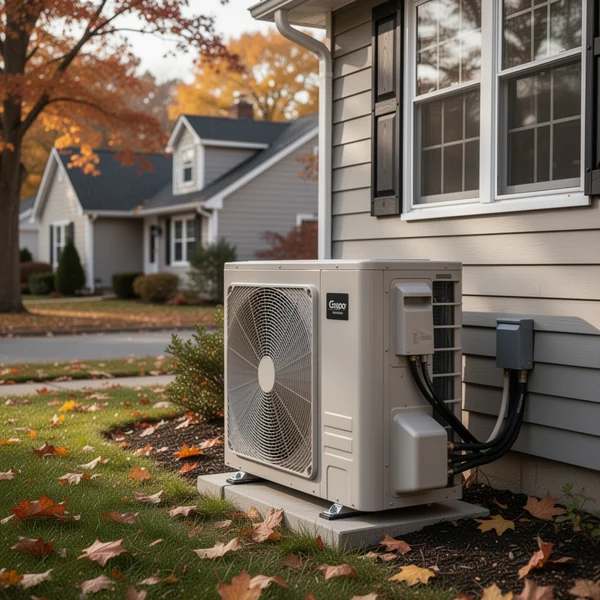
There is no honest single figure for heat pump cost in the North Country, and any page that gives you one has invented it. What there is, reliably, is a short list of things that move the price in Clinton, Essex, Franklin, St. Lawrence, Jefferson, Lewis and Hamilton counties — and a method for turning three quotes into a number that is actually yours.
This region prices differently from the rest of New York for reasons that have nothing to do with the equipment: the coldest design temperatures in the state, the longest heating season, a thin contractor market, and an incumbent fuel that is usually oil or propane rather than natural gas. Each of those pushes in a different direction, and two of them push in your favour.
Why we will not print a price
Installed heat pump pricing is not a product price. It is a labour-and-materials estimate for a job that has never been done in your specific house, produced by a contractor with their own backlog, their own drive time and their own view of how bad your electrical is going to be. A national average would be wrong here by a wide margin in both directions, and a regional average published last winter is already stale.
The number that matters is the median of three real, comparable quotes on your house. Everything below is about making the quotes comparable, which is where most homeowners lose money — not on the equipment, but on comparing a bid that includes electrical work against one that quietly does not.
What actually moves heat pump cost in the North Country
| Driver | Which way it pushes | What to ask |
|---|---|---|
| Design temperature | Up. Colder design means more capacity, or a backup strategy | What outdoor design temperature is the Manual J run at? |
| Contractor travel | Up. Fewer installers over more miles; mobilisation is real cost | Is travel priced in, and how many visits does the job need? |
| Ductless heads vs ducted | Varies. Head count, line-set runs and mounting all price separately | Line-item every head, not a lump sum |
| Electrical service and panel | Up, sometimes sharply | Is a load calculation included, and is a service upgrade in or out of this price? |
| Snow and mounting | Up modestly. Outdoor units need to be raised clear of snowpack | What stand height, and is a roof-drip location being avoided? |
| Existing oil or propane system | Varies. Removal, or retention as backup with controls | Is decommissioning or dual-fuel control in scope? |
| Buried oil tank | Up if it is being removed | Is tank removal quoted separately? It usually is |
| Clean Heat rebate | Down | Is the rebate deducted on this quote, and by how much? |
Two of these deserve more than a table row.
Snow stands are not optional here
An outdoor unit sitting on a slab at grade in Lewis County will spend February buried. Units need clearance under the coil for defrost water to drain away and for airflow, which means a stand tall enough for local snowpack, and a location that is not under a roof valley or an eave that sheds ice onto it. This is cheap to get right at install and expensive to fix later, and it is one of the fastest ways to tell whether a bidder actually works in this region.
The incumbent fuel is the good news
Most of the North Country heats with oil or propane. Those are the fuels a heat pump beats most easily on running cost, which means the economics here are better than in a natural-gas town downstate even though the winter is harder. It also means the honest comparison is not “heat pump versus nothing” but “heat pump versus the boiler or furnace you were going to replace anyway” — and that incremental framing usually changes the decision.
Municipal utilities: check before you count on Clean Heat
This is the North Country trap, and it is specific to this region. NYS Clean Heat is administered by NYSERDA with seven sponsoring utilities — Central Hudson, Con Edison, National Fuel Gas, National Grid, NYSEG, Orange & Rockland and RG&E. Much of the region sits under National Grid, and NYSEG covers other parts.
But several North Country communities are served by municipal electric utilities rather than by an investor-owned one, and a municipal utility is not a Clean Heat sponsor. If your power comes from a village or town electric department, the statewide rebate may not reach you, and the answer is not something to take from a contractor’s memory. Run your address through the official finder at cleanheat.ny.gov/find-available-rebates/. That tool is address-based and it is the authoritative answer for who sponsors you and what is currently offered.
Clean Heat rebate amounts are deliberately not published as one statewide table — they differ by utility and by equipment type. Anyone quoting you a flat per-ton figure that supposedly applies across New York is quoting something they made up. The rebate is claimed through a participating contractor and shows up as a deduction on the quote, so when you compare bids, compare the gross price and the net price separately. A higher gross with a real rebate can beat a lower gross with none.
Federal credits are gone — take them out of the budget
Both federal residential credits ended for property placed in service after 31 December 2025. Section 25C, the Energy Efficient Home Improvement Credit, was allowed only for qualifying property placed in service before that date; while it existed it capped heat pumps, heat pump water heaters and biomass systems at $2,000 a year, with $1,200 for the general improvement bucket. Section 25D, the Residential Clean Energy Credit, terminated for expenditures after the same date.
A North Country household installing in 2026 gets nothing federal. This is the most common error in heat pump proposals circulating right now: a 30% federal line inherited from a 2025 template. If you see one, the rest of that budget is wrong too. Our explainer on what changed with the federal credit in New York covers the timing, and it applies to efficiency equipment as much as to solar.
New York’s own credit survives but is narrower than people assume. Form IT-255 gives 25% of system cost capped at $5,000, carried forward up to five years, for solar energy system equipment. It is not a heat pump credit. Geothermal is treated differently again under New York’s tax code, so if you are pricing a ground loop, ask the Department of Taxation and Finance which credit applies to that equipment rather than assuming the solar form covers it.
Paying for it
The NYSERDA On-Bill Recovery Loan puts the repayment on your utility bill instead of requiring a home equity draw, which matters in a region where the same project often needs envelope work and equipment in the same year. The broader picture of what the state still funds is in our guide to New York State renewable energy incentives beyond solar, and if you are considering an array alongside the heat pump, what NYSERDA still offers in 2026 is the current position.
One warning on financing: some contractor-arranged financing is priced with the fee built into the equipment price, so the “0%” bid and the cash bid are not the same job. Ask for the cash price and the financed price as two separate numbers.
What to do next
- Run your address through cleanheat.ny.gov/find-available-rebates/ first. If you are on a municipal utility, that changes the budget more than any equipment choice will.
- Get three quotes and require each to line-item the same things: equipment, each indoor head, line sets, electrical, permits, snow stand, and the rebate shown separately.
- Ask each bidder for the Manual J with the design temperature visible on it, and for the outdoor unit’s MCA and MOCP so an electrician can price the circuit properly.
- Price the job incrementally against replacing your existing oil or propane system, not against zero.
- Delete every federal credit line from the budget until the IRS page for that section says otherwise.
NY Solar Incentives
Independent New York solar research. We summarise NYSERDA, NY-Sun and federal programme rules from published sources and state plainly when a figure is an estimate. We are not a government agency and do not sell equipment.
Run the arithmetic on your own system
Check the dated program table and your arrangement before counting an incentive. Standard residential NY-Sun blocks are closed; Long Island Affordable Solar has a conditional income-verification route. The NY credit depends on qualified costs and tax liability, while the NYC abatement reduces future property-tax bills. The estimator keeps those timings separate.