Heating an Upstate Farmhouse With a Heat Pump
A heat pump can carry an upstate farmhouse, but balloon framing, attic ducts and a stone foundation decide the outcome long before the equipment does. Here is the order to work in.
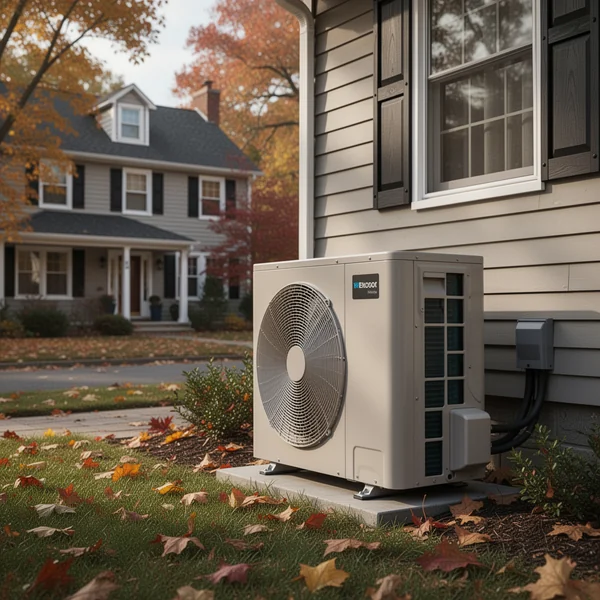
A heat pump for a farmhouse upstate works, but the equipment is the easy part — the building is what decides the outcome. A 120-year-old farmhouse in Otsego or St. Lawrence County typically has balloon-framed walls open from sill to attic, no sheathing insulation, a stone or fieldstone foundation, and a stack effect strong enough that the second floor is warm while the kitchen never gets there.
Put a correctly sized cold-climate heat pump into that house without touching the envelope and you get an expensive machine running flat out at 5°F, doing exactly what the oil boiler did, for money. Fix the envelope first and the same house needs meaningfully less capacity, which changes the equipment, the electrical work and the bill.
What makes an upstate farmhouse different
Farmhouses were built to be heated by a stove, then retrofitted twice. That history shows up in specific ways a contractor needs to look for:
- Balloon framing. Wall cavities run continuously from the basement sill plate to the attic, so warm air leaves the house through the walls rather than through the ceiling. Blocking those cavities at the top plate does more for comfort than another inch of attic insulation.
- An unconditioned attic full of ductwork. If a previous owner added forced air, the ducts are probably in the attic or an unheated crawl. Ducts outside the thermal envelope leak conditioned air into a space that is at outdoor temperature. Either bring them inside the envelope, seal and bury them properly, or go ductless.
- A stone foundation and a dirt or slab basement. Rim joists at the top of a fieldstone wall are a major leakage path and one of the cheapest to fix.
- Additions with different construction in every direction. A summer kitchen, an enclosed porch and a 1970s bedroom wing all behave differently. This is a house that wants zoning, not one big blower.
- Knob-and-tube wiring. Common in houses of this age and a hard stop on blowing insulation into a cavity until it is dealt with. It has to be found before insulation is priced, not after.
Sizing: insist on a Manual J with your design temperature on it
Upstate design temperatures are the coldest in New York. The number a contractor uses for a house near Malone or Old Forge should be nowhere near the number used in Poughkeepsie, and the capacity table in the equipment brochure only means something once someone has established what your house actually demands at your design condition.
Two questions separate a real proposal from a guess. What design temperature did you run the load at, and can I see the Manual J? If the load calculation was run on the leaky house, ask what it becomes after air sealing — because sizing to the pre-retrofit load buys you an oversized unit that short-cycles in shoulder season, which is where an inverter compressor is supposed to be at its best.
Cold-climate models hold usable capacity well below freezing, but capacity is not the only thing that falls with temperature — efficiency does too. That is why the honest plan for most farmhouses is a heat pump that carries the house for the great majority of hours, with a decision made deliberately about what happens in the coldest week.
Backup heat, and the outage question nobody raises
If the house currently runs on oil or propane, you have a choice: remove the boiler, or keep it as backup and let a control switch over below a set outdoor temperature. Keeping it is not a failure of nerve. Upstate, it buys you two things — capacity in the coldest hours, and a fuel that does not depend on the grid being up in a February ice storm.
But be honest about the second one. An oil or propane boiler still needs electricity for the burner, the controls and the circulators, so it is not an off-grid heat source either. What matters is what your generator can start. A heat pump has an inrush at start-up that a small portable generator will not handle; a soft-start kit reduces it, and a properly sized standby unit removes the problem. Have that conversation with the electrician while the panel is open, not the following winter.
Rural upstate outages are longer than downstate ones because the lines are longer and the crews are further away. Whatever you decide, decide it explicitly and write the plan down for whoever is in the house when it happens.
Ductless, ducted, or both
Farmhouses rarely take one clean answer. What tends to work:
| Situation | Usually the right approach |
|---|---|
| Existing ductwork inside the conditioned envelope, in decent shape | Ducted air handler, after sealing the ducts |
| Ducts in an unheated attic or crawl | Do not reuse them. Ductless heads, or new ducts inside the envelope |
| Rooms with wildly different loads and no shared path | Ductless heads per zone, floor-mounted where wall space is taken by windows |
| Big open kitchen and parlour, small closed bedrooms | Hybrid: a small ducted unit for the bedroom wing, heads for the open rooms |
One design note that costs people money: on a multi-zone system, several indoor heads share a single outdoor compressor. When only one small head is calling — a bedroom at 3am — the compressor is forced above the output that room needs, and efficiency suffers. Two single-zone systems can outperform one multi-zone system for exactly this reason, and can also cost less to repair. Ask each bidder why they chose the configuration they did.
What New York pays toward it
NYS Clean Heat is the programme. NYSERDA runs it with seven sponsoring utilities: Central Hudson, Con Edison, National Fuel Gas, National Grid, NYSEG, Orange & Rockland and RG&E. Most upstate farmhouses sit under National Grid, NYSEG or RG&E, but a few upstate villages are served by municipal electric utilities, which are not Clean Heat sponsors. The address-based finder at cleanheat.ny.gov/find-available-rebates/ is the authoritative test — do not assume from the town name.
Rebate amounts are not published as a single statewide table; they vary by utility and equipment type, and they are claimed through a participating contractor, appearing as a line on your quote. That means quotes must be compared both gross and net.
Federal money is not part of the plan. Both residential federal credits ended for property placed in service after 31 December 2025 — Section 25C, which had a $2,000 annual cap for heat pumps while it existed, and Section 25D, the Residential Clean Energy Credit. A 2026 install gets nothing federal. If a proposal shows a 30% federal line, it was written against last year’s rules and everything under it needs redoing.
At the state level, Form IT-255 gives 25% of system cost up to $5,000 for solar energy system equipment, carried forward up to five years — that is a solar credit, not a heat pump credit, so do not let it be presented as one. If you are heating a farmhouse electrically and thinking about an array to go with it, our page on farm solar incentives and land leases in New York covers the agricultural side, and the NYSERDA On-Bill Recovery Loan lets the financing ride on the utility bill rather than the mortgage. If you are a NYSEG customer, understanding how NYSEG net metering credits your exports matters before you assume solar offsets a winter heating load — the production and the demand fall in opposite seasons.
What to do next
- Book a blower door test and get the leakage number before anyone quotes equipment. It is the input every other decision depends on.
- Have someone check for knob-and-tube in the walls and attic before insulation is priced.
- Ask every bidder for a Manual J with the design temperature printed on it, and ask what the load becomes after air sealing.
- Decide the backup question deliberately: keep the boiler, or remove it — and if you keep it, confirm what your generator can actually start.
- Run the address through cleanheat.ny.gov/find-available-rebates/ and confirm which utility sponsors you, especially if your village has a municipal electric department.
NY Solar Incentives
Independent New York solar research. We summarise NYSERDA, NY-Sun and federal programme rules from published sources and state plainly when a figure is an estimate. We are not a government agency and do not sell equipment.
Run the arithmetic on your own system
Check the dated program table and your arrangement before counting an incentive. Standard residential NY-Sun blocks are closed; Long Island Affordable Solar has a conditional income-verification route. The NY credit depends on qualified costs and tax liability, while the NYC abatement reduces future property-tax bills. The estimator keeps those timings separate.