Heat Pumps in a NYC Co-op: What the Board Controls
A heat pump in a NYC co-op is a board decision before it is an HVAC decision. What the corporation controls, the three routes ranked by friction, and what a shareholder can claim in 2026.
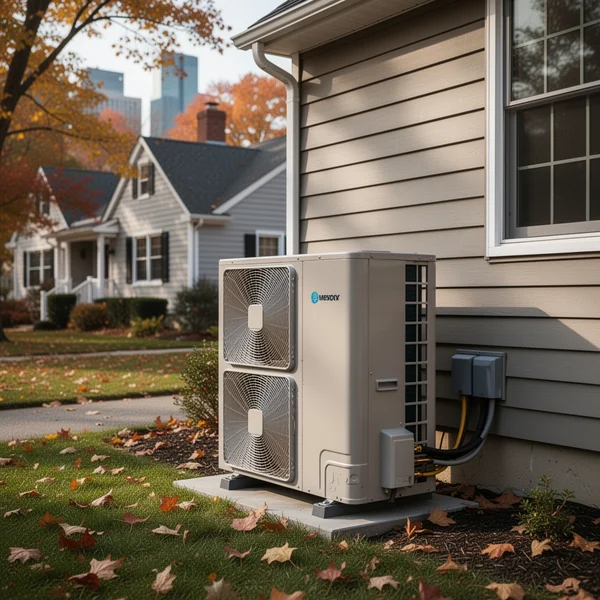
In a New York City co-op you own shares and a proprietary lease, not the walls — so a heat pump in a co-op apartment is a board decision before it is an HVAC decision. Anything that penetrates the facade, hangs off the building, drains into a common riser or draws more power through the building’s electrical service belongs to the corporation, and the board can say no to all of it without giving you a reason beyond the alteration agreement.
That sounds like a wall. It usually is not. Boards approve these regularly. But shareholders who lead with equipment brochures get turned down, and shareholders who lead with the building’s exposure get approved.
What the board actually controls
Read your proprietary lease and the house rules before your first email to management. In nearly every NYC co-op the corporation controls:
- The facade and any penetration through it. A refrigerant line set through an exterior wall is a facade alteration, full stop.
- Anything mounted outside. A condenser on a setback, roof, balcony, terrace or bracket sits on or attaches to a common element, even when the terrace is yours to use exclusively.
- Existing sleeves and openings. A through-wall PTAC sleeve is generally a building component, so replacing what is in it is a building question even though it looks like swapping an appliance.
- Condensate. Where the water goes — a building drain line, a wet column, a condensate pump discharge — is a plumbing tie-in to common systems.
- Electrical capacity. Your apartment’s feeder and the building’s service are shared infrastructure. A board is entitled to ask what the added draw does across forty apartments doing the same thing.
- Structure and roof warranty. Curbs, dunnage, and any roof penetration touch a roof the corporation has paid for and probably still has a warranty on.
What you generally control is the inside of the apartment: a wall-mounted head, a ducted cassette in a soffit, the thermostat, the finish work. That is the seam to argue from — the more of the project that lives inside your four walls, the shorter the conversation.
The three routes into a co-op apartment, ranked by friction
1. Replace an existing PTAC or through-wall sleeve
If your apartment already has a through-wall sleeve, a packaged terminal heat pump can go into it. No new hole, no new outdoor unit hanging off the facade, and the visual change from the street is limited to the grille. This is by a distance the easiest approval to get in a post-war building, and it is why so many NYC electrification conversations start here rather than with mini splits. Expect the board to specify the grille appearance so the facade stays uniform.
2. A ductless split with the condenser on a terrace, setback or roof
Better performance, harder approval. You are asking for a facade penetration, an outdoor unit on a common element, a condensate route and — if the condenser goes on the roof — a long line set through common space. Boards say yes to this when the engineering is presented properly and no when it arrives as a contractor’s sketch.
3. A building-wide system
Not your project, but worth knowing it exists: buildings replacing steam or a central plant across all lines can access incentive routes that an individual shareholder cannot. If two or three shareholders are asking separately, the board may reasonably decide to look at the building instead. That is not a rejection, it is a longer timeline.
The paperwork the alteration agreement will demand
Co-op alteration agreements vary, but the recurring requirements are predictable enough to prepare in advance:
- Drawings from a licensed New York architect or professional engineer, not a contractor’s sketch.
- Contractor licence numbers and a certificate of insurance naming the corporation, the managing agent and often the board individually as additional insureds.
- An NYC Department of Buildings work permit filed under the building’s address — mechanical and electrical work in an apartment is filed work, and unpermitted work discovered later is the shareholder’s problem at resale.
- Work hours, elevator and freight scheduling, and protection of common corridors.
- A refundable deposit against damage to common areas.
- Frequently, an engineer’s letter confirming the added electrical load is acceptable on the apartment feeder.
If the building is an individual landmark or sits in a historic district, the Landmarks Preservation Commission is a separate approval on top of the board’s, and it concerns itself with anything visible from a public street. A condenser on a rear setback invisible from the sidewalk is a very different application from one on a street-facing facade — the same logic that governs solar panels in a New York historic district.
Noise, which is where approved projects go wrong
New York City’s noise code sets limits at the property line and at neighbouring dwellings, and a condenser six feet from someone’s bedroom window in an airshaft will generate a complaint whatever the code says. Ask the contractor for the published sound rating of the outdoor unit, ask where it will sit relative to the nearest window, and offer the board a sound blanket or an anti-vibration mount before they ask for one. Volunteering the mitigation reads as competence; being asked for it reads as an oversight.
Money: what a shareholder can and cannot claim in 2026
Start with the correction most pages have not made. Both federal residential credits ended for property placed in service after 31 December 2025. Section 25C, which had covered heat pumps up to $2,000 a year, and Section 25D are both closed for 2026 installations. A co-op shareholder installing this year gets nothing federal. If a contractor’s proposal shows a 30% federal deduction at the bottom, the proposal is out of date and so is their pricing.
NYS Clean Heat is still running. It is NYSERDA plus seven sponsoring utilities — Central Hudson, Con Edison, National Fuel Gas, National Grid, NYSEG, Orange & Rockland and RG&E. Con Edison serves the five boroughs and most of Westchester, so a NYC co-op is in sponsor territory. Two things to understand before you count on it:
- Rebate amounts are not published as one statewide table. They vary by utility and equipment, and the address-based finder at cleanheat.ny.gov is the authoritative source for your building.
- Whether a multifamily building is treated as a residential or a multifamily project — and whether the shareholder or the corporation is the eligible customer — depends on how the building is metered and how the job is filed. That is a question for the participating contractor and the utility, not something to assume.
Master-metered buildings, where electricity is included in maintenance, add a wrinkle worth raising honestly with the board: your new equipment draws on the building’s meter. Boards notice. Offering to have the apartment sub-metered, or to discuss a maintenance adjustment, removes the objection before it is raised.
If the building is over 25,000 gross square feet, Local Law 97’s emissions limits apply to the corporation, and electrifying apartments generally helps the building’s position. Framing your application as something that moves the building toward compliance rather than something you want for yourself is not spin — it is the argument that actually persuades boards. Shareholders exploring the wider set of city and state programmes will find the map in our overview of New York renewable energy incentives beyond solar and, for property-level city mechanics, how NYC property tax credits and abatements work.
What to do next
- Pull your proprietary lease and house rules and find the alteration clause. Read it before you talk to anyone.
- Ask the managing agent for the current alteration agreement and the insurance requirements as a document, not a summary.
- Check whether your apartment has an existing through-wall sleeve. If it does, price that route first — it is the approval you are most likely to win.
- Find out whether the building is master-metered or individually metered, and whether the NYC Department of Buildings lists it as covered by Local Law 97.
- Engage a NYSERDA-participating contractor who has worked in NYC co-ops and can file with DOB. Ask for two buildings they have done, and confirm the filings exist.
- Run the building’s address through cleanheat.ny.gov before the board meeting, so your application contains a real incentive figure rather than a range you invented.
NY Solar Incentives
Independent New York solar research. We summarise NYSERDA, NY-Sun and federal programme rules from published sources and state plainly when a figure is an estimate. We are not a government agency and do not sell equipment.
Run the arithmetic on your own system
Check the dated program table and your arrangement before counting an incentive. Standard residential NY-Sun blocks are closed; Long Island Affordable Solar has a conditional income-verification route. The NY credit depends on qualified costs and tax liability, while the NYC abatement reduces future property-tax bills. The estimator keeps those timings separate.