Windows or Insulation: Where the Money Actually Goes
Air sealing and attic insulation beat window replacement per dollar in almost every New York house. When windows are still the right call, and what 2026 leaves you.
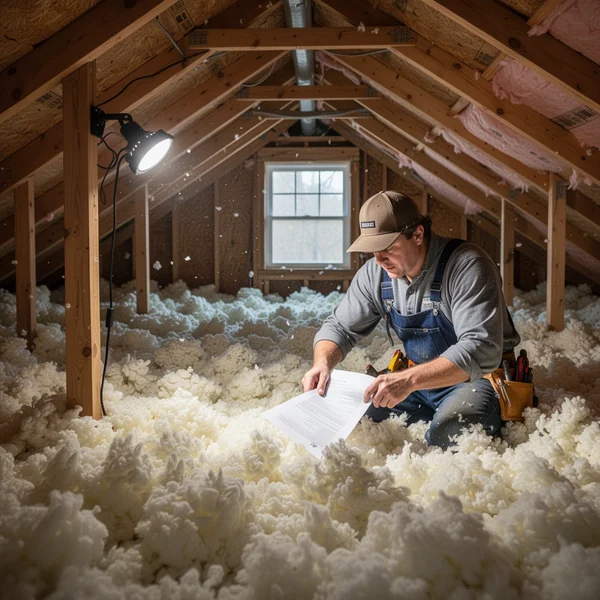
In almost every New York house, air sealing and attic insulation return more comfort and more saved fuel per dollar than replacing windows — and it is not a close contest. The window replacement versus insulation ROI question has a lopsided answer because windows are a small share of the surface area of your house and by far the most expensive square footage to improve.
That does not make new windows a bad purchase. It makes them a comfort, noise, rot and appearance purchase that also saves a little energy, rather than an energy purchase. Knowing which one you are actually making changes how you should budget for it.
Why the arithmetic favours insulation
Three things drive it.
Area. Add up the glass in a typical New York colonial or Cape and compare it with the ceiling plane and the walls. The attic alone usually dwarfs the window area, and the attic is the cheapest surface in the building to improve because it is accessible and needs no structural work.
Air, not just conduction. A great deal of the heat leaving an old house is not conducting through materials at all — it is riding out on air. Warm air rises, escapes through gaps at the top of the house (recessed lights, chimney chases, plumbing penetrations, the attic hatch), and pulls cold air in at the bottom through the rim joist, the basement bulkhead and the sill. That is the stack effect, and it gets stronger the colder it is outside, which is precisely why a leaky house in Watertown feels worse than the same house in Nassau County. Sealing those gaps costs a fraction of what glass costs and there is nothing about a new window that fixes a hole in your attic floor.
Marginal improvement. If you are replacing single-pane sash with modern double glazing, the improvement is real. If you are replacing serviceable double-pane windows from the 1990s, you are buying a very small thermal upgrade at full price. Many New York quotes are for exactly that second case.
The order that actually works in a New York house
- Diagnose before you buy. A blower door test with an infrared scan tells you where your house actually leaks instead of where a salesperson says it does. Insist on the numbers and the images being handed to you.
- Air seal the top of the house. Attic floor penetrations, the chimney chase, the attic hatch, top plates. This is the highest-value work in the building and the least visible.
- Air seal the bottom. Rim joists and sill plates in the basement, the bulkhead door, any crawl space.
- Insulate the attic to the depth your code and climate call for. New York spans several climate zones — Long Island and the city at the mild end, the Southern Tier and the Adirondacks at the cold end — and the Energy Conservation Construction Code of New York State sets the values a retrofit is measured against. Ask your contractor for the figure that applies to your county rather than accepting a national rule of thumb.
- Deal with knee walls and cathedral ceilings if you have them. Cape Cods across Long Island and Westchester are full of unsealed knee-wall triangles, and they are a classic source of a bedroom that never warms up.
- Then walls, then windows. Dense-pack wall insulation in a balloon-framed house is disruptive and belongs after the cheap wins.
When windows genuinely are the right call
Do not let a general rule override an obvious specific case. Replace windows when:
- The frames or sills are rotten. Water damage does not wait for your ROI calculation.
- The glass is single pane with failed or missing storms. The comfort change at the seating distance from the window is significant, and cold glass is what makes a room feel draughty even when it is not.
- Seals have failed — fogging between panes means the insulating gas is gone.
- Noise is the problem. On a busy Bronx or Yonkers street, or near the LIE, laminated glass does something no amount of attic insulation can.
- The windows cannot be opened or safely operated. Egress and ventilation are not optional.
There is also a middle path that gets ignored: repairing and weatherstripping original sash, adding good interior or exterior storm windows, and keeping the original wood. In a historic district this may not be a preference but a requirement — municipal preservation commissions across New York regulate what is visible from the street, and the same logic that governs solar equipment in a New York historic district applies to changing the appearance of front-elevation windows. Check before you order anything custom.
What the 2026 money looks like
This is where most articles on this topic are now wrong, so read it carefully. Both federal residential energy credits ended for property placed in service after 31 December 2025. While Section 25C existed it carried an annual cap of $1,200 for the general efficiency bucket, within which windows were capped at $600 and exterior doors at $250 each up to $500; insulation and air sealing materials sat in the same $1,200 bucket, and heat pumps had their own $2,000 cap. All of that is historical. A New York household doing this work in 2026 gets nothing federal. If a window company’s proposal still shows a federal tax credit line, it is quoting last year’s rules.
What remains is state and utility side:
- NYSERDA runs residential efficiency programmes and an income-qualified programme, EmPower+. The thresholds and benefit levels change, so get them from NYSERDA directly on 1-866-NYSERDA or from the live programme page rather than from a blog — including this one.
- Financing is not an incentive, but it changes the monthly number. The NYSERDA On-Bill Recovery Loan lets qualifying measures be repaid through your utility bill.
- Utility programmes vary by territory. Con Edison, National Grid, NYSEG, RG&E, Central Hudson, Orange & Rockland and National Fuel Gas each run their own efficiency offerings, and PSEG Long Island runs separate programmes again. Ask yours what it currently funds for shell work.
- New York’s own Form IT-255 solar credit — 25% of system cost capped at $5,000, carried forward up to five years — is unaffected by the federal expiry, but it is a solar credit and does not apply to windows or insulation. Our page on New York State renewable energy incentives beyond solar covers what does and does not qualify.
Getting a real number instead of a sales number
Any promise of a specific percentage saving from a window replacement, made without a blower door test and without looking at your fuel bills, is a guess dressed as a fact. The way to get a defensible comparison is:
- Pull twelve months of fuel and electric bills. That is your baseline and it is the only one that counts.
- Get a home energy assessment that produces measurements — a blower door result, infrared images, insulation depths by area.
- Ask the assessor to rank the measures by cost per unit of energy saved, and to say plainly where windows land in that ranking for your house.
- Get separate quotes for the shell work and the windows so you can stage them, rather than one bundled number you cannot pull apart.
What to do next
- Book a home energy assessment with blower-door testing before spending anything, and ask for the raw results in writing.
- Price attic air sealing and insulation as its own job. In most New York houses this is the work that changes how the house feels this winter.
- If your windows are rotten, single-glazed with no storms, or fogged, put them on the list on their own merits — not on a claimed energy payback.
- Call NYSERDA on 1-866-NYSERDA for current programme eligibility instead of relying on any figure you read online, and ask your utility what shell-work incentives it funds this year.
- Delete any federal tax credit line from a 2026 proposal, and ask the contractor to requote without it.
NY Solar Incentives
Independent New York solar research. We summarise NYSERDA, NY-Sun and federal programme rules from published sources and state plainly when a figure is an estimate. We are not a government agency and do not sell equipment.
Run the arithmetic on your own system
Check the dated program table and your arrangement before counting an incentive. Standard residential NY-Sun blocks are closed; Long Island Affordable Solar has a conditional income-verification route. The NY credit depends on qualified costs and tax liability, while the NYC abatement reduces future property-tax bills. The estimator keeps those timings separate.