Why Air Sealing Comes Before the Heat Pump
Sealing the house first changes the size of heat pump you have to buy, and equipment size drives both the install price and the January electric bill.
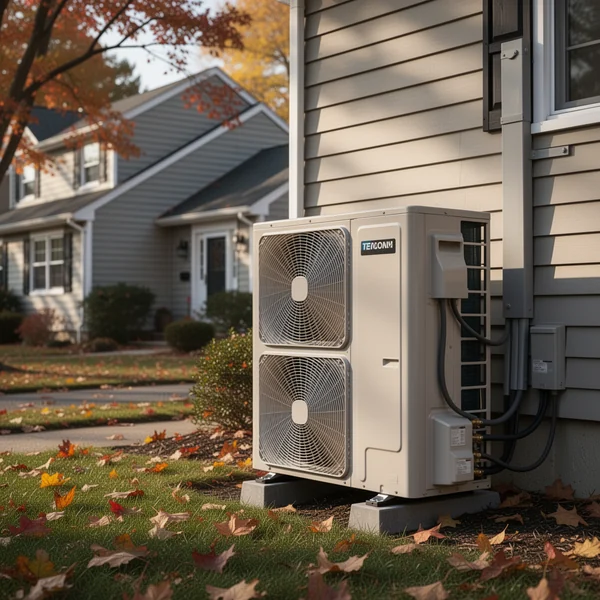
Air sealing before the heat pump goes in changes the size of the machine you have to buy, and equipment size is the biggest single lever on both the install price and the winter electric bill. A leaky house needs more capacity to hold temperature on a design day, and once that larger unit is bolted to the pad you are stuck with it for fifteen years — including every mild October afternoon it spends short cycling because it is far too big for the load.
That is the whole argument, and it is a sequencing argument rather than a spending argument. Most New York homeowners will end up doing both jobs. The question is only which one happens first, and doing the shell first is the version where the money goes further.
Why air sealing before the heat pump changes the equipment, not just the bill
A heat pump is sized from a Manual J load calculation, which asks how much heat the house loses at the local design temperature — the cold outdoor condition your system is expected to hold against. That calculation takes air leakage as an input. Reduce the leakage and the calculated load drops, and the machine that satisfies it gets smaller.
New York spans a wide range of design temperatures. A design day in the North Country or the Tug Hill is a genuinely severe condition; a design day in Mineola or Staten Island is not the same event at all. Ask any contractor quoting you which design temperature they used, because that one number silently sets everything downstream. If they will not tell you, they did not run the calculation.
The knock-on effects of sealing first are worth listing plainly, because “you’ll save on heating” undersells it:
- A smaller outdoor unit costs less to buy and less to install. Fewer tons, smaller line set, sometimes a smaller electrical circuit.
- It may keep you off a service upgrade. Panel capacity is the most common surprise cost in a New York electrification project. A smaller heat pump draws less, and the difference is sometimes exactly the difference between fitting in your existing panel and not.
- It moves the balance point in your favour. A tighter house means the heat pump can carry the whole load down to a colder outdoor temperature before backup heat has to engage — which is where the expensive kilowatt-hours live.
- It fixes comfort problems the heat pump would otherwise get blamed for. Cold floors above a leaky rim joist and a freezing back bedroom are air-leakage symptoms. New equipment does not cure them; it just runs harder trying.
Air sealing is not insulation, and the order matters
These get conflated constantly. Insulation slows heat conduction through an assembly. Air sealing stops air physically moving through gaps and carrying heat and moisture with it. Insulation laid over an unsealed attic floor is a filter, not a barrier — air travels straight through fibreglass, and in a New York winter that air is warm, humid indoor air heading into a cold attic where it condenses on the sheathing.
So the sequence within the shell work is: seal, then insulate, then size the equipment. Doing insulation first buries the leaks you were about to fix under a foot of cellulose.
Where the leaks are in New York housing stock
The distribution is remarkably consistent by building era, and a contractor who has worked the local stock will go straight to these:
- Attic bypasses. Plumbing stacks, chimney chases, dropped soffits over kitchen cabinets, recessed light housings, and the top plates of interior walls. In most houses this is the largest single category.
- Balloon-framed exterior walls in pre-1930 stock — very common in Buffalo, Syracuse, Albany and the older village housing across the Hudson Valley. The wall cavities run uninterrupted from the basement to the attic, which is a chimney by another name.
- The rim joist at the top of the foundation wall, all the way round the house.
- Knee walls in Capes and story-and-a-half houses, where the side attic space is outside the thermal boundary but the wall separating it was never sealed.
- Ducts in unconditioned space. If your ducts run through an attic or a vented crawlspace, leaks there are effectively leaks in the envelope, and sealing them pays twice once the heat pump is delivering cooler supply air.
The blower door is the only honest way to know
You cannot eyeball air leakage. A blower door test depressurises the house with a calibrated fan and gives a measured leakage rate, and a technician with an infrared camera can walk the building while it is running and point at exactly where the outside air is coming in. That is the difference between a contractor guessing at your Manual J infiltration input and one measuring it.
Insist on two things: that the blower door number goes into the load calculation you are shown, and that the house is re-tested after the sealing work so you can see what actually changed. A sealing job with no post-test is a job with no result.
One caution that is specific to older houses: a house can be sealed to the point where combustion appliances no longer draft properly. If you still have an atmospheric-draft boiler or gas water heater sharing a masonry chimney, combustion safety testing after air sealing is not optional. Any contractor doing this work under a New York programme should be doing it as a matter of course; if yours does not raise it, that tells you something.
Who pays for the shell in New York
This is where the sequencing gets financially awkward, and it is worth being straight about it. NYS Clean Heat — NYSERDA plus its seven sponsoring utilities, Central Hudson, Con Edison, National Fuel Gas, National Grid, NYSEG, Orange & Rockland and RG&E — pays for the heat pump. It is an equipment programme. The shell work sits with NYSERDA’s residential efficiency and income-qualified programmes instead, including EmPower+ and the state’s weatherization assistance route, which for eligible households can cover a substantial share of exactly this work.
Thresholds and dollar figures for those programmes change and are not something to take from a third-party page. Go to NYSERDA directly or call 1-866-NYSERDA and get the current position for your household. For the rebate side of the equipment itself, the address-based finder at cleanheat.ny.gov/find-available-rebates is the only authoritative source — amounts are set per utility and are revised, and there is no single statewide table.
The federal picture is simple and most pages still have it wrong. Section 25C, which used to give up to $1,200 a year for envelope work and up to $2,000 for heat pumps, applied to property placed in service through 31 December 2025. Section 25D terminated for expenditures after the same date. Air sealing done in 2026 earns no federal credit at all, and neither does the heat pump. Strike those lines out of any quote that still carries them.
If the cash flow is the obstacle, financing the shell work through the utility bill is a real option in New York — the explainer on the NYSERDA On-Bill Recovery Loan covers how that repayment mechanism works. For the broader map of what the state funds outside its solar programmes, see New York State renewable energy incentives beyond solar.
When to skip ahead anyway
There is one situation where installing the heat pump first is defensible: your existing heating system has failed in January and you cannot wait. In that case, get the equipment in, but ask the contractor to size to a load calculation that assumes the air sealing you intend to do, and get that assumption written into the paperwork. It is a compromise, and you should know you are making it.
What to do next
- Book a blower door test with an infrared walk-through before you take heat pump quotes, and keep the report.
- Check your household against NYSERDA’s income-qualified programmes by calling 1-866-NYSERDA — if you qualify, the sequencing question largely answers itself.
- Give the blower door number to every contractor quoting the heat pump, and ask each to state the design temperature and the resulting load in writing.
- Have the attic bypasses and rim joist sealed first, insulation second, equipment third.
- If you have any atmospheric-draft combustion appliance, require combustion safety testing after the sealing work.
- Remove any federal tax credit line from a 2026 quote and re-check the total.
NY Solar Incentives
Independent New York solar research. We summarise NYSERDA, NY-Sun and federal programme rules from published sources and state plainly when a figure is an estimate. We are not a government agency and do not sell equipment.
Run the arithmetic on your own system
Check the dated program table and your arrangement before counting an incentive. Standard residential NY-Sun blocks are closed; Long Island Affordable Solar has a conditional income-verification route. The NY credit depends on qualified costs and tax liability, while the NYC abatement reduces future property-tax bills. The estimator keeps those timings separate.