Will a Heat Pump Water Heater Freeze Your New York Basement?
It will not freeze the basement, but it cools and dries the room it stands in. What that means upstate, and the heating-season penalty nobody mentions.
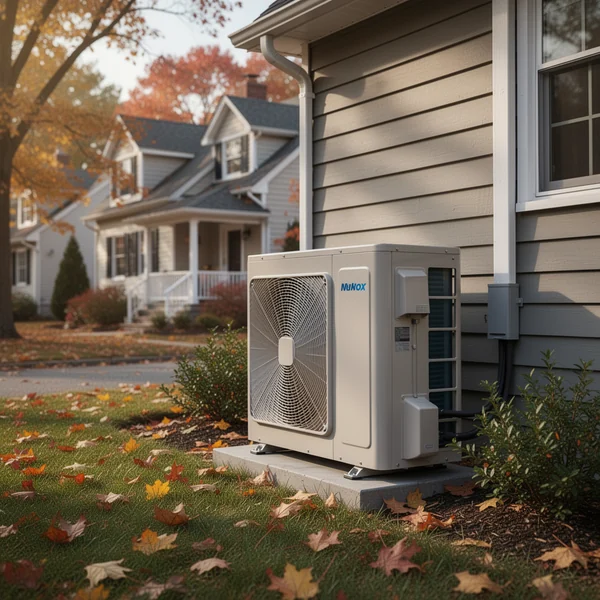
No — a heat pump water heater will not freeze your basement, but it will make the space around it noticeably cooler and drier, and in an already cold basement it can cool the room enough to matter. The unit works by pulling heat out of the surrounding air and putting it into the tank, so the air it discharges comes out colder and dehumidified, and that is the entire trade you are making.
Whether a heat pump water heater in a cold basement is a good idea in New York comes down to three things: how big and how isolated the room is, how cold it actually gets down there in February, and whether the heat the unit steals is heat you already paid your boiler or furnace to produce.
What the unit is doing to your basement air
An integrated heat pump water heater is essentially a small air conditioner sitting on top of a storage tank. It runs a fan, draws room air across an evaporator coil, moves that heat into the water, and blows the cooled air back out. Two by-products follow automatically:
- Cooling. The room gives up heat. In a large open basement this is barely perceptible; in a small closed utility closet it is dramatic and the unit will eventually starve itself of heat to work with.
- Dehumidification. Moisture condenses on the cold coil and drains away. In a Long Island or Westchester basement that runs clammy from May to September, this is a genuine benefit — people who install one often stop running a separate dehumidifier.
That second point is why the same appliance reads as a win in one season and a nuisance in another. In summer, free dehumidification. In January, a cool corner in a room you may already dislike.
Will it actually get too cold down there?
Manufacturers set a minimum ambient operating temperature for heat pump mode and a minimum room volume — or a requirement to duct the unit if the space is smaller. Both numbers are printed on the specification sheet for the exact model, and they differ enough between brands that quoting a typical figure here would be worse than useless. Ask the installer for the submittal sheet and read those two lines yourself before the tank is ordered.
Below the stated minimum ambient temperature, the unit does not fail — it falls back to its electric resistance elements, which is to say it becomes an ordinary electric water heater with a worse price tag. That is the real risk in New York, and it is a bill problem rather than a frozen-pipe problem.
Which basements are at risk:
- Unheated, uninsulated basements upstate — Buffalo, Rochester, Syracuse, the North Country. A field-stone or block foundation with no rim-joist insulation and no heat source can run cold through a long winter. A heat pump water heater there will spend the heating season in resistance mode more than the brochure suggests.
- Small mechanical closets and pantries. Room volume, not house size, is what the manufacturer cares about. A big house with the tank in a sealed closet has a small-room problem.
- Crawl spaces and unconditioned garages. Usually the wrong location outright.
Which basements are fine:
- A basement that already contains a boiler or furnace, which leaks heat continuously into the space.
- An open, partly conditioned basement in a Brooklyn or Queens house, or anywhere south of the Hudson Highlands where basements are relatively temperate.
- Any basement where the unit can be ducted — supply air pulled from a warmer zone, or exhaust discharged outside in summer and into the basement in winter.
The heating-season penalty nobody puts in the brochure
Here is the part that separates a real conversation from a sales pitch. If your basement is heated — directly, or indirectly by a boiler standing in it — then heat the water heater takes from that air is heat your heating system has to replace. You have not created energy from nothing; you have moved a share of your water heating load onto your space heating system for part of the year.
How much that matters depends on what heats the house. If the basement heat comes from a high-efficiency heat pump, the penalty is small. If it comes from an oil boiler in Dutchess County or a propane furnace in the Catskills, you are effectively buying part of your hot water at oil or propane prices during the coldest months. In the cooling season the arithmetic reverses and you gain, because the unit is doing dehumidification you would otherwise pay for.
None of this makes the appliance a bad choice — over a full New York year it generally still comes out ahead of a plain electric tank. It means the honest comparison is annual, not January-only, and anyone quoting you a single savings number without asking what heats your house is not doing that arithmetic.
Practical New York installation details
Condensate is the winter problem
The unit produces condensate whenever it runs, and that water has to go somewhere: a floor drain, a condensate pump, or a gravity line. If any part of that line runs through an unheated space or exits through a rim joist to the outside, it can freeze and back up. In an upstate basement, keep the drain path entirely inside the conditioned envelope, and if a pump is used, put it somewhere you will actually notice a failure.
Space, height and noise
These tanks are taller than the electric or gas tank they replace and need clearance above for the compressor section and around for airflow. Measure the joist height in an old Buffalo or Albany basement before ordering — low headroom is the most common reason a job gets changed on install day. They also make fan and compressor noise, which matters if the basement is finished or sits under a bedroom.
Electrical
Most integrated models run on a 240-volt circuit, though some 120-volt units exist. If you are replacing a gas water heater there may be no suitable circuit at all, and the cost of running one has to sit in the quote. Ask before you compare prices, because a quote without the electrical work is not comparable to one with it.
Rebates and the 2026 federal reality
Both federal residential energy credits ended for property placed in service after 31 December 2025. The 25C credit, which carried a $2,000 annual cap covering heat pump water heaters while it existed, is gone, and so is the 25D clean energy credit. A New York household installing a heat pump water heater in 2026 gets nothing federal. If a contractor’s proposal still shows a federal credit line, that proposal was built from an out-of-date template.
What is still live is NYS Clean Heat, administered by NYSERDA with seven sponsoring utilities: Central Hudson, Con Edison, National Fuel Gas, National Grid, NYSEG, Orange & Rockland and RG&E. PSEG Long Island is not a Clean Heat sponsor and runs separate programmes of its own. Rebate amounts are not published as a single statewide table — they depend on your utility and the equipment category — so put your address into the official finder at cleanheat.ny.gov/find-available-rebates and take the number it gives you rather than one from a national comparison site. Income-qualified households should also ask NYSERDA about EmPower+ directly on 1-866-NYSERDA; the thresholds move and are not worth repeating second-hand.
If the reason you are electrifying hot water is a bigger plan, two of our existing guides are worth reading alongside this: New York State renewable energy incentives beyond solar, and the NYSERDA On-Bill Recovery Loan, which lets qualifying measures be repaid through your utility bill instead of a separate finance agreement.
What to do next
- Put a cheap thermometer in the basement, next to where the tank would stand, and read it on the coldest week of winter. That single measurement answers most of this article for your house.
- Measure the room volume and the headroom, and get the manufacturer’s spec sheet for the exact model quoted. Check its minimum ambient temperature and minimum room volume against what you measured.
- Decide the condensate route before install day, and keep it inside the heated envelope.
- Ask whether the quote includes a new 240-volt circuit, and whether a ducting kit is included or extra.
- Run your address through the Clean Heat finder, and if a contractor quotes you a rebate figure, ask them to show you where it comes from.
NY Solar Incentives
Independent New York solar research. We summarise NYSERDA, NY-Sun and federal programme rules from published sources and state plainly when a figure is an estimate. We are not a government agency and do not sell equipment.
Run the arithmetic on your own system
Check the dated program table and your arrangement before counting an incentive. Standard residential NY-Sun blocks are closed; Long Island Affordable Solar has a conditional income-verification route. The NY credit depends on qualified costs and tax liability, while the NYC abatement reduces future property-tax bills. The estimator keeps those timings separate.