Switching From Natural Gas to a Heat Pump in New York
Going from natural gas to a heat pump in New York hinges on whether you keep the gas meter. Here is the fuel arithmetic, the panel question, and what Clean Heat actually pays.
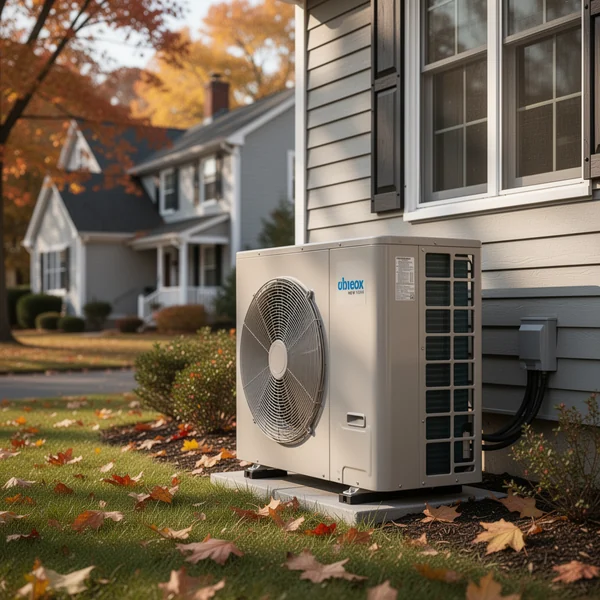
Switching from natural gas to a heat pump in New York works technically in every part of the state, including Buffalo and the Adirondacks, provided the equipment is a cold-climate model and the house has been sized honestly. The harder question is financial, and it turns on three things you can look up tonight: your all-in electric rate, your delivered gas rate, and whether you are going to keep the gas meter.
That last one is the decision most people skip, and it is the one that decides whether the switch shows up on your bill at all.
The gas customer charge is the hinge
Every gas bill in New York has two parts: a fixed monthly charge for being a customer at all, and a variable charge for the therms you burn. If you replace the furnace or boiler with a heat pump but keep the gas water heater, the gas range and the gas dryer, you keep the fixed charge for all twelve months and you keep a service you now barely use. Heating is the big consumer, so your therms collapse, but the fixed charge does not move.
Fully leaving gas means every gas appliance goes — heat, hot water, cooking, laundry — and then you ask the utility to remove the meter and cap the service. Con Edison, National Grid, National Fuel Gas, NYSEG, RG&E, Central Hudson and Orange & Rockland each run their own process for that, with their own paperwork and their own lead time. Treat it as a one-way door: restoring a capped gas service later is a new-service job, not a phone call, and it is priced accordingly.
So there are really three positions, not two:
| Position | What happens to the gas bill | Who it suits |
|---|---|---|
| Heat pump, gas furnace kept as backup (dual fuel) | Fixed charge stays, therms fall a lot | Existing ducted system, cold upstate design temperature, boiler with life left |
| Heat pump for heat, gas still doing hot water or cooking | Fixed charge stays, therms fall further | Most partial conversions, by default rather than by decision |
| All-electric, meter removed | Gas bill goes to zero | Whole-house projects where the water heater and range are being replaced anyway |
Doing the fuel arithmetic yourself
Nobody can tell you the answer from outside your house, because New York electric and gas rates differ by utility and change by season. But the arithmetic is short, and you have all the inputs.
Convert both fuels to the same unit — dollars per million BTU actually delivered into the house:
- Gas. A therm is 100,000 BTU by definition. Take your total gas bill, subtract the fixed charge, divide by therms used, and that is your variable cost per therm. Multiply by 10 for a million BTU, then divide by your furnace or boiler’s AFUE as a decimal (an 80% unit is 0.80). The AFUE is on the yellow EnergyGuide label or the nameplate.
- Heat pump. A kilowatt-hour is 3,412 BTU. Take your total electric bill — supply, delivery, surcharges, everything — and divide by kWh used. That all-in rate is the number people get wrong, because they quote the supply rate off the top of the bill and understate their real cost by a wide margin. Then: (all-in $/kWh × 1,000,000) ÷ (3,412 × seasonal COP).
Seasonal COP is the estimate in that formula. It is not a constant: it falls as the outdoor temperature falls, and a New York January is not the lab condition the rating was measured at. Ask your contractor what seasonal coefficient they used and what design temperature they ran the Manual J at, and get both in writing.
When you run this in most of New York, natural gas usually still comes out cheaper per unit of delivered heat than heat pump electricity — which is exactly why honest gas-to-heat-pump conversions in this state are justified by other things: getting central cooling out of the same equipment, removing combustion from the house, retiring a furnace that was going to fail anyway, and no longer being exposed to a volatile commodity. If a salesperson promises you a fast payback against natural gas, ask to see the two calculations above with your own bill numbers in them.
The panel, and what actually decides whether you need an upgrade
Every heat pump outdoor unit has a data plate with two numbers on it: minimum circuit ampacity (MCA) and maximum overcurrent protection (MOCP). Those, not a rule of thumb, set the circuit. What decides whether your existing service can carry the new load is a load calculation run against the whole house — the electrician’s calculation, not the HVAC contractor’s opinion.
A 100-amp service in a Queens row house or a 1950s Levittown cape is not automatically too small. Many pass, particularly when the heat pump replaces gas heat rather than adding to electric resistance heat. Where it gets tight is the combination: heat pump plus an electric water heater plus an EV charger plus an induction range. If you are planning to end up all-electric, have the load calculation done once for the finished house rather than three times as you go, and have the electrician tell you in the same visit whether a load-management device could save you the service upgrade.
Buffalo is not Long Island, and the design temperature proves it
New York spans a wide range of winter design conditions. The outdoor design temperature used for a house in Erie County is materially colder than the one used on the South Shore of Long Island, and colder again in the North Country. That number drives everything downstream: capacity at design, whether backup heat is needed at all, how many hours a year the unit runs at maximum, and how big the outdoor unit is.
Ask for the Manual J and look for the design temperature on it. If the contractor cannot produce a load calculation, or produces one where the design temperature is a round national number rather than something specific to your county, you are being sold a box rather than a heating system. Cold-climate models hold usable capacity far below freezing, but the capacity table only means something once someone has established what your house needs at your design temperature.
What New York pays, and what it does not
NYS Clean Heat is the programme that funds this. It is run by NYSERDA with seven sponsoring utilities: Central Hudson, Con Edison, National Fuel Gas, National Grid, NYSEG, Orange & Rockland and RG&E. PSEG Long Island is not one of them — Nassau and Suffolk electric customers have separate PSEG-LI programmes and should not be sent to Clean Heat for a rebate.
Rebate amounts are not published as one statewide table. They vary by utility and by equipment type, and the honest route is the official address-based finder at cleanheat.ny.gov/find-available-rebates/. In practice the rebate is claimed by a participating contractor and appears as a deduction on your quote, so when you compare bids, compare both the gross price and the net — a higher gross with a bigger rebate can beat a lower gross with none.
Federal money is a different story, and this is where most pages on the internet are still wrong. Both residential federal credits ended for property placed in service after 31 December 2025. Section 25C, which capped heat pumps and heat pump water heaters at $2,000 a year while it existed, was allowed only for property placed in service before that date. Section 25D terminated for expenditures after the same date. A New York household converting from gas in 2026 gets nothing federal. Any proposal showing a 30% federal line is running last year’s rules; our explainer on what changed with the federal credit in New York covers the timing.
Do not expect the state solar credit to help either. Form IT-255 gives 25% of system cost up to $5,000 for solar energy system equipment, carried forward up to five years — a genuinely valuable credit, but it is not a heat pump credit. If you are pairing the conversion with a rooftop array, the NYSERDA On-Bill Recovery Loan can carry the financing on your utility bill, and it is worth understanding how net metering credits work in New York before you assume solar will offset a winter heating load — the production and the demand are in opposite seasons.
What to do next
- Pull twelve months of gas and electric bills and calculate both dollars-per-million-BTU figures above. Do it before you talk to anyone.
- Decide, on paper, whether you are going all-electric or keeping gas for hot water and cooking. The answer changes the whole budget.
- Run your address through cleanheat.ny.gov/find-available-rebates/ and note which of the seven utilities sponsors you.
- Ask every bidder for a Manual J with the design temperature visible, and the outdoor unit’s MCA and MOCP.
- Get one electrician to run a whole-house load calculation for the finished configuration, not the current one.
NY Solar Incentives
Independent New York solar research. We summarise NYSERDA, NY-Sun and federal programme rules from published sources and state plainly when a figure is an estimate. We are not a government agency and do not sell equipment.
Run the arithmetic on your own system
Check the dated program table and your arrangement before counting an incentive. Standard residential NY-Sun blocks are closed; Long Island Affordable Solar has a conditional income-verification route. The NY credit depends on qualified costs and tax liability, while the NYC abatement reduces future property-tax bills. The estimator keeps those timings separate.