Heat Pump or Furnace: The New York Operating-Cost Math
The honest way to compare a heat pump against your furnace in New York: one cost-per-million-BTU formula, two numbers off your own bills, and the 2026 incentive rules that actually apply.
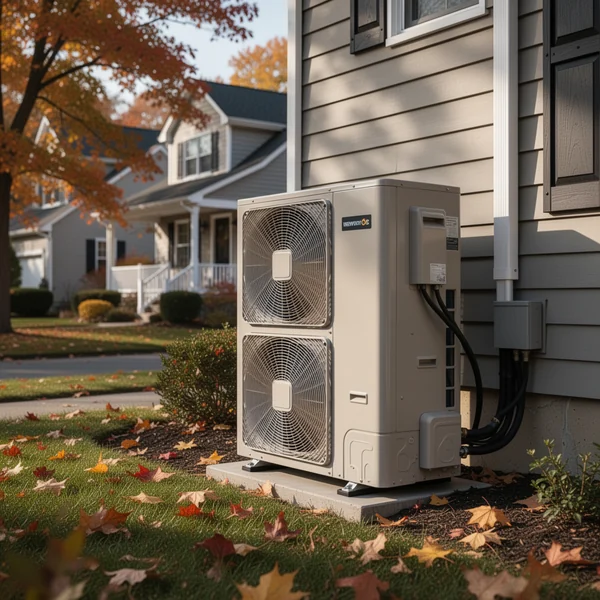
The heat pump vs furnace operating cost question in New York comes down to one comparison you can run yourself: the price of a million BTU of delivered heat from electricity against the price of a million BTU from natural gas, oil or propane. Nobody can hand you a single statewide answer, because a Con Edison customer in Queens and a National Grid customer in Erie County pay very different electricity prices and face very different Januarys.
What follows is the arithmetic, the two numbers you need off your own bills, and the New York-specific traps that decide whether the answer comes out in the heat pump’s favour.
The one formula behind heat pump vs furnace operating cost in New York
Every heating appliance converts a purchased unit of fuel into heat at some efficiency. Put both on the same footing — dollars per million BTU delivered into the house — and the comparison stops being an argument:
Cost per million BTU = (price per fuel unit ÷ BTU per fuel unit × 1,000,000) ÷ efficiency
You need three inputs per fuel: the price you actually pay, the energy content of the unit, and the efficiency of the equipment burning or moving it. Only the middle one is fixed.
| Fuel | How it is billed | Energy content per unit | Efficiency term |
|---|---|---|---|
| Natural gas | per therm (some bills show ccf) | 1 therm = 100,000 BTU by definition | AFUE of the furnace or boiler |
| Heating oil | per gallon | roughly 138,500 BTU per gallon of No. 2 heating oil, per the EIA’s energy conversion tables | AFUE |
| Propane | per gallon | roughly 91,500 BTU per gallon, same EIA source | AFUE |
| Electricity | per kWh | 1 kWh = 3,412 BTU by definition | COP for a heat pump; 1.0 for resistance strips |
That is the whole model. Everything else on this page is about getting honest values into it.
Getting your real electricity price, not the one on the advert
Take a recent bill, add every charge on it, and divide by the kWh used. That all-in number — supply plus delivery plus riders plus taxes — is what an extra kWh of heat pump run time really costs you. Using the supply rate alone is the single most common way people talk themselves into a heat pump that then disappoints them, because in New York the delivery side of the bill is charged per kWh too and it is not small.
Do the same on the gas side, but with one correction. If you are keeping a gas water heater or a gas range, you keep paying the basic service charge on that account whether you heat with gas or not. So the heat pump does not have to beat your whole gas bill — it has to beat the marginal therm. Exclude the fixed monthly charge from the gas cost per million BTU unless you are genuinely disconnecting the service.
COP is not one number, and that is the whole story in New York
A furnace’s AFUE barely moves with the weather. A heat pump’s coefficient of performance falls as the outdoor air gets colder, which is precisely when you need it most. A machine that is cheap to run on a 45°F November evening in Westchester may be running near break-even against gas on a 5°F morning in Oneida County.
Do not accept a single seasonal number from a salesperson. Cold-climate air source heat pumps have published capacity and COP figures at 47°F, 17°F and 5°F outdoor temperature, listed on the Northeast Energy Efficiency Partnerships cold-climate product list and on the manufacturer’s submittal sheet. Ask for the model number, look it up, and read the 5°F row. Then ask your contractor for the ASHRAE 99% winter design temperature used in the Manual J for your county — a Buffalo design temperature and a Suffolk County design temperature are not close to each other, and a system sized for one is the wrong machine in the other.
The backup-heat line item people forget
When the heat pump cannot keep up, something else finishes the job. If that something is electric resistance strips, its efficiency is 1.0 by definition — the worst row in the table above. A handful of strip hours during a cold snap can swallow a whole month of savings, and they will not show up in anyone’s pre-sale estimate.
This is why, for a New York house that already has a working gas furnace in decent condition, a dual-fuel or hybrid setup is often the honest recommendation: the heat pump carries the mild two-thirds of the season and the furnace takes the deep cold, with a switchover temperature set where the two cost-per-million-BTU lines cross. Run the formula at several outdoor temperatures and the switchover point falls out of it. Homes on oil or propane usually see the crossover much further down the thermometer than homes on natural gas, which is why upstate oil-heated houses tend to be the strongest heat pump cases in the state.
What the incentives do to the arithmetic in 2026
Operating cost is only half the decision; the install price is the other half, and the 2026 rules changed sharply.
There is no federal credit for a 2026 install. Section 25C, the Energy Efficient Home Improvement Credit that carried up to $2,000 a year for a qualifying heat pump, applied to property placed in service through 31 December 2025 — the IRS page states the window plainly. Section 25D, the residential clean energy credit, terminated for expenditures after the same date. Any quote or webpage still applying 30% to your heat pump number in 2026 is wrong, and we have written about the same shift on the solar side in The Federal Solar Tax Credit and New York: What Changed.
NYS Clean Heat is the live incentive. It is run by NYSERDA with seven sponsoring utilities — Central Hudson, Con Edison, National Fuel Gas, National Grid, NYSEG, Orange & Rockland and RG&E. There is no single statewide rebate table, and anyone quoting you one has invented it; amounts vary by utility and equipment type. The official route is the address-based finder at cleanheat.ny.gov. Note that PSEG Long Island is not a Clean Heat sponsor — it runs its own separate efficiency and heat pump programmes, so Nassau and Suffolk readers should start on PSEG-LI’s own pages instead.
One clarification that saves people a disappointing April: New York’s Form IT-255 credit — 25% of system cost capped at $5,000 — is a solar equipment credit. It does not cover a heat pump. If you are combining projects, that credit still applies to the solar half, and the mechanics are set out in Form IT-255: Claiming the NY State Solar Tax Credit. The broader picture of what New York still funds beyond panels sits in New York State Renewable Energy Incentives Beyond Solar.
Where solar changes the answer
A heat pump paired with rooftop solar is a different calculation again, because winter production in New York is the weakest part of the year and your heating load is the strongest. Net metering credits banked in July can carry a January heating bill, but only if your net metering arrangement lets them — the rules differ by utility, and Net Metering in New York: How Credits Work covers how the banking actually behaves.
What to do next
- Pull your last twelve months of electric and gas (or oil, or propane) bills and compute all-in cost per kWh and per therm or gallon. Twelve months, not one — summer and winter rates differ.
- Run the cost-per-million-BTU formula above for your current system and for a heat pump at COPs taken from the manufacturer’s 47°F, 17°F and 5°F rows, not a marketing average.
- Ask any contractor for the Manual J load calculation and the design temperature they used, in writing, before you look at a price.
- Enter your address in the NYS Clean Heat finder to see what your specific utility currently pays, and confirm the contractor is enrolled in that utility’s programme — the rebate is claimed through them, not by you.
- If you are on Long Island, check PSEG Long Island’s own programme pages rather than Clean Heat.
- Budget the 2026 install with no federal credit in the spreadsheet. If it only works with 30% federal money in the model, it does not work.
NY Solar Incentives
Independent New York solar research. We summarise NYSERDA, NY-Sun and federal programme rules from published sources and state plainly when a figure is an estimate. We are not a government agency and do not sell equipment.
Run the arithmetic on your own system
Check the dated program table and your arrangement before counting an incentive. Standard residential NY-Sun blocks are closed; Long Island Affordable Solar has a conditional income-verification route. The NY credit depends on qualified costs and tax liability, while the NYC abatement reduces future property-tax bills. The estimator keeps those timings separate.