The NYC Solar Property Tax Abatement, Explained
New York City runs a solar incentive that most state-level guides miss entirely: an abatement applied straight to your property tax bill, spread over four years, approved by the Department of Buildings and applied by the Department of Finance.
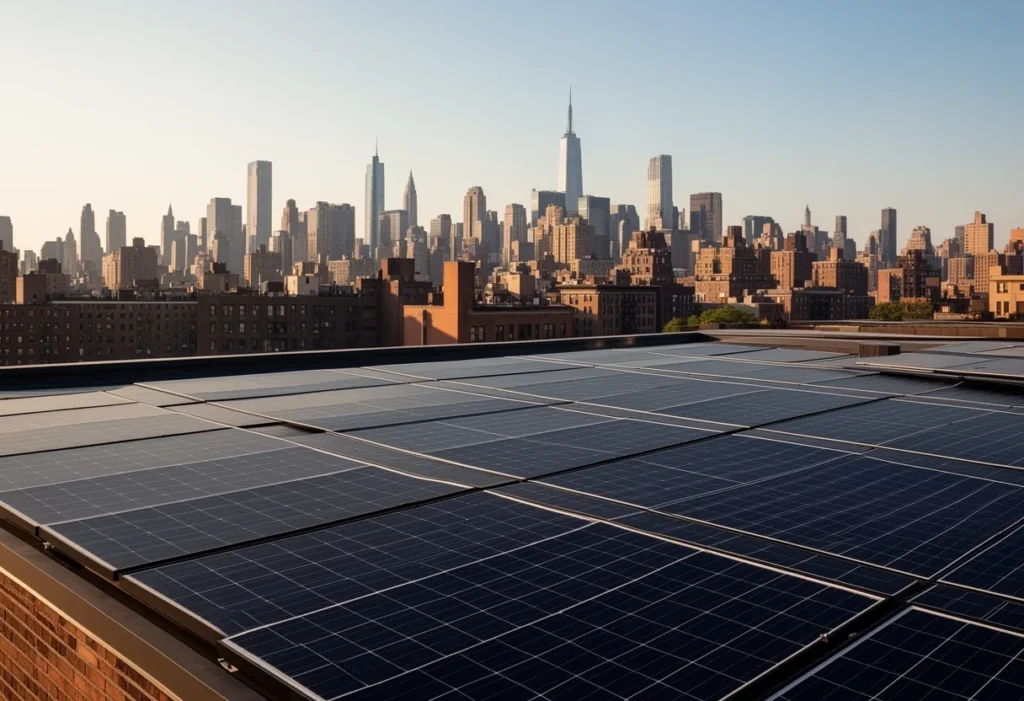
If your property is in one of New York City’s five boroughs, the Solar Electric Generating Systems (SEGS) tax abatement may reduce the building’s property tax. It is separate from the New York income-tax credit and any approved NY-Sun incentive. Each has its own eligibility and cost-base rules.
It is not a rebate and not an income tax credit. It reduces the property tax bill on the building itself, in instalments, over four years.
What the abatement actually is
The SEGS abatement reduces property tax owed on an eligible NYC building with a qualifying solar installation. The NYC Department of Buildings determines eligibility and approves the application; the Department of Finance applies the approved benefit to the property tax bill. See NYC Department of Finance guidance. It is not filed as an income-tax credit with the state tax department.
That administrative detail matters more than it sounds. Because it is a property tax mechanism rather than an income tax one, it does not depend on your income, your tax liability on a return, or whether you itemise. It depends on the building.
The one-line version
For qualifying systems placed in service on or after 1 January 2024 and before 1 January 2035, each of four annual abatements is the smallest of 7.5% of eligible expenditures, $62,500, or eligible property tax payable for that year. An unused annual amount is not refunded or carried forward.
Who qualifies
The abatement is available to Class 1, Class 2 and Class 4 properties in New York City. In practice that covers:
- Class 1 — one-, two- and three-family homes, which is most of Staten Island, much of Queens and the outer parts of Brooklyn and the Bronx.
- Class 2 — co-ops, condominiums and rental buildings with more than three units.
- Class 4 — commercial and industrial property.
The current service window is 1 January 2024 through 31 December 2034. DOF identifies incompatible benefits including ICAP, 421-a, 421-b, 421-g and PILOT. The statute also restricts benefits where specified property-tax, water/sewer or other municipal charges are in arrears. Tax-exempt property has no eligible tax to abate. Check the property’s actual status with DOB and DOF; see NYC Department of Finance guidance and Real Property Tax Law section 499-CCCC. Filing and job sign-off requirements are explained below.
If you live in a co-op or condo
The applicant is the building owner or the condominium/co-op board; a unit owner cannot simply submit an income-tax claim for the building’s system. For a condominium, the statute apportions the abatement among condominium tax lots, so it is inaccurate to say the benefit can never reach a unit’s tax bill. Ask the board or managing agent how an approved benefit would be allocated. See Real Property Tax Law section 499-BBBB and solar for NYC apartments and co-ops.
What it is worth
Under Real Property Tax Law section 499-BBBB, the annual rate is 7.5% of eligible expenditures for four years for the current service window. The potential four-year total is 30%, capped at $250,000, but only if every year’s eligible tax and the other conditions permit the full annual amount. It is not a 30% cash payment at installation.
Each year’s benefit cannot exceed $62,500 or the eligible real-property tax payable on the relevant property that year. If the tax cap binds, the unused portion of that year’s 7.5% calculation cannot be added to a later year.
Check the current percentage and cap before you rely on them
The rate is determined by the system’s placed-in-service period. These figures were checked on 7 October 2026 against NYC Department of Finance guidance and Real Property Tax Law section 499-BBBB. Confirm your eligible service date, approved expenditures and property-tax amount before treating the maximum as a saving.
Eligible cost and a tax-capped example
Eligible expenditures include qualifying solar materials and properly allocated preparation, installation, architectural and engineering costs. Interest and financing charges are excluded. The statutory cost definition and DOB solar FAQ require grants and cash rebates to be removed from eligible cost; other tax credits, abatements, exemptions and tax rebates are not subtracted as if they were grants. Do not exclude the same grant a second time from an already net cost.
Assume $20,100 of fully eligible solar expenditures after any required grant or cash-rebate adjustment, a system within the current service window, and an otherwise eligible property with $1,000 of eligible property tax for the year. The 7.5% calculation is $1,507.50, but that year’s abatement is limited to $1,000. The remaining $507.50 cannot carry to another year. The NY State solar income-tax credit is not deducted from this NYC cost base. This is an assumed example, not a finding that a particular property qualifies.
How it stacks with the other two programmes
For new installation expenditures treated as made in 2026, the federal household section 25D credit is unavailable. A historical 2025 claim and unused carryforward are different cases. The IRS timing FAQ (questions 1 and 7) explains normal installation completion and the special construction/reconstruction timing rule. The NY State credit and NYC abatement remain separate benefits: neither is guaranteed solely because the other applies.
| Programme | Type | Reduces | Who administers |
|---|---|---|---|
| NY-Sun | Conditional installation incentive | Approved project cost; verify regional/program availability rather than assuming an award | NYSERDA |
| NY State solar credit | Nonrefundable income-tax credit; unused credit may carry to the next five tax years | Available NY State income-tax liability, subject to IT-255 rules | NYS Department of Taxation and Finance |
| Federal household credit (§25D) | Historical income-tax credit/carryforward | No new credit for installation expenditures treated as made after 31 December 2025; eligible older carryforward is separate | IRS |
| NYC SEGS abatement | Four-year property-tax abatement | 7.5% of eligible cost per year, capped at $62,500 and eligible property tax each year | NYC DOB (approval) and DOF (tax bill) |
As checked on 7 October 2026, the regular residential NY-Sun blocks in the Con Edison, Upstate and Long Island regions are closed. The Con Edison and Upstate Affordable Solar blocks are also closed. However, the Affordable Solar intake accepts applications for PSEG Long Island customers, and the Long Island dashboard lists a conditional $0.40-per-watt Affordable Solar incentive. This does not establish remaining funding or an approved award for a particular project. Confirm income eligibility, current funding and contractor approval before including an incentive in a quote. For an NYC project, an incentive should only be included if the contractor can document applicable approval. The state credit is claimed under IT-255 rules; the NYC abatement is approved separately and starts on 1 July following DOB approval. These are different filing and payment schedules.
For the NYC abatement, the DOB solar FAQ says to subtract grants and cash rebates, including NYSERDA grants, but not other tax credits or abatements. For a NY income-tax credit, use its own eligible-cost rules rather than copying a universal net-cost formula. The same amount must not be subtracted twice. A new 2026 quote should also exclude an inapplicable household federal credit. See the real cost of installing solar panels in New York.
How it is claimed
The applicant is the building owner or the condominium/co-op board. Coordinate the abatement paperwork with the installer and the licensed professionals responsible for the DOB job. Do not assume a completed solar installation automatically creates the abatement.
- Discuss the abatement when the DOB solar job and permit are being prepared; identify who will submit the application and supporting documents for the owner or board.
- Prepare the final eligible-cost affidavit and required completion records. Under DOB rule 1 RCNY 105-02(e)(5), the solar abatement application must be submitted with job sign-off; an application missing at sign-off is denied.
- Submit the request by 15 March before the tax year beginning 1 July for which the abatement is sought, and obtain DOB approval. The statute’s final application boundary is before 1 January 2036; this does not extend the placed-in-service window beyond 2034. See Real Property Tax Law section 499-CCCC.
- DOB sends the approval to DOF. The four-year abatement begins on 1 July following DOB approval, subject to continuing eligibility and each year’s tax cap.
Ask who is filing it
Confirm in writing who will submit the abatement application, final cost affidavit and sign-off documents. A March deadline can affect the start year, but missing the required application at job sign-off is more serious: DOB’s rule provides for denial. See how to vet a solar installer in New York.
What it does not do
- It is not refundable. If the year’s instalment is larger than your property tax bill, the difference is lost rather than paid out or carried forward.
- This NYC abatement does not apply outside the five boroughs. Other New York properties must check the state credit, local exemptions and any separately available incentive under their own rules.
- A lease or PPA needs arrangement-specific confirmation. Do not assume a universal equipment-ownership exclusion under the NYC abatement rules. The applicant, expenditures, installation and property must qualify under DOB’s process. Separately, qualifying leases and PPAs of at least ten years can be eligible for the NY income-tax credit under different rules. See lease vs buy in New York and have the agreement checked.
Frequently asked questions
Is the NYC solar abatement the same as the state solar tax credit?
No. The state credit reduces available New York State income-tax liability and is claimed on the return; the NYC abatement reduces eligible building property tax through DOB approval and DOF billing. A qualifying purchase can potentially receive both, but each set of conditions must be met. Other tax credits are not subtracted from NYC eligible cost under the DOB solar FAQ.
Can I claim it if I lease my panels?
Do not assume either approval or exclusion from the label “lease” alone. Ask DOB and the provider who applies and which documented expenditures and property qualify. The official rules reviewed here do not establish a blanket exclusion for all leased equipment. Separately, the official Form IT-255 instructions expressly permits qualifying written leases and PPAs of at least ten years; those income-tax calculations are different from the NYC abatement.
What happens if I sell the building partway through the four years?
The abatement is applied to the property-tax account, but do not promise a buyer an unconditional remaining amount. Ask DOF to confirm the approved start year, remaining years, annual tax caps and continuing eligibility for the property. Include the approval and tax-bill records in the sale documents.
Does the abatement reduce what I can claim federally?
A new installation expenditure treated as made in 2026 does not earn a section 25D household credit. A historical 2025 claim, its cost adjustments and any unused carryforward require a separate check using the final 2025 Form 5695 instructions. Do not assume every benefit is a grant or apply one net-cost formula to all taxes. A provider’s potential business credit is not the household’s credit.
Figures change; mechanics rarely do
Official-source check: 7 October 2026. The current service window, rate and application rules are linked above. Older forms and fact sheets can carry older rates or abbreviated filing windows; use the current statute and DOB/DOF instructions for the actual job. Confirm the property and contract before relying on a financial estimate. No professional tax review of this article is claimed.
This article is general information, not tax, legal or financial advice. Incentive amounts, eligibility rules and deadlines change and depend on your utility, your tax situation and your property. Confirm current terms with NYSERDA, your utility and a qualified tax professional before making a decision.
NY Solar Incentives
Independent New York solar research. We summarise NYSERDA, NY-Sun and federal programme rules from published sources and state plainly when a figure is an estimate. We are not a government agency and do not sell equipment.
Run the arithmetic on your own system
Check the dated program table and your arrangement before counting an incentive. Standard residential NY-Sun blocks are closed; Long Island Affordable Solar has a conditional income-verification route. The NY credit depends on qualified costs and tax liability, while the NYC abatement reduces future property-tax bills. The estimator keeps those timings separate.