Orange & Rockland Solar Rebate: What Actually Exists
Orange and Rockland does not run a residential solar rebate programme. The money in your proposal comes from somewhere else, and knowing where changes what you ask for.
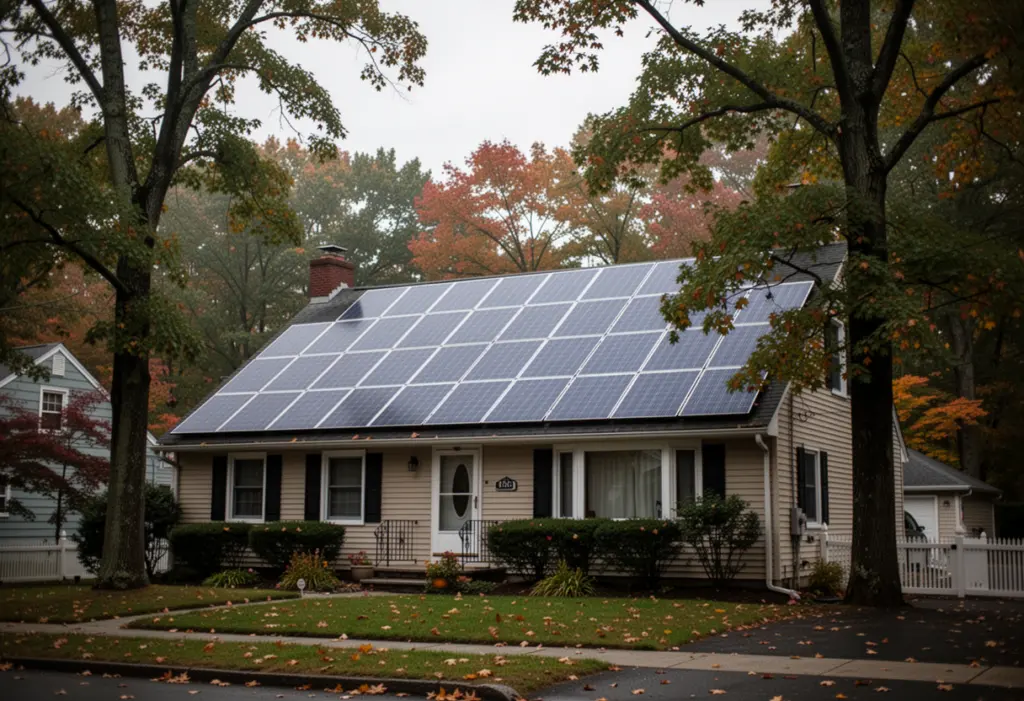
Start with the answer, because it saves a phone call: Orange & Rockland does not pay a residential solar rebate. There is no utility cheque, no bill credit for installing, and no O&R form to fill in. What the utility does is process your interconnection, apply net metering, and bill you a monthly capacity charge afterwards.
Every dollar of incentive in a Rockland County solar proposal comes from somewhere else. Knowing which pot each line came from is the difference between checking a number and accepting one.
Where the money actually is
- NY-Sun. A NYSERDA incentive that, while a block is open, is paid through the contractor as a reduction on the price. You never touch it, and it never arrives as a payment to you. It is structured as megawatt blocks: as each regional block fills, the per-watt figure steps down, and once the last block closes there is nothing to apply. That is where homes stand now: as of September 2026 NYSERDA has no open NY-Sun block for homes in any utility territory; check NYSERDA’s NY-Sun dashboard for a new one.
- Affordable Solar. NYSERDA’s higher per-watt incentive for low- to moderate-income households, also contractor-applied. Its blocks have closed too; the last Upstate one ran from 18 December 2025 to 9 March 2026. If a new one opens, the customer usually has to raise it, because a salesperson who never asks about income will never apply it.
- The New York State credit. 25 percent of qualified solar energy system equipment expenditure, capped at $5,000, claimed by you on Form IT-255. It requires the system to be installed and used at your principal residence in New York. A weekend house on the Hudson does not qualify. It is not refundable, but unused credit carries forward up to five years.
- The state sales tax exemption on residential solar energy systems equipment. Localities may separately elect to exempt their local share, so the total exemption is not identical everywhere.
- RPTL 487, a 15-year real property tax exemption on the added value of the system, available where the city, town or village, the county and the school district have each not opted out. That is three separate checks, not one, and the system must be constructed before 1 January 2030.
Reading a proposal that shows a rebate line
Three questions do most of the work:
- Does the proposal deduct a NY-Sun figure at all? As of September 2026 NYSERDA has no open NY-Sun block for homes in any utility territory, so a 2026 proposal should not. If it does, ask which block it assumes and check NYSERDA’s NY-Sun dashboard; if that block is closed, the net cost on that page is wrong.
- Does the proposal show a 30 percent federal credit? If it does, it is materially wrong for 2026 and the whole document should be re-priced. Section 25D was terminated for expenditures made after 31 December 2025, and an expenditure is treated as made when the original installation is completed.
- Does the state credit line assume the full $5,000? It is limited by your actual New York State tax liability. A household with a small state liability may take several years to use it, or may not use all of it.
The bill is the authority on who your utility is
Orange & Rockland serves Rockland County and parts of Orange and Sullivan. Central Hudson serves other parts of the same two counties, and the boundary does not follow town lines in any way you can guess from a map. Read the utility name printed on your own bill before you rely on any page about O&R, including this one. The CBC rates differ, and so does the interconnection queue.
And if the name on your bill is a village or city electric department rather than an investor-owned utility, none of this applies to you at all. Municipal electric utilities sit outside Public Service Commission jurisdiction: no PSC net metering, no capacity charge, no state interconnection process. Terms are set by the utility itself and you have to ask it directly.
What O&R does charge you
The Customer Benefit Contribution is billed on the DC size of your array rather than on what it produces. For 2026 the O&R residential rate is $1.00 per kW-month. A 7 kW array is therefore $7.00 a month, $84 a year, in every month including the ones where snow keeps production near zero. It applies to systems interconnected on or after 1 January 2022, and it is recalculated annually rather than locked in.
Put that in the arithmetic before you sign rather than finding it on a bill. It is small, but it is permanent, and it scales with a size decision made months earlier.
2026 incentives, foregrounded honestly
For an O&R homeowner buying in 2026, the two contractor-applied levers, NY-Sun and Affordable Solar, are not available: as of September 2026 NYSERDA has no open NY-Sun block for homes in any utility territory; check NYSERDA’s NY-Sun dashboard for a new one. The state credit and the sales tax exemption arrive more or less automatically once the paperwork is right. Programmes change; NYSERDA publishes the current block status and the tax department publishes the current IT-255, and both are worth reading yourself on the day you sign.
Frequently Asked Questions
Does Orange & Rockland offer a solar rebate?
No. O&R does not run a residential solar rebate. Its role is interconnection, net metering and billing the monthly Customer Benefit Contribution. The incentives come from NYSERDA and from New York State tax law.
What incentives can an Orange & Rockland customer actually get in 2026?
The 25% state credit capped at $5,000 on Form IT-255, the state sales tax exemption, and the RPTL 487 exemption on the added value, which needs three separate checks — the municipality, the county and the school district must each not have opted out — for a system constructed before 1 January 2030. NY-Sun and its Affordable Solar incentive are not on the list: as of September 2026 NYSERDA has no open NY-Sun block for homes in any utility territory; check NYSERDA’s NY-Sun dashboard for a new one.
Is the 30% federal solar credit still available?
No. Section 25D was terminated for expenditures made after 31 December 2025, with an expenditure treated as made when the original installation is completed. Any 2026 proposal showing a 30% federal line is materially wrong.
How do I know Orange & Rockland is really my utility?
Read the utility name printed on your electric bill. Central Hudson serves other parts of Orange and Sullivan counties, and municipal electric departments serve some communities outside Public Service Commission rules entirely.
This article is general information, not tax, legal or financial advice. Incentive amounts, eligibility rules and deadlines change and depend on your utility, your tax situation and your property. Confirm current terms with NYSERDA, your utility and a qualified tax professional before making a decision.
NY Solar Incentives
Independent New York solar research. We summarise NYSERDA, NY-Sun and federal programme rules from published sources and state plainly when a figure is an estimate. We are not a government agency and do not sell equipment.
Run the arithmetic on your own system
Check the dated program table and your arrangement before counting an incentive. Standard residential NY-Sun blocks are closed; Long Island Affordable Solar has a conditional income-verification route. The NY credit depends on qualified costs and tax liability, while the NYC abatement reduces future property-tax bills. The estimator keeps those timings separate.