Solar Carports in New York: Cost and Permit Reality
A solar carport costs more than a roof mount because you are buying a structure as well as an array. The permit path reflects that, and so should the quote.
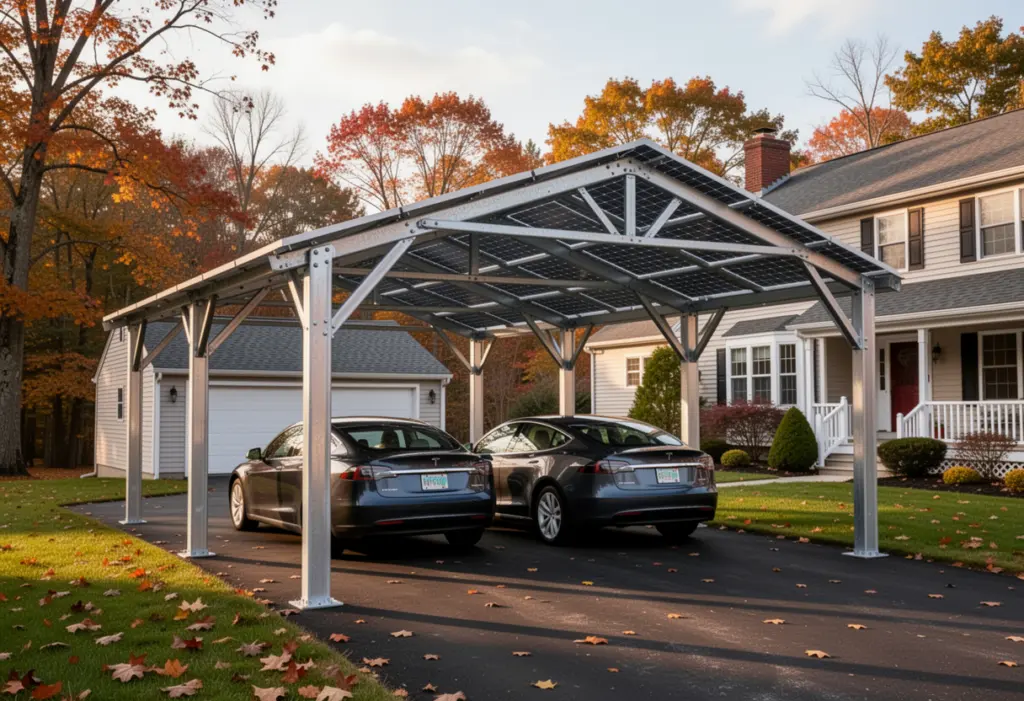
If a New York installer has quoted you a solar carport, the figure is higher than a rooftop quote for a reason that has little to do with the panels: you are buying a building as well as an array. Footings, steel, engineering and a trench across the yard all sit underneath the modules, and every one of them is a line you are entitled to see on its own.
Where the money actually goes
A roof mount borrows a structure that already exists and that somebody else paid for. A carport has to supply its own. That means concrete footings taken below the local frost depth, a frame engineered for New York snow and wind loading, and stamped drawings from an engineer licensed in this state. None of that appears anywhere in a rooftop proposal.
Then the electricity has to travel. A carport sits away from the house, so there is a trench to dig, conduit to lay and a conductor run long enough that voltage drop becomes a design question rather than a footnote. Rock, a driveway to cut and reinstate, or a septic field in the way can each move that number substantially, and none of them are visible from a satellite image.
Ask for the proposal broken into four parts:
- The structure — footings, frame, rails and the engineering behind them.
- The array — modules, inverter or optimisers, racking and wiring.
- The run — trench length, conduit, conductors and any subpanel work at the house.
- The approvals — the authority fees, the electrical inspection and the labour to file.
A single line reading carport installed tells you nothing you can compare, negotiate or check.
The permit path is not the rooftop path
The New York State Unified Solar Permit standardises residential and small commercial solar permitting for systems of 25 kW DC and under, and more than 300 authorities having jurisdiction have adopted it. It does not apply in the five boroughs, where the New York City Department of Buildings runs its own process.
A carport can sit comfortably inside that size limit and still need more, because it is also a new accessory structure on your lot. Before signing, establish:
- Setbacks from the side and rear lot lines, and whether the proposed position clears them.
- Maximum lot coverage, and whether the carport roof counts toward it.
- Whether a variance, site plan review or stormwater review is triggered, how long that adds and who pays for it.
- Whether the property sits in a historic or architectural review district with its own separate approval.
Establish which body issues the permit, by name. A house inside an incorporated village is usually permitted by the village rather than the surrounding town, and a city permits its own. Getting that wrong wastes weeks before anything has even been reviewed.
The monthly charge does not care what the array sits on
The Customer Benefit Contribution is billed on the DC size of the system, on systems interconnected on or after 1 January 2022, regardless of production and regardless of mounting. On a 10 kW carport array that is 10 multiplied by $1.67, or $16.70 a month under Central Hudson — roughly $200 a year — against 10 multiplied by $0.97, or $9.70 a month and about $116 a year, under National Grid. Those rates are recalculated annually and are not fixed at interconnection.
If your electricity comes from a municipal electric utility rather than an investor-owned one, none of this applies: municipal systems sit outside Public Service Commission jurisdiction, so there is no state interconnection process, no Commission net metering and no Customer Benefit Contribution. Confirm the utility name from your own bill rather than from the installer.
The honest case for one
A carport earns its cost when the roof genuinely cannot carry the array — heavy shading, an old covering, an orientation that wastes half the production, slate or standing seam that makes penetrations expensive — or when covered parking has real value to you in its own right. As a route to a lower price per kilowatt it is not one, and a proposal that presents it that way is selling you the structure twice.
What New York still pays in 2026
The 30% federal residential credit is gone. Section 25D was terminated for expenditures made after 31 December 2025, with an expenditure treated as made when the original installation is completed, so any 2026 proposal still showing a 30% federal line is materially wrong. New York State has not followed: the 25% credit capped at $5,000 on Form IT-255 remains for equipment at your principal residence, and the state sales tax exemption on residential solar equipment stands. NY-Sun, which the contractor used to apply as a reduction in the price, is the exception: as of September 2026 NYSERDA has no open NY-Sun block for homes in any utility territory; check NYSERDA’s NY-Sun dashboard for a new one. Because a carport adds a visible structure, ask the assessor about RPTL 487 specifically. It exempts the added value for 15 years where the municipality, the county and the school district have each not opted out, three separate checks, and the system must be constructed before 1 January 2030. Ask a New York tax preparer how the structural portion of the invoice is treated before assuming the whole amount is qualified equipment.
Frequently Asked Questions
Does a solar carport need a building permit in New York?
Expect a building permit and an electrical permit, because a carport is a new accessory structure as well as a solar array. Zoning setbacks and lot coverage are checked too, and in the five boroughs the process runs through the NYC Department of Buildings rather than the Unified Solar Permit.
Why does a carport cost more than a roof mount?
You are paying for a structure the roof would otherwise have provided at no cost — footings below frost depth, an engineered frame and stamped drawings — plus a trench and conductor run from the carport back to the house.
Does the Customer Benefit Contribution apply to a carport array?
Yes. It is billed on DC system size for systems interconnected on or after 1 January 2022, whatever the array is mounted on. A 10 kW array pays about $16.70 a month under Central Hudson and about $9.70 under National Grid at 2026 rates.
Is a solar carport eligible for the New York State credit?
The 25% credit capped at $5,000 on Form IT-255 applies to qualified solar energy system equipment at your principal residence. Ask a New York tax preparer how the structural part of a carport invoice is treated before assuming the whole amount qualifies.
This article is general information, not tax, legal or financial advice. Incentive amounts, eligibility rules and deadlines change and depend on your utility, your tax situation and your property. Confirm current terms with NYSERDA, your utility and a qualified tax professional before making a decision.
NY Solar Incentives
Independent New York solar research. We summarise NYSERDA, NY-Sun and federal programme rules from published sources and state plainly when a figure is an estimate. We are not a government agency and do not sell equipment.
Run the arithmetic on your own system
Check the dated program table and your arrangement before counting an incentive. Standard residential NY-Sun blocks are closed; Long Island Affordable Solar has a conditional income-verification route. The NY credit depends on qualified costs and tax liability, while the NYC abatement reduces future property-tax bills. The estimator keeps those timings separate.