Solar Panel Wattage Explained for New York Homeowners
A 400 watt panel is not better than a 350 watt panel in any way you can bank. What your bill, your incentive and your monthly charge are all built on is total DC kilowatts.
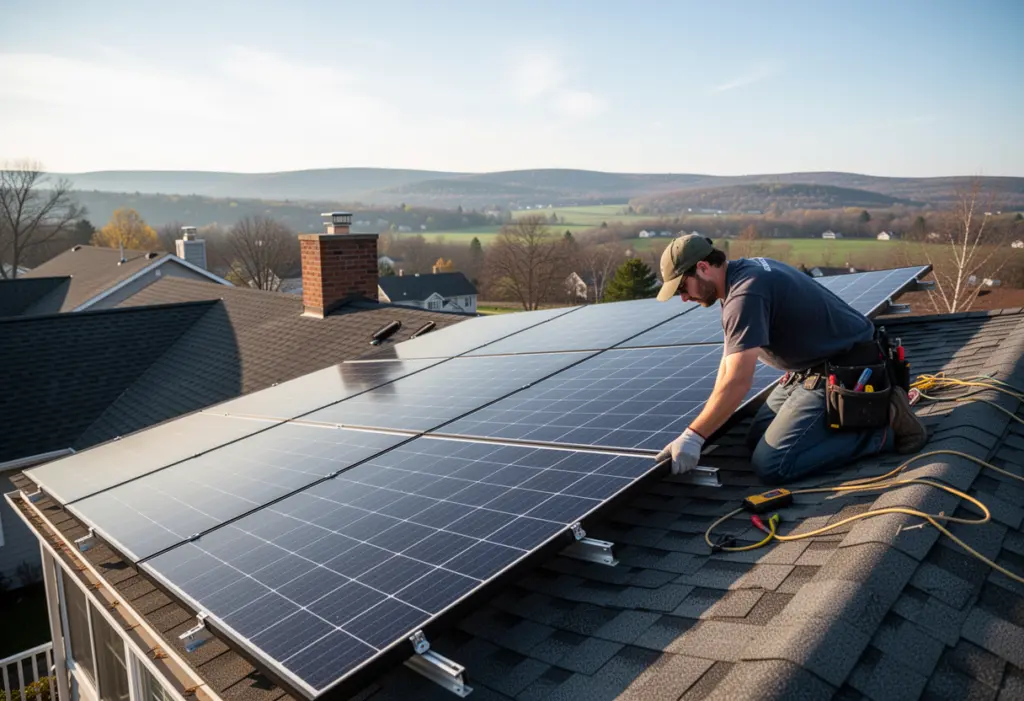
A panel rated at 400 watts is not better than one rated at 350 watts in any way you can bank. What your bill, your incentive and your monthly charges are all built on is the total DC size of the array in kilowatts, and that is simply panel wattage multiplied by panel count and divided by 1,000. Wattage matters mainly because it decides how many panels it takes to reach the kilowatts you need, and therefore how much roof you use getting there.
The arithmetic, once
Twenty-four panels rated at 400 watts each give 9,600 watts, which is 9.6 kilowatts DC. Thirty-two panels rated at 300 watts each give exactly the same 9.6 kilowatts. On the same roof pitch in the same town the two arrays produce broadly the same electricity. What differs is the area they cover, the number of roof penetrations, the length of racking and the labour — and those differences land in the price rather than in the output.
So when a quote leads with a panel wattage, translate it before comparing anything. Ask for the panel count and the DC kilowatt total, then compare quotes on that number and on the price per kilowatt it implies.
DC and AC are different numbers
Your array has two ratings and they are rarely equal. DC size is the sum of the panel nameplates. AC size is what the inverter can deliver into the house. Installers routinely fit more DC than AC deliberately, because panels almost never reach nameplate and a slightly oversized DC array harvests more of the morning and the evening. Push that ratio too far and the inverter clips the peak of the best days.
Both numbers appear on your paperwork and each is used for different things:
- The DC number is what the Customer Benefit Contribution is billed on, and it is the number in the 25 kW DC threshold that defines what the New York State Unified Solar Permit covers for residential and small commercial work. The five boroughs are outside that permit and use the New York City Department of Buildings instead.
- The AC number is what the utility interconnection paperwork and your electrical service are sized around.
What kilowatts cost you every month
The Customer Benefit Contribution is charged per kilowatt of DC size per month, regardless of production, on systems interconnected on or after 1 January 2022. That 9.6 kW array in Orange & Rockland territory pays 9.6 multiplied by $1.00, which is $9.60 a month and $115.20 a year. The identical array on Con Edison pays 9.6 multiplied by $1.29, or $12.38 a month. Rates are recalculated annually rather than fixed at interconnection.
Two consequences follow and neither is obvious from a brochure. First, a bigger array is not free even in the months it produces nothing. Second, if you are served by a municipal electric utility rather than one of the investor-owned utilities, none of this applies — municipal utilities are outside Public Service Commission jurisdiction, so there is no Customer Benefit Contribution, no state net metering rules and no state interconnection process, and you have to ask your own electric department what it offers. Read the name on your bill.
Higher wattage is not automatically the better buy
- Higher-wattage panels are usually physically larger and heavier, which matters far more on a cut-up roof with dormers and valleys than on a clean rectangle.
- Fewer panels means fewer attachments and less rail, which is genuinely cheaper to install and gives fewer places to leak.
- A very new high-wattage model may be hard to match years later if a single panel needs replacing. Ask what happens in that case.
- Efficiency and wattage are not the same claim. Efficiency is output per unit of area, so a physically large panel can be high wattage and unremarkable efficiency at the same time.
The size that is too big
Under Phase One net metering exports are credited at the full retail rate and the arrangement holds for 20 years from interconnection, so covering your annual consumption is straightforward arithmetic. Going well beyond it is not rewarded: you build a credit balance you never consume, you paid for the extra panels, and you pay the monthly capacity charge on them for as long as they sit on the roof. Size to the load you will genuinely have, including a heat pump or an electric vehicle if either is actually coming, and no further.
Where 2026 incentives stand
Almost everything worth having in New York is indexed either to size or to spend, which is exactly why the kilowatt figure is the one to get right. NY-Sun was calculated per watt and applied by your contractor as a reduction in the quoted price, but as of September 2026 NYSERDA has no open NY-Sun block for homes in any utility territory; check NYSERDA’s NY-Sun dashboard for a new one. The state sales tax exemption applies to the residential equipment itself. The New York credit is 25% of qualified expenditure capped at $5,000 on Form IT-255, and it requires the equipment to be installed and used at your principal residence in New York State; the cap means it stops growing once the job passes $20,000 no matter how many kilowatts you add after that. RPTL 487 exempts the added value from property tax for 15 years where the municipality, the county and the school district have each not opted out, and requires construction before 1 January 2030.
The 30% federal residential credit is not on that list. Section 25D was terminated for expenditures made after 31 December 2025 and the operative test is when the original installation is completed, so a 2026 proposal showing a federal line is wrong on its face. Check current NY-Sun block figures with NYSERDA before treating any per-watt number as live.
Frequently Asked Questions
Is a 400 watt panel better than a 350 watt panel?
Not in itself. What matters is the total DC size of the array, which is panel wattage times panel count divided by 1,000. Twenty-four 400 watt panels and thirty-two 300 watt panels are both 9.6 kW.
Why are the DC and AC sizes on my quote different?
DC size is the sum of the panel nameplates; AC size is what the inverter can deliver. Installers fit more DC than AC on purpose, because panels rarely reach nameplate. Too large a ratio clips the best hours.
Which number is my monthly charge based on?
The DC number. The Customer Benefit Contribution is billed per kilowatt of DC size each month regardless of production, so a 9.6 kW array on Orange & Rockland pays 9.6 x $1.00 = $9.60 a month.
How many kilowatts do I actually need?
Enough to cover the annual consumption you will actually have, including a heat pump or EV charger if one is genuinely planned. Beyond that you build credits you never consume and still pay the capacity charge.
This article is general information, not tax, legal or financial advice. Incentive amounts, eligibility rules and deadlines change and depend on your utility, your tax situation and your property. Confirm current terms with NYSERDA, your utility and a qualified tax professional before making a decision.
NY Solar Incentives
Independent New York solar research. We summarise NYSERDA, NY-Sun and federal programme rules from published sources and state plainly when a figure is an estimate. We are not a government agency and do not sell equipment.
Run the arithmetic on your own system
Check the dated program table and your arrangement before counting an incentive. Standard residential NY-Sun blocks are closed; Long Island Affordable Solar has a conditional income-verification route. The NY credit depends on qualified costs and tax liability, while the NYC abatement reduces future property-tax bills. The estimator keeps those timings separate.