Commercial Solar Payback Period in New York: How to Model It
A commercial payback is not a residential one with bigger numbers. Demand charges, the compensation mechanism and a different federal provision decide it.
On this page 7 sections
- 01Start with the federal position, and do not borrow the residential rule
- 02Demand charges are usually why the model is wrong
- 03Which compensation mechanism does the proposal assume
- 04The capacity charge, where the small commercial rates surprise people
- 05Property tax is three separate checks
- 06What to hand whoever builds the model
- 07Frequently Asked Questions
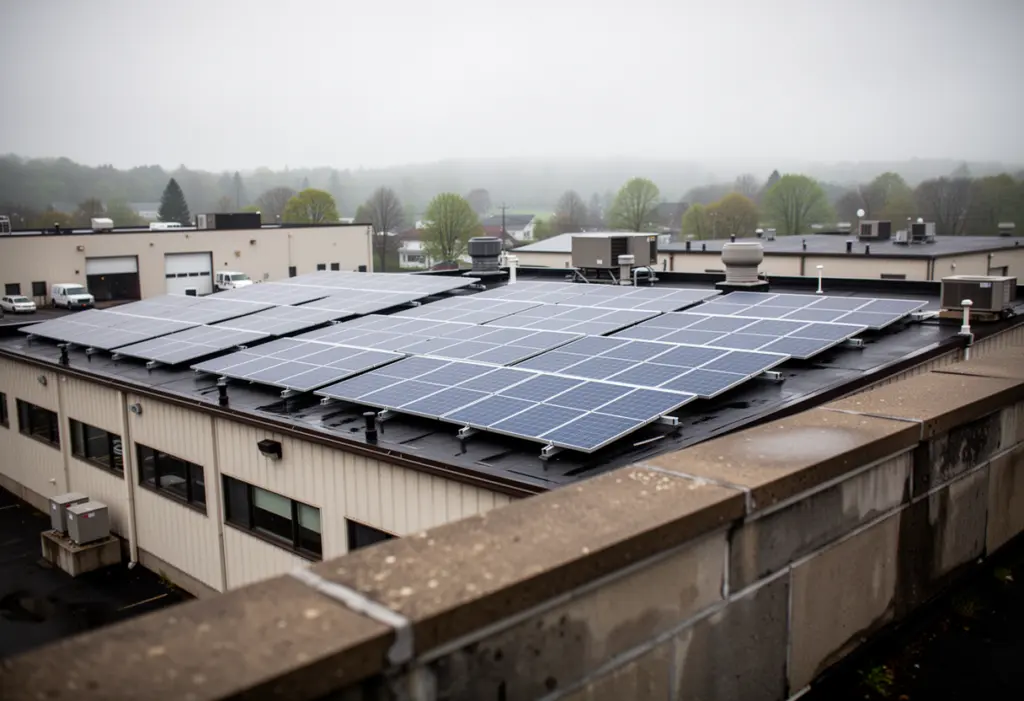
A commercial solar payback in New York is not a residential payback with bigger numbers. The tax treatment is different, the compensation mechanism is frequently different, and on most commercial accounts the bill is shaped by demand charges that solar struggles to touch. If a proposal divides system price by annual kilowatt-hours times a blended rate, it has skipped every part that decides the answer.
Start with the federal position, and do not borrow the residential rule
Section 25D is the residential credit, and it is gone: terminated for expenditures made after 31 December 2025, with an expenditure treated as made when the original installation is completed. Business and farm projects fall under a different provision entirely. Do not read the residential termination across to a commercial project, and do not treat a developer proposal as tax advice. Take the number that goes into your model from your own accountant, in writing, with the provision named.
Demand charges are usually why the model is wrong
Commercial bills typically have two engines: energy, billed per kilowatt-hour, and demand, billed on the highest short interval of power draw in the billing period. Solar reduces energy consistently. It reduces demand only when your peak happens to fall in a sunny hour. A peak set at seven on a January morning, or on an overcast afternoon when a compressor and a chiller start together, is not reduced by the array at all.
So make the request specific: model the savings against twelve months of my interval data, separating energy savings from demand savings, and show the assumed demand reduction as its own line. A payback built on annual kilowatt-hours and a blended cent per kilowatt-hour rate is not a payback. It is an average pretending to be a forecast.
Which compensation mechanism does the proposal assume
Phase One net metering, which credits exports at the full retail rate and holds for 20 years from interconnection, is the mass market residential arrangement. Larger and commercial projects are generally compensated through the Value Stack, also called VDER, which prices exports by component rather than at the retail rate. Those produce materially different revenue over twenty years. Ask the developer in writing which one the model assumes, and on what basis this project qualifies for it.
The capacity charge, where the small commercial rates surprise people
The Customer Benefit Contribution is billed monthly on DC system size for systems interconnected on or after 1 January 2022, and it does not apply to commercial accounts with a demand charge, which is a real exemption for many businesses and worth confirming against your own tariff before it goes into a spreadsheet. Where it does apply, the 2026 small commercial rates for net metered PV are Central Hudson $1.83, Con Edison $1.47, National Grid $1.38, LIPA and PSEG Long Island $1.19, NYSEG $1.14, RG&E $0.96 and Orange & Rockland $0.88.
Note what that list does not do: it does not run parallel to the residential one. Three utilities charge small commercial customers less than residential customers, namely RG&E at $0.96 against $1.31, NYSEG at $1.14 against $1.19, and Orange & Rockland at $0.88 against $1.00. On the Value Stack the small commercial figures are different again, running from Central Hudson at $1.28 down to Orange & Rockland at $0.61, and mass market LIPA projects cannot opt into the Value Stack at all. On a 150 kW DC array a $1.47 rate is $220.50 a month, about $2,646 a year, which is a line in a model rather than a rounding error.
Property tax is three separate checks
RPTL 487 gives a 15-year exemption on the added value of the system, available only where the municipality, the county and the school district have each not opted out. That is three separate enquiries and any one of them can be a no. The system must be constructed before 1 January 2030. In New York City, Buffalo, Rochester, Syracuse and Yonkers there is no separate school district check, because those five school districts are fiscally dependent and levy no separate property tax. Some municipalities that have not opted out will still expect a payment in lieu of taxes agreement, so ask the assessor before the model is finalised rather than after.
What to hand whoever builds the model
- Twelve months of interval data, and the demand history that goes with it.
- Your current tariff and supply arrangement, including whether you buy supply from an ESCO.
- Roof age, remaining roof life and structural capacity, or the site survey if it is a ground mount.
- Any planned load change: refrigeration, electric vehicle charging, a process addition, an expansion.
- Your accountant contact, so that the tax lines are theirs rather than the developer’s.
One more caution: the New York State sales tax exemption is written for residential solar energy systems equipment and does not automatically describe a commercial purchase, and localities elect separately on their own share. Confirm the treatment rather than assuming it into the model. Incentive programmes and rates change annually, so check NYSERDA and the Department of Taxation and Finance for the current position before signing anything.
Frequently Asked Questions
How do I calculate a commercial solar payback in New York?
Model against twelve months of interval data, separate energy savings from demand savings, state which compensation mechanism applies, and take the tax lines from your accountant rather than from the proposal.
Does the residential federal credit apply to my business?
No. Section 25D is the residential credit and it ended for expenditures made after 31 December 2025. Business and farm projects fall under a different provision, so ask your accountant to name it.
Does the Customer Benefit Contribution apply to commercial accounts?
It does not apply to commercial accounts with a demand charge. Where it does apply, 2026 small commercial rates run from $0.88 on Orange and Rockland to $1.83 on Central Hudson.
Can my business get the property tax exemption?
RPTL 487 exempts the added value for 15 years only where the municipality, the county and the school district have each not opted out, and the system must be constructed before 1 January 2030.
This article is general information, not tax, legal or financial advice. Incentive amounts, eligibility rules and deadlines change and depend on your utility, your tax situation and your property. Confirm current terms with NYSERDA, your utility and a qualified tax professional before making a decision.
NY Solar Incentives
Independent New York solar research. We summarise NYSERDA, NY-Sun and federal programme rules from published sources and state plainly when a figure is an estimate. We are not a government agency and do not sell equipment.
Run the arithmetic on your own system
Check the dated program table and your arrangement before counting an incentive. Standard residential NY-Sun blocks are closed; Long Island Affordable Solar has a conditional income-verification route. The NY credit depends on qualified costs and tax liability, while the NYC abatement reduces future property-tax bills. The estimator keeps those timings separate.