RG&E and Battery Storage: What It Changes on Your Bill
On RG&E a home battery buys resilience rather than savings, because the grid is already crediting your exports at the full retail rate.
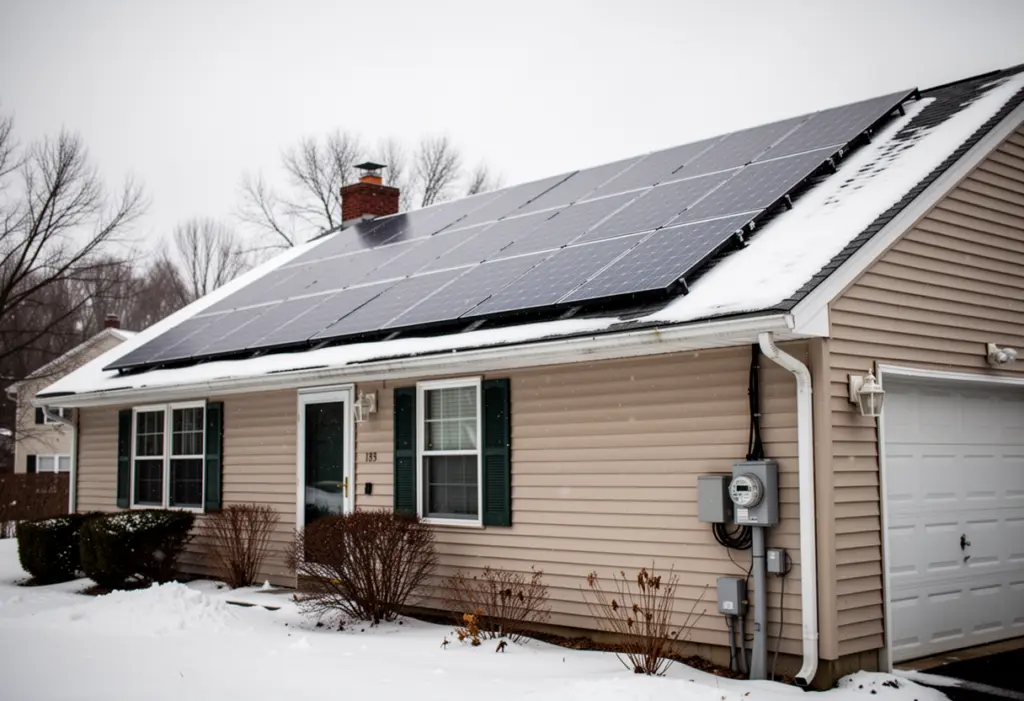
Start with the sentence a battery salesperson will not lead with. On RG&E, a residential rooftop array is almost always on Phase One net metering, which credits exports at the full retail rate and holds that structure for 20 years from interconnection. The grid is already storing your surplus at full value. A battery therefore buys you power during an outage rather than a better return, and the whole decision should be judged on that basis.
What the battery does not change
The Customer Benefit Contribution is billed monthly on the DC size of the solar array, not on the battery and not on what the system produces. It applies to systems interconnected on or after 1 January 2022, and the 2026 residential rate on RG&E is $1.31 per kW-month — the second highest in the state, behind Central Hudson at $1.67 and ahead of Con Edison at $1.29. An 8.5 kW array is 8.5 x $1.31 = $11.14 a month, roughly $134 a year, and adding storage leaves that number exactly where it was.
Two details on that charge are worth knowing before anyone quotes you a monthly saving. Rates are recalculated annually and are not locked in at interconnection, so a figure printed on a proposal is this year’s figure. And RG&E is one of three utilities where the small commercial rate is lower than the residential one, at $0.96 against $1.31, which surprises people who assume the residential rate is always the gentler one.
What it does change, honestly stated
- It keeps selected circuits alive in an outage. A grid-tied array without storage shuts down when the grid fails, so panels alone give you nothing during an ice storm. That is the purchase.
- It changes what has to be designed. A critical loads panel, the placement of the battery, and whether a well pump, a sump pump or medical equipment is on the protected list are the real design conversation.
- It adds equipment with its own warranty terms, usually limited by whichever comes first among years, cycles and total throughput.
- It does not make an oversized array sensible. Credits you never consume are not free — you paid for the panels and you keep paying the capacity charge on them.
Check which utility you are actually on first
RG&E serves Rochester and Monroe County, but not all of it. The villages of Fairport, Spencerport and Churchville run their own municipal electric utilities, and a municipal electric customer sits outside Public Service Commission jurisdiction entirely: no PSC net metering, no Customer Benefit Contribution, and no state interconnection process. Terms there are set by the village utility and must be asked for directly. This is not a technicality — it changes the export credit, the interconnection paperwork and the monthly arithmetic at once, so read the utility name printed on your own bill before applying anything above.
Adding storage to an array you already have
Retrofitting a battery to an existing system is a modification, and it is worth asking RG&E what its current process requires before an installer tells you. Ask specifically whether the work is treated as a change to the existing interconnection or as a new application, and what that means for your net metering position.
There is one nuance for older systems that is easy to get wrong. Systems interconnected before 1 January 2022 are outside the Customer Benefit Contribution, and the current NYSERDA fact sheet states that later expansions to them stay outside it as well. Earlier versions of that same fact sheet said the opposite, and the superseded wording is still widely repeated by industry blogs, so confirm the position against the current document rather than against a search result before assuming an expansion is free of the charge.
The questions that actually decide it
Write down what must keep running and for how long, then ask for the battery sized against that list rather than against the roof. In the Rochester area the outage that matters is usually winter weather, at night, in the cold, which is when a heat pump or resistance backup heat is drawing hardest and when an unheated space is least kind to battery hardware. Ask where the unit is to be mounted and what the manufacturer requires for ambient temperature there.
Then ask for the numbers you can check: modelled production month by month rather than an annual total, the cash price and the financed price for identical equipment in the same document, and what the installer’s labour warranty covers as opposed to the manufacturer’s part warranty.
The 2026 incentive position
There is no federal residential credit to put against any of this. Section 25D was terminated for expenditures made after 31 December 2025, and an expenditure is treated as made when the original installation is completed, so a residential purchase this year claims nothing federally and a proposal still showing a 30 percent line is materially wrong.
What remains is state and local. NY-Sun, which a contractor used to apply as a reduction in the price, is not among them: as of September 2026 NYSERDA has no open NY-Sun block for homes in any utility territory, the Rochester region included, so a NY-Sun figure from an old proposal no longer exists; check NYSERDA’s NY-Sun dashboard for a new one. New York’s credit is 25 percent of qualifying expenditure capped at $5,000 on Form IT-255 for a principal residence, not refundable, limited by the state tax you actually owe and carried forward for up to five years; whether a particular storage installation falls inside that definition is a question for your tax preparer with the invoice in hand. The state sales tax exemption covers residential solar equipment, and RPTL 487 exempts the added value from property tax for 15 years on a system constructed before 1 January 2030, where the municipality, the county and the school district have each separately not opted out. Those are three checks rather than one, opt-outs are local and programme terms move, so confirm with your assessor and with NYSERDA before signing.
Frequently Asked Questions
Does a battery lower my RG&E capacity charge?
No. The Customer Benefit Contribution is billed on the DC size of the solar array rather than on storage or production. An 8.5 kW array is 8.5 x $1.31 = $11.14 a month for 2026 whether or not a battery is installed.
Will a battery save me money on RG&E?
Rarely. Under Phase One net metering exports are credited at the full retail rate for 20 years from interconnection, so the grid already stores your surplus at full value. A battery is bought for outage resilience, not for return.
Do my solar panels work during an outage without a battery?
No. A grid-tied array shuts down when the grid fails so it cannot energise lines crews treat as dead. Storage plus a critical loads panel is what keeps selected circuits alive.
Is everyone in Monroe County served by RG&E?
No. Fairport, Spencerport and Churchville run their own municipal electric utilities, which sit outside Public Service Commission jurisdiction: no PSC net metering, no Customer Benefit Contribution and no state interconnection process. Check your bill.
This article is general information, not tax, legal or financial advice. Incentive amounts, eligibility rules and deadlines change and depend on your utility, your tax situation and your property. Confirm current terms with NYSERDA, your utility and a qualified tax professional before making a decision.
NY Solar Incentives
Independent New York solar research. We summarise NYSERDA, NY-Sun and federal programme rules from published sources and state plainly when a figure is an estimate. We are not a government agency and do not sell equipment.
Run the arithmetic on your own system
Check the dated program table and your arrangement before counting an incentive. Standard residential NY-Sun blocks are closed; Long Island Affordable Solar has a conditional income-verification route. The NY credit depends on qualified costs and tax liability, while the NYC abatement reduces future property-tax bills. The estimator keeps those timings separate.