Solar Panel Cost in Freeport, NY: What Sets the Price
Freeport runs its own electric utility, and that single fact changes more about a solar quote here than any equipment choice on the page.
On this page 6 sections
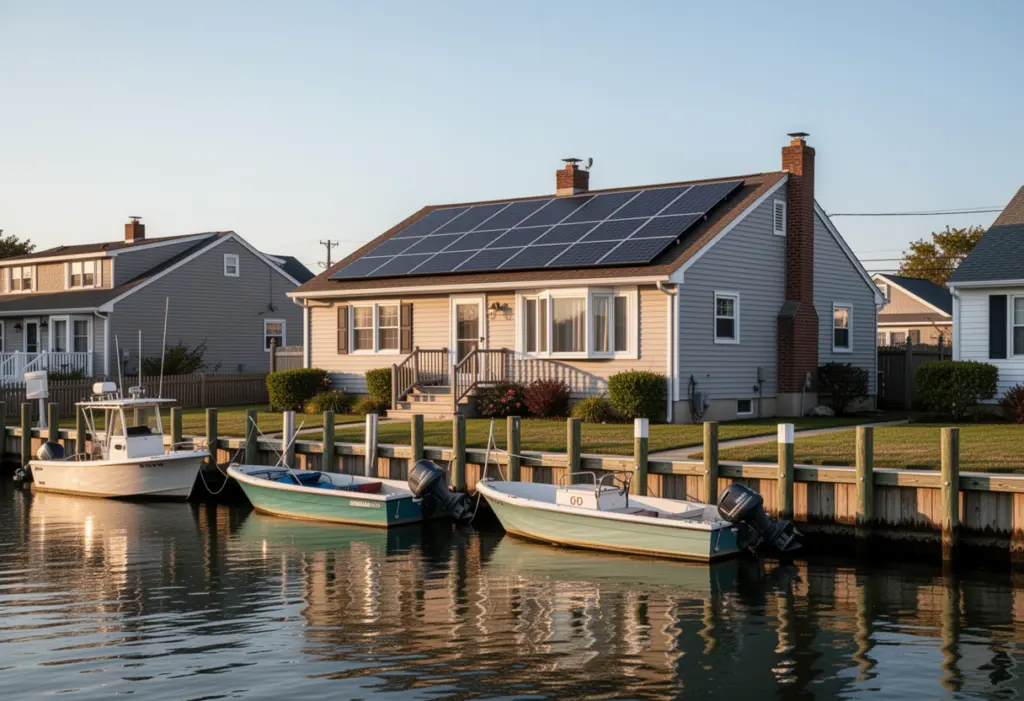
Before comparing a single price in Freeport, settle one question: which utility name is printed on your electricity bill. The Village of Freeport runs its own municipal electric utility, which is why the surrounding Nassau County advice about PSEG Long Island net metering does not describe an 11520 address, and why two neighbours a mile apart can be working under completely different rules.
A municipal electric customer sits outside the state framework
Municipal electric utilities are outside Public Service Commission jurisdiction. In practice that means no PSC net metering, no Customer Benefit Contribution, and no state interconnection process. Terms for connecting a rooftop array, and how exported energy is treated, are set by the utility itself and have to be asked for directly rather than read off a state page.
That is not automatically worse. It is simply different, and it is the first thing to establish in writing, because an installer working mostly in PSEG Long Island territory may quote you a bill saving calculated on rules that do not apply at your address. Ask the village utility for its current interconnection requirements and its treatment of exports, and ask the installer to rebuild the savings estimate on that answer.
It also affects incentive eligibility. Some programmes follow the utility rather than the address, so ask NYSERDA and your contractor specifically whether NY-Sun applies to a Freeport installation before treating an incentive line on a quote as real money.
The village is the authority having jurisdiction
Freeport is an incorporated village inside the Town of Hempstead, so the village building department is the permitting authority for a rooftop array here rather than the town. New York has a Unified Solar Permit for residential and small commercial systems of 25 kW DC and under, developed by NYSERDA with the Department of State and adopted by more than 300 authorities having jurisdiction across the state. Ask your installer whether your job is being filed on that standard form or on a local one, and how long the village review is currently taking. Schedule is not a line item, but on a financed system a delay still costs money.
What actually moves the number on the south shore
- Flood mapping and equipment height. On and near the canals, mapped flood elevations affect where an inverter, a disconnect or a battery can be mounted, and elevated houses change the access and rigging. Ask for the proposed mounting height of every ground-level component in writing.
- Salt air. Corrosion-rated racking, flashing and fasteners are a genuine cost near the water rather than an upsell. Have them named on the equipment list so two quotes are comparable.
- Roof planes and roof age. Much of the housing stock here has modest south and west planes broken by dormers and vents. Fewer usable planes means either fewer panels or panels on a worse orientation, and both change the production estimate the price is justified by.
- Electrical service. A house still on a 100 amp service may need an upgrade before a solar breaker, and it should be priced before you compare proposals rather than discovered between them.
The arithmetic to ask for instead of a headline saving
Because the state capacity charge does not apply to a municipal utility customer, the monthly comparison here is simpler than in most of New York — and it depends entirely on the village utility’s own tariff. Ask three numbers: what a kilowatt-hour costs you today, what the utility credits for exported energy, and what fixed charges remain on the account after an array is installed. Two of those three are frequently missing from a proposal, and a saving calculated without them is not a saving, it is an assumption.
Then ask for production by month rather than as an annual total. A south shore roof with afternoon shade from a neighbouring house or a mature street tree produces its shortfall in the months you use most.
What is available in 2026, and what is not
The New York State credit is a tax matter rather than a utility one, so it reaches an 11520 address on the same terms as anywhere else in the state: 25 percent of qualifying expenditure, capped at $5,000, claimed on Form IT-255 for equipment at your principal residence, not refundable, limited by the state tax you actually owe and carried forward up to five years. Leases and power purchase agreements of ten years or more also qualify, with the ten-year minimum applying to the lease as well as the PPA. The state sales tax exemption covers residential solar equipment.
Property tax is the other one worth chasing locally. RPTL 487 exempts the added value of the system for 15 years, and it requires construction before 1 January 2030. The opt-out is local and there are three separate ones to check — the village or town, the county and the school district may each have opted out independently — so ask your assessor which of the three apply at your address. And the 30 percent federal residential credit is gone: section 25D was terminated for expenditures made after 31 December 2025, with an expenditure treated as made when the original installation is completed, so any 2026 proposal still showing a federal line is materially wrong. Confirm all of it at source before signing, because incentives and utility tariffs both move.
Frequently Asked Questions
Which utility serves Freeport?
The Village of Freeport runs its own municipal electric utility, so a Freeport address is not PSEG Long Island. Confirm from the utility name printed on your own bill before applying any advice written for PSEG customers.
Do I pay the Customer Benefit Contribution in Freeport?
Municipal electric utilities sit outside Public Service Commission jurisdiction, which means no PSC net metering, no Customer Benefit Contribution and no state interconnection process. The village utility sets its own terms, so ask it directly.
Who issues the solar permit in Freeport?
Freeport is an incorporated village inside the Town of Hempstead, so the village building department is the authority having jurisdiction. Ask whether your job is filed on the state Unified Solar Permit form or a local one.
Can I still claim the New York State solar credit here?
Yes. The state credit is a tax matter rather than a utility one: 25 percent of qualifying expenditure capped at $5,000 on Form IT-255 for a principal residence, limited by the state tax you owe and carried forward up to five years.
This article is general information, not tax, legal or financial advice. Incentive amounts, eligibility rules and deadlines change and depend on your utility, your tax situation and your property. Confirm current terms with NYSERDA, your utility and a qualified tax professional before making a decision.
NY Solar Incentives
Independent New York solar research. We summarise NYSERDA, NY-Sun and federal programme rules from published sources and state plainly when a figure is an estimate. We are not a government agency and do not sell equipment.
Run the arithmetic on your own system
Check the dated program table and your arrangement before counting an incentive. Standard residential NY-Sun blocks are closed; Long Island Affordable Solar has a conditional income-verification route. The NY credit depends on qualified costs and tax liability, while the NYC abatement reduces future property-tax bills. The estimator keeps those timings separate.