Solar for a Condo Building in New York: Who Decides
On a condominium the roof is a common element, so solar is an association project rather than a unit owner one, and the electricity rarely reaches your own meter.
On this page 8 sections
- 01Who controls the roof
- 02The metering question decides what the array is worth
- 03What the association pays every month
- 04Tax questions the board cannot answer for you
- 05Property tax, and the extra layer inside New York City
- 06What a unit owner can do without the board
- 07Questions to put to the board in writing
- 08Frequently Asked Questions
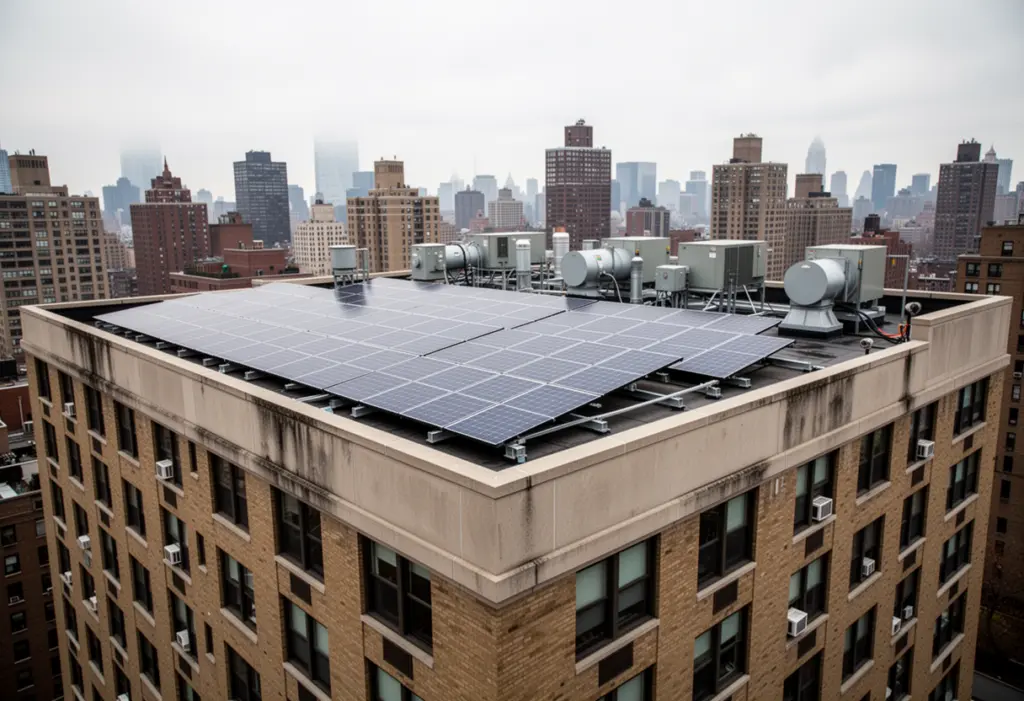
The short answer: on a condominium the roof is almost always a common element controlled by the board, so a rooftop array is an association project rather than a unit owner project. And even once it is built, the electricity it produces usually cannot reach your own meter. For most individual condo owners in New York the realistic route to a lower bill is community solar, which needs neither a roof nor a vote.
Who controls the roof
Read the declaration and the bylaws before anything else happens. Between them they establish who owns the roof surface, what majority the board needs to authorise work on a common element, whether a licence or easement to a third party is permitted at all, and whether a capital project of this size triggers a unit owner vote or a reserve study. A single owner cannot grant roof access to an installer, and an installer who suggests otherwise has told you something useful about the rest of their process.
The second document to pull is the roof warranty. Penetrations made by anyone other than the original roofer can void it, and a membrane with six years left on it should be re-roofed before an array is fixed on top of it, not after. Removing and reinstalling an array to replace a roof is a cost the association will meet twice.
The metering question decides what the array is worth
Most New York condominiums meter units individually: your own account, your own bill, your own utility relationship. An array wired into the building’s common account offsets common electricity, which means hallway and stair lighting, the elevator, circulation pumps, garage ventilation and the lobby. The saving lands in the operating budget and shows up as pressure off common charges. That can be a sound project. It is not the same thing as putting solar on your own meter, and it is frequently presented as though it were.
Ask the installer to write down which meter the system connects to and what appears on an individual owner’s bill in month one. If the answer is nothing, that is not a reason to abandon the project, but it is a reason to stop describing it to owners as solar for their apartments.
What the association pays every month
The Customer Benefit Contribution is charged on the DC size of the system rather than on what it generates, and which rate applies depends on the service class of the account the array is wired into. At the 2026 residential rate a 20 kW array in Con Edison territory is 20 × $1.29, so $25.80 a month and $309.60 across the year, and $19.40 a month under National Grid. Where the common-element account is billed as small commercial the figure is that utility small commercial rate instead, $1.47 per kW-month on Con Edison and $1.38 on National Grid, and a commercial account that already carries a demand charge sits outside the contribution altogether. Establish the service class on the meter before any number goes into the budget. The charge applies to systems interconnected on or after 1 January 2022, the rates are recalculated annually, and it belongs in the operating budget from the first month rather than as a footnote to the payback model.
Tax questions the board cannot answer for you
New York’s 25 percent credit, capped at $5,000 on Form IT-255, requires the equipment to be installed and used at the taxpayer’s principal residence and requires the expenditure to be the taxpayer’s own. Where the association owns and pays for the system through common charges, the relationship between that spending and an individual owner’s return is a question for an accountant who can read the declaration. Do not take it from a sales deck, and do not let one owner’s answer become the answer circulated to the whole building.
The federal position is simpler and worse. The 30 percent residential credit under section 25D ended for expenditures made after 31 December 2025, with an expenditure treated as made when the original installation is completed. Any board presentation still carrying it is out of date and its net cost per unit is overstated.
Property tax, and the extra layer inside New York City
RPTL 487 exempts the added value of the system for fifteen years where the municipality, the county and the school district have each declined to opt out, and only for a system constructed before 1 January 2030. It is not restricted to areas outside New York City: the city administers it as the Clean Energy Systems Exemption on form RP-487, preceded by a Notice of Intent to Construct. Inside the five boroughs there is no separate school district check, because the city school district is fiscally dependent and levies no separate property tax. The Title 4-C abatement, filed on form PTA4 with the Department of Buildings across a four-year compliance period, sits on top of section 487 rather than replacing it.
What a unit owner can do without the board
Subscribe to community solar. A share of an off-site project produces credits that land on your own utility bill, with no equipment, no roof and no vote. Front-of-the-meter projects such as community solar pay no Customer Benefit Contribution, and subscribers pay none either. Before signing, check the notice period for cancellation, whether the discount applies to the credit or to the whole bill, what happens if your consumption drops, and what happens when you sell the unit.
Questions to put to the board in writing
- Which meter does the proposed system serve, and what changes on an individual owner’s bill?
- What is the remaining life of the roof membrane, and who carries its warranty after penetrations?
- What monthly capacity charge does the array carry at our utility’s 2026 rate?
- Has the NY-Sun incentive been shown as its own line, or folded into a discounted price?
- Have the municipality, the county and the school district each been checked separately for an opt-out from the fifteen-year property tax exemption?
NY-Sun money is applied by the contractor rather than claimed by the building, so its size should be visible in the bid comparison rather than inferred from a bottom line. Incentive levels step down as regional capacity blocks fill and the capacity charge is reset each year, so confirm both at NYSERDA on the day the board votes rather than on the day the proposal was drafted.
Frequently Asked Questions
Can I put solar on my own condo unit?
Usually not. The roof is a common element controlled by the board under the declaration and bylaws, so an array is an association project. A single owner cannot grant an installer access to a common element.
Will a building array lower my electric bill?
Generally no, if units are metered individually. A common-element array offsets the building's own account, so the saving reaches you as pressure off common charges rather than as a change on your own bill.
What does the association pay every month?
The Customer Benefit Contribution, charged on DC system size regardless of output. A 20 kW array is $25.80 a month on Con Edison and $19.40 on National Grid at 2026 residential rates. If the common account is billed as small commercial the rates are $1.47 and $1.38 per kW-month instead, and an account carrying a demand charge is outside the charge.
What can a condo owner do alone?
Subscribe to community solar. Credits land on your own utility bill with no roof, no equipment and no board vote, and community solar subscribers pay no Customer Benefit Contribution. Check the cancellation notice period before signing.
This article is general information, not tax, legal or financial advice. Incentive amounts, eligibility rules and deadlines change and depend on your utility, your tax situation and your property. Confirm current terms with NYSERDA, your utility and a qualified tax professional before making a decision.
NY Solar Incentives
Independent New York solar research. We summarise NYSERDA, NY-Sun and federal programme rules from published sources and state plainly when a figure is an estimate. We are not a government agency and do not sell equipment.
Run the arithmetic on your own system
Check the dated program table and your arrangement before counting an incentive. Standard residential NY-Sun blocks are closed; Long Island Affordable Solar has a conditional income-verification route. The NY credit depends on qualified costs and tax liability, while the NYC abatement reduces future property-tax bills. The estimator keeps those timings separate.