Solar Panel Cost in Long Beach, NY: Flood Zone and Salt Air
Long Beach is a city on a barrier island, so equipment height, corrosion-rated hardware and who owns the roof all move the price before panels are even discussed.
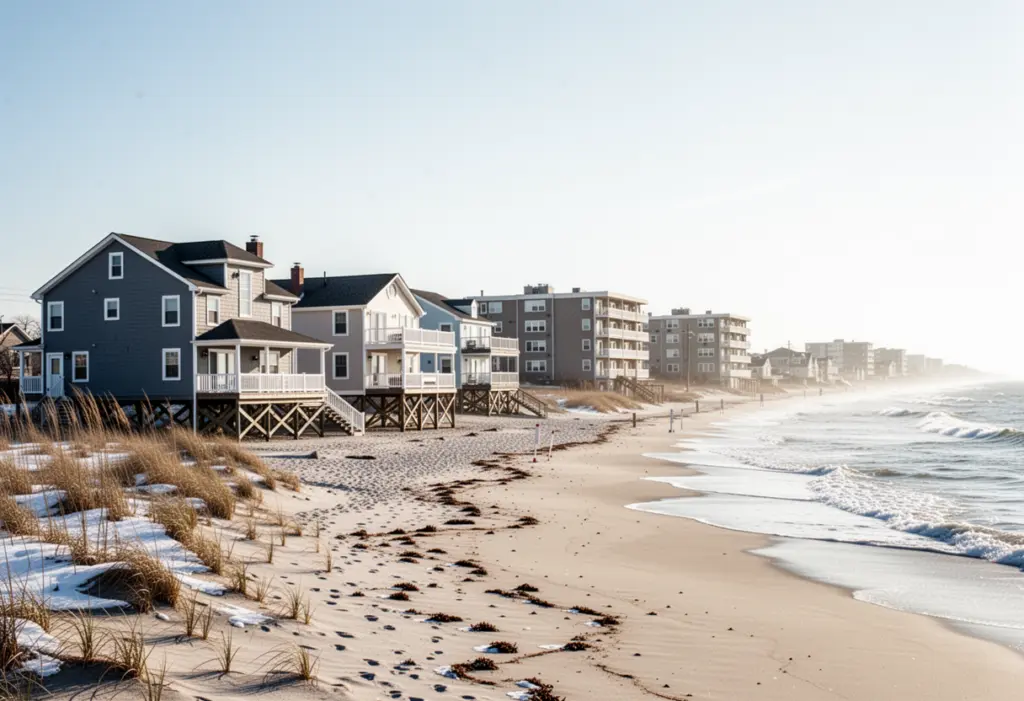
Long Beach is a city, not a town or a village, so the city building department is the authority having jurisdiction inside the city limits. That is unusually simple compared with the rest of Nassau County, with one catch worth settling before you compare quotes: the 11561 postal area also covers Lido Beach, which is unincorporated Town of Hempstead rather than City of Long Beach, and further along the same barrier island sit Point Lookout in the town and the incorporated Village of Atlantic Beach. A shared ZIP code is not proof of a shared building department. Almost everything else about solar here is more complicated than the mainland, and it is complicated in ways that cost money.
Elevation is a design constraint, not a formality
Mapped flood elevation governs where electrical equipment may be mounted. Inverters, disconnects, meter equipment and any battery need to sit above the relevant elevation, which in practice means brackets, a wall location that may not be the convenient one, and sometimes a rerouted conduit run. None of that is optional and none of it is expensive as an idea, but it is labour, and it is a legitimate reason for a Long Beach quote to exceed one from ten miles inland for identical panels.
Ask for the proposed mounting height of every piece of ground-adjacent equipment to be shown on the plan set before you sign, rather than agreed with the crew on the day.
Salt air changes the hardware list
- Racking and fasteners. Marine exposure argues for corrosion-rated components throughout. Ask for the specific racking series and fastener material to be named on the equipment list.
- Roof penetrations and flashing. Wind-driven rain here is relentless. The flashing detail is worth more attention than the panel model.
- Wind loading. An oceanfront roof faces a different design wind speed than an inland one, which affects attachment spacing and therefore labour hours.
One thing you can stop worrying about: routine paid cleaning of a pitched, rain-washed array is rarely worth buying here. Salt film is a real phenomenon but rain does most of the work on a sloped roof, and a cleaning contract is usually a better deal for the seller than for you. Monitor production and act on a measured drop rather than a schedule.
Who owns the roof
Long Beach has a high proportion of two-family houses, rentals, co-operative and condominium buildings. If the roof is common property, the decision belongs to the board and the array serves a common meter, not your unit. If you own a two-family house, establish which meter the system will be connected to, because net metering credits that account alone. These are questions to settle before any site survey, not after.
The utility charge on the island
Long Beach is served by PSEG Long Island, operator of the LIPA system, which the name on your own bill will confirm. The Customer Benefit Contribution is billed on the DC size of the array rather than on production. At the 2026 residential rate of $1.13 per kW-month, a 5.5 kW system sized for a compact house pays 5.5 x $1.13 = $6.22 a month, roughly $75 a year. It applies to systems interconnected on or after 1 January 2022 and is recalculated each year. Exports are credited at the full retail rate under Phase One net metering for 20 years from interconnection.
The property tax check that catches people out here
RPTL 487 exempts the added value of the system for 15 years, subject to three separate opt-out checks. In a city the instinct is to assume the school levy is bundled in, but that shortcut only holds for the five fiscally dependent big city school districts, which are New York City, Buffalo, Rochester, Syracuse and Yonkers. Long Beach is not one of them, so its school district is a separate taxing authority and a separate check, alongside Nassau County and the city itself. The exemption also requires construction before 1 January 2030.
What 2026 leaves you
The state credit of 25 percent capped at $5,000 on Form IT-255 is available for a principal residence, which rules out a Long Beach property held as a summer or second home. Residential solar equipment is exempt from state sales tax with local shares elected separately. NY-Sun no longer reduces the price here: the last Long Island residential block closed on 17 April 2016. As of September 2026 NYSERDA has no open NY-Sun block for homes in any utility territory; check NYSERDA’s NY-Sun dashboard for a new one. The 30 percent federal residential credit is gone for anyone completing an installation after 31 December 2025, section 25D having been terminated on that basis. Confirm all of it at tax.ny.gov and nyserda.ny.gov before signing, because incentive rules change without warning to the person holding the proposal.
Frequently Asked Questions
Who permits solar in Long Beach?
Inside the city limits, the city building department, with no town or village layer to identify first. Note that the 11561 postal area also covers Lido Beach, which is Town of Hempstead, so the ZIP code alone does not settle it.
Why does a Long Beach quote cost more than an inland one?
Flood elevation dictates where inverters, disconnects and batteries can be mounted, and marine exposure argues for corrosion-rated racking and fasteners. Both are labour and hardware, not padding.
Is a cleaning contract worth it near the ocean?
Rarely on a pitched roof. Rain does most of the work on a sloped array, so monitor production and act on a measured drop rather than paying for a routine schedule.
Does the Long Beach school district need a separate exemption check?
Yes. Only the five fiscally dependent big city districts, New York City, Buffalo, Rochester, Syracuse and Yonkers, levy no separate school tax. Long Beach is not among them, so check the district as well as the county and city.
This article is general information, not tax, legal or financial advice. Incentive amounts, eligibility rules and deadlines change and depend on your utility, your tax situation and your property. Confirm current terms with NYSERDA, your utility and a qualified tax professional before making a decision.
NY Solar Incentives
Independent New York solar research. We summarise NYSERDA, NY-Sun and federal programme rules from published sources and state plainly when a figure is an estimate. We are not a government agency and do not sell equipment.
Run the arithmetic on your own system
Check the dated program table and your arrangement before counting an incentive. Standard residential NY-Sun blocks are closed; Long Island Affordable Solar has a conditional income-verification route. The NY credit depends on qualified costs and tax liability, while the NYC abatement reduces future property-tax bills. The estimator keeps those timings separate.