Solar Panel Installation in Long Beach, NY
Long Beach is a barrier island city. Wind, salt and flood elevation all matter more here than anywhere else in Nassau County.
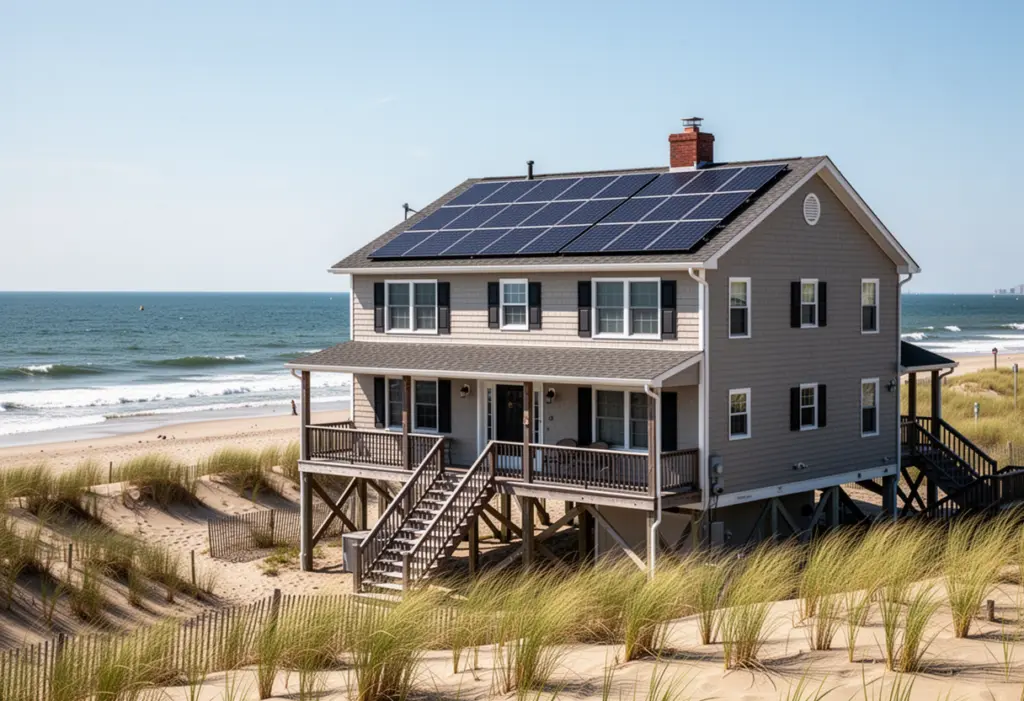
Long Beach is a city on a barrier island off the south shore of Nassau County. ZIP code 11561. Everything about a solar installation here is shaped by being on a sandbar in the Atlantic.
Wind is the dominant design factor
Nowhere in Nassau County has more exposure. Racking and attachment must be specified for the local wind zone, and on a barrier island that specification is materially more demanding than inland.
Ask two things and get them in writing: what wind load is this system designed to, and who confirmed the roof attachment can carry it. An installer who answers the first and not the second has done half the work.
Salt
Ocean air is corrosive, and it affects mounting hardware, fasteners and the enclosure ratings on any equipment mounted outdoors. Ask what is specified and why. This is a genuine specification question here rather than a detail, and it is one where the cheapest hardware is not the right hardware.
Flood elevation
Much of the city sits in mapped flood zones, and a great deal of the housing has been raised or rebuilt since 2012. That affects where the inverter, disconnects and any battery may be mounted, how conduit is run on a raised house, and where the service equipment sits.
This is a design question rather than a detail. Raise it explicitly at the quoting stage, and prefer an installer who has done work in the city since the rebuilding.
Roof types
Long Beach housing is mixed — raised single-family houses, semi-attached homes, and a great many multi-family and co-op buildings with flat roofs.
On a flat roof, the array is ballasted or penetrating and almost always tilted, which means row spacing and therefore less capacity per square metre than the bare area suggests. Ballast adds dead load, and whether the roof can carry it is a structural question for an engineer.
If you live in a co-op or condominium, the roof is common property and solar is a board decision rather than a right — the protection New York law gives against a homeowners association obstructing solar applies to property the homeowner owns, and in a co-op the roof is not that.
The utility position
Phase One net metering credits exports at the full retail rate and holds for 20 years from interconnection. The Customer Benefit Contribution is $1.13 per kW-month of DC system size for LIPA in 2026 — about $9.04 a month on an 8 kW system. Billed on capacity regardless of production and recalculated annually. Mass-market LIPA projects cannot opt into the Value Stack.
Permits
The City of Long Beach issues its own building permits and inspects the work — it is a city, not part of a town, which is a distinction worth knowing when an installer talks about town processes.
2026 incentives
The 30% federal residential credit has ended — section 25D was terminated for expenditures made after 31 December 2025, with an expenditure treated as made when the original installation is completed.
Still available: New York’s 25% credit capped at $5,000 on Form IT-255, reaching leases and PPAs of ten years or more as well as purchases; the state sales tax exemption; and RPTL 487’s 15-year property tax exemption where the city, Nassau County and your school district have not opted out. The RPTL 487 exemption is not automatic: file form RP-487 with your assessor by the taxable status date (March 1 in most towns; January 2 in Nassau towns; May 1 or June 1 in Westchester towns; set by charter in cities; usually January 1 in villages), and the system must be built before January 1, 2030 (RP-487 instructions).
NY-Sun is not on that list. Long Island’s last standard residential block closed in April 2016, and as of September 2026 NYSERDA has no open NY-Sun block for homes in any utility territory. Check NYSERDA’s NY-Sun dashboard for a new one. NYSERDA’s April 2026 NY-Sun Program Manual still lists one home incentive on Long Island that is not tied to a block: the Affordable Solar Residential Incentive of $0.40 per watt for income-qualified homeowners, paid to a participating NY-Sun contractor, who must pass it on in your contract. Ask the contractor to confirm funding is still available.
For co-op residents and renters, community solar needs no roof and no board approval, and its subscribers pay no Customer Benefit Contribution at all.
Frequently Asked Questions
Does barrier island exposure change a solar installation?
Considerably. Wind is the dominant design factor and the specification is materially more demanding than inland, salt air affects mounting hardware and outdoor enclosure ratings, and flood elevation affects where equipment may be mounted.
Who issues a solar permit in Long Beach?
The City of Long Beach issues its own building permits and inspects the work. It is a city rather than part of a town, which is worth knowing when an installer describes town processes.
Can I install solar if I live in a Long Beach co-op?
The roof is common property, so it is a board decision rather than a right — the protection New York law gives against a homeowners association obstructing solar applies to property the homeowner owns. Community solar needs no roof or board approval.
Why does a flat roof fit fewer panels?
Tilted rows shade the row behind them at low sun angles, so they must be spaced apart, and the array fits less capacity per square metre than the bare area suggests. Ballast also adds dead load, which is a structural question for an engineer.
This article is general information, not tax, legal or financial advice. Incentive amounts, eligibility rules and deadlines change and depend on your utility, your tax situation and your property. Confirm current terms with NYSERDA, your utility and a qualified tax professional before making a decision.
NY Solar Incentives
Independent New York solar research. We summarise NYSERDA, NY-Sun and federal programme rules from published sources and state plainly when a figure is an estimate. We are not a government agency and do not sell equipment.
Run the arithmetic on your own system
Check the dated program table and your arrangement before counting an incentive. Standard residential NY-Sun blocks are closed; Long Island Affordable Solar has a conditional income-verification route. The NY credit depends on qualified costs and tax liability, while the NYC abatement reduces future property-tax bills. The estimator keeps those timings separate.