Your RG&E Bill After Solar, Line by Line
The first RG&E bill after switch-on confuses almost everyone. Here is which line is the credit, which one is new, and which one never goes away.
On this page 8 sections
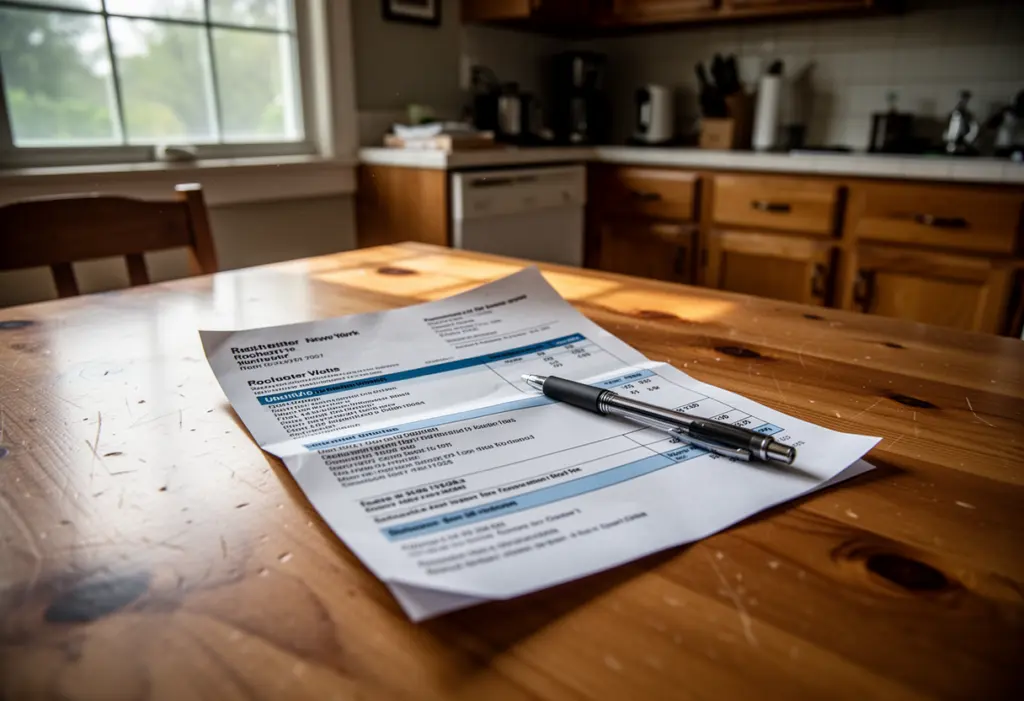
The first RG&E bill after permission to operate is where most Rochester homeowners discover what they actually bought. It is rarely zero, it usually covers an odd partial period, and it contains at least one line that was never mentioned during the sale. Read it in four parts.
1. The charge that never goes away
Every account carries a fixed charge for being connected, and solar does not remove it. You are still using the network — every night, every still winter week, and every time the array produces less than the house consumes. A homeowner who was sold on eliminating the bill will read this line as an error. It is not. The honest framing is that solar reduces the electricity you buy, not the cost of the connection you rely on.
2. Delivery, supply, and where the credit lands
The bill separates what you pay to move electricity from what you pay for the electricity itself. This matters because Phase One net metering credits your exports at the full retail rate — the whole rate, not the supply portion alone — and a system interconnected today holds that structure for 20 years. That single mechanism is what makes rooftop solar work in New York, and it is why a battery in this state is a resilience purchase rather than an economic one: exports already bank at full value without one.
If you buy your supply from an energy services company rather than from RG&E, read both sections carefully, because the crediting mechanics can differ and the two suppliers are settled separately. And if a proposal quoted you compensation under the Value Stack, ask why: that structure is for community distributed generation and larger or commercial projects, not for a mass-market residential roof.
3. The banked credit balance
Look for a running balance of kilowatt-hours carried forward. It builds through May, June and July, when the array makes far more than the house uses, and it drains through the short grey Rochester winter. That seasonal swing is normal and it is the whole design — judging a system on a January bill is like judging a savings account on the day you make a withdrawal.
The uncomfortable corollary: because the arrangement reconciles annually, a surplus you never consume is not converted into money at the retail rate. An array oversized beyond your consumption builds a balance that quietly expires, while you keep paying for the capacity that built it.
4. The line billed on system size
The Customer Benefit Contribution is charged on the DC size of the array rather than on anything the array produced, which is why it does not fall in a cloudy month. It applies to systems interconnected on or after 1 January 2022, and it funds public benefit programmes such as low income assistance, energy efficiency and clean energy.
For 2026 the RG&E residential rate is $1.31 per kW-month. A 7.5 kW system therefore carries $9.83 a month, roughly $118 over a year. Two things follow. Rates are recalculated annually and are not locked in at interconnection, so a modest change in January is a rate revision rather than a billing mistake. And the charge scales with what you installed, so a system sized above your consumption is paying twice — once in the purchase and again every month.
Several accounts do not see the charge at all. Systems interconnected before 1 January 2022 are outside it, and the current version of the NYSERDA fact sheet also places later expansions to those systems outside it — a point worth attributing to the current version, because earlier versions of the same document said the opposite and that superseded text is still widely repeated. Front-of-the-meter projects such as community solar carry no Customer Benefit Contribution, and neither do commercial accounts with a demand charge. If you also hold a community solar subscription, its credit appears on this same bill.
Reading the first bill specifically
- Check the period. The first bill after permission to operate usually spans a partial cycle, so comparing it to a full month before solar tells you nothing.
- Check the meter reading type. An estimated read will correct itself on the next actual read, and an estimate on a solar account can look alarming in either direction.
- Compare the bill to the app, then trust the bill. The monitoring app reports what the panels made; the bill reports what the utility measured and credited. Where they disagree, the bill is what you pay.
- Confirm the DC size used for the charge matches the system on your contract. It is a small check and it is worth doing once.
If your bill does not come from RG&E
RG&E serves Rochester and Monroe County, but three villages in the county — Fairport, Spencerport and Churchville — run their own municipal electric utilities. Those customers are outside Public Service Commission jurisdiction, so none of the crediting rules or charges described here apply, and the terms have to be requested from that utility directly. The name printed on the bill in front of you is the only reliable test.
What the bill does not show you
None of the incentives appear on it. NY-Sun, on a system that received it, was applied by the contractor as a reduction on the contract price, so it was settled before you ever received a bill, and the Affordable Solar incentive for households under 80% of area median income worked the same way. Neither is open to a new buyer: as of September 2026 NYSERDA has no open NY-Sun block for homes in any utility territory; check NYSERDA’s NY-Sun dashboard for a new one. The New York State credit of 25% capped at $5,000 is claimed on Form IT-255 with your income tax return, at a principal residence, non-refundable and carried forward up to five years. RPTL 487’s property tax exemption shows up on a property tax bill rather than an electric one, and only where Monroe County, your municipality and your school district have each not opted out, on a system constructed before 1 January 2030. Inside the City of Rochester the school question does not arise, because Rochester is one of the Big Five districts that levies no separate property tax. And the federal residential credit is simply gone — section 25D ended for expenditures made after 31 December 2025, with completion of the original installation as the test. Programme terms move each year, so check the current position with NYSERDA and the New York State Department of Taxation and Finance rather than relying on last season’s paperwork.
Frequently Asked Questions
Why is my RG&E bill not zero after installing solar?
A fixed charge for being connected remains regardless of production, and systems interconnected on or after 1 January 2022 also carry the Customer Benefit Contribution. Solar reduces the electricity you buy rather than the cost of the connection itself.
What is the extra solar line on my RG&E bill?
The Customer Benefit Contribution, billed on the DC size of the array rather than on production. For 2026 the RG&E residential rate is $1.31 per kW-month, so a 7.5 kW system pays $9.83 a month, about $118 a year.
What is the credit balance on my bill?
Banked net metering credits, in kilowatt-hours. Under Phase One net metering exports are credited at the full retail rate, so the balance builds through summer and drains through winter. It reconciles annually, so an unused surplus is not paid out at retail value.
My bill looks wrong in the first month — what should I check?
Check whether the period is partial, whether the read was estimated rather than actual, and whether the DC system size used for the capacity charge matches your contract. Compare the bill against the monitoring app, and trust the bill.
This article is general information, not tax, legal or financial advice. Incentive amounts, eligibility rules and deadlines change and depend on your utility, your tax situation and your property. Confirm current terms with NYSERDA, your utility and a qualified tax professional before making a decision.
NY Solar Incentives
Independent New York solar research. We summarise NYSERDA, NY-Sun and federal programme rules from published sources and state plainly when a figure is an estimate. We are not a government agency and do not sell equipment.
Run the arithmetic on your own system
Check the dated program table and your arrangement before counting an incentive. Standard residential NY-Sun blocks are closed; Long Island Affordable Solar has a conditional income-verification route. The NY credit depends on qualified costs and tax liability, while the NYC abatement reduces future property-tax bills. The estimator keeps those timings separate.