Do You Need a Smart Meter for Solar in New York?
You need a meter that measures in both directions, and the utility handles it. The step matters because it is usually the last one between a finished array and switch-on.
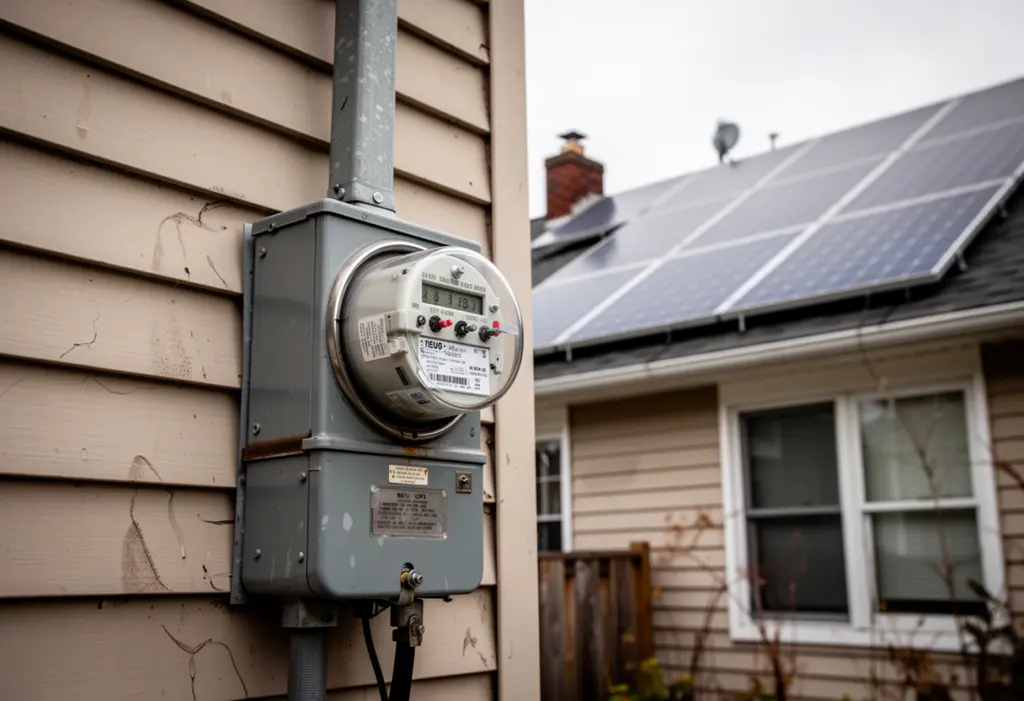
The short answer: a net metered solar system needs a meter that can measure electricity flowing in both directions, and the utility supplies and installs it. You do not buy it, you do not choose it, and you do not schedule it — your installer’s interconnection application triggers it. Whether the unit that arrives is an advanced meter or another type of bi-directional meter depends on what your utility has deployed in your area, and the rollouts are at different stages across the state.
Why the question matters more than it looks
The meter is rarely a technical obstacle. It is a scheduling one, and it usually sits at the very end of the sequence:
- Contract and design.
- Interconnection application to the utility, and the building permit from your authority having jurisdiction.
- Installation on the roof.
- Electrical inspection.
- Utility meter exchange and permission to operate.
Nothing may be switched on before that last step. A finished array sitting dark for weeks while the paperwork clears is one of the most common complaints in residential solar, and it is almost always this stage. Ask the installer, before signing, who submits the interconnection application and when — some submit at contract, some at installation, and the difference is measured in weeks of a system you own producing nothing.
What to ask your utility and your installer
- Which meter will be installed, and does the utility charge anything for the exchange?
- How long does the utility typically take between passing the electrical inspection and granting permission to operate, in your territory?
- Who chases it if it stalls — the installer, or you?
- If you previously opted out of an advanced meter, what does that mean for net metering? A non-communicating meter may still need to be exchanged for one that records export, and that is a question for the utility rather than for the salesperson.
What changes on the bill afterwards
Two things surprise people. The first is that the fixed customer charge does not disappear. Solar reduces the electricity you buy; it does not cancel the cost of being connected to a network you rely on every night and every cloudy week. A bill of zero is not the target and, for most households, not the outcome.
The second is a new line: the Customer Benefit Contribution, billed monthly on the DC size of the array rather than on production, and applying to systems interconnected on or after 1 January 2022. On NYSEG the 2026 residential rate is $1.19 per kW-month, so a 7 kW array carries $8.33 a month, roughly $100 a year. The rate is recalculated annually and is not locked in at interconnection, so a small rise in January is a rate change rather than a billing error.
What you should see alongside those is the credit mechanism working: exports credited at the full retail rate under Phase One net metering, with a banked balance that builds through the summer and draws down through the winter. Read the bill rather than the monitoring app — the app tells you what the panels made, and only the bill tells you what the utility recorded and credited. The two are answering different questions, and where they disagree it is the bill that governs.
Two situations where the answer is different
Municipal electric utility customers. Roughly fifty New York municipalities run their own electric systems, and they are outside Public Service Commission jurisdiction: no PSC net metering, no Customer Benefit Contribution and no state interconnection process. Metering, crediting and timelines are whatever that utility sets, and they must be asked for directly. Check the name printed on your own bill before assuming any of this page applies to you.
Community solar subscribers. There is no meter change at all, because nothing is installed at your home. The credit arrives on your existing bill from an off-site array, it is available to renters and to anyone whose roof does not work, and subscribers pay no Customer Benefit Contribution.
Where the incentives stand in 2026
Metering is free of the tax question, but the tax question has changed. The 30% federal residential credit is gone: section 25D was terminated for expenditures made after 31 December 2025, and an expenditure is treated as made when the original installation is completed — not when the meter is swapped and not when permission to operate arrives. That distinction genuinely mattered for systems finished at the end of 2025 and energised in 2026, which still qualify. For 2026 buyers there is nothing federal to claim.
New York’s own credit continues: 25% of qualified solar energy system equipment expenditure capped at $5,000, on Form IT-255, at your principal residence, non-refundable with a five-year carryforward, and reaching leases and power purchase agreements of ten years or more. Residential solar equipment is exempt from state sales tax, and RPTL 487 exempts the added value from property tax for 15 years, subject to three separate opt-out checks — county, municipality and school district — and only for a system constructed before 1 January 2030. NY-Sun no longer reduces the contract price for a home: as of September 2026 NYSERDA has no open NY-Sun block for homes in any utility territory, including the income-qualified Affordable Solar blocks; check NYSERDA’s NY-Sun dashboard for a new one. Confirm all of it with NYSERDA and the New York State Department of Taxation and Finance rather than with a proposal.
Frequently Asked Questions
Do I need a smart meter to install solar in New York?
You need a meter that measures flow in both directions, and the utility supplies and installs it as part of interconnection. Whether it is an advanced meter or another bi-directional type depends on what your utility has deployed in your area.
Who arranges the meter exchange?
Your installer's interconnection application triggers it and the utility carries it out. Ask who submits that application and when, because a system finished before the paperwork clears sits dark until permission to operate is granted.
I opted out of an advanced meter — can I still get solar?
Ask your utility directly. A non-communicating meter may still need to be exchanged for one that records export, and the answer depends on what your utility has deployed and on the terms of the opt-out you chose.
Will my electric bill go to zero after solar?
Almost certainly not. The fixed customer charge for being connected remains, and systems interconnected on or after 1 January 2022 also carry the Customer Benefit Contribution, billed monthly on the DC size of the array regardless of production.
This article is general information, not tax, legal or financial advice. Incentive amounts, eligibility rules and deadlines change and depend on your utility, your tax situation and your property. Confirm current terms with NYSERDA, your utility and a qualified tax professional before making a decision.
NY Solar Incentives
Independent New York solar research. We summarise NYSERDA, NY-Sun and federal programme rules from published sources and state plainly when a figure is an estimate. We are not a government agency and do not sell equipment.
Run the arithmetic on your own system
Check the dated program table and your arrangement before counting an incentive. Standard residential NY-Sun blocks are closed; Long Island Affordable Solar has a conditional income-verification route. The NY credit depends on qualified costs and tax liability, while the NYC abatement reduces future property-tax bills. The estimator keeps those timings separate.