Solar Panel Installation in Spring Valley, NY: What to Check
Spring Valley sits inside the Town of Ramapo, and that single fact decides who issues your permit. Here is what to establish before a contract is signed.
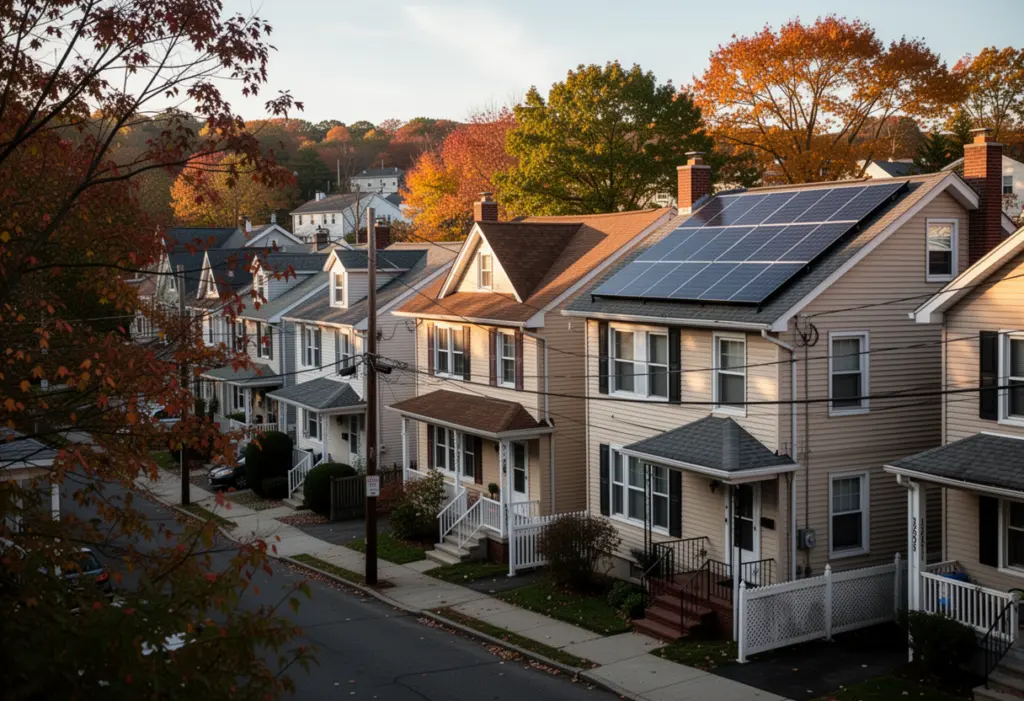
Spring Valley is a village inside the Town of Ramapo, in Rockland County, and that one sentence decides most of what follows. A rooftop project here is permitted by whichever authority your parcel actually falls under, interconnected under Orange & Rockland rules, and taxed according to three separate opt-out decisions. A homeowner who assumes the village handles all of it loses weeks.
Who issues your permit
If the parcel sits inside the village line, the Village of Spring Valley building department is your authority having jurisdiction. If it sits outside, the Town of Ramapo is — even where the mailing address still reads Spring Valley and the ZIP code is still 10977. Postal routes in this part of Rockland County do not follow municipal boundaries, and the surrounding 10952, 10954, 10970 and 10901 areas behave the same way. Ask the installer to name the office they will file with, in writing, before you sign, and check that name against your own tax bill.
Then ask a second question: does that office use the New York State Unified Solar Permit? It standardises residential permitting for systems of 25 kW DC and under, and it has been adopted by over 300 authorities having jurisdiction across the state. Where it is in use the application is predictable. Where it is not, the local form governs and the timeline is whatever the building department says it is. Ignore any suggestion that your town can earn a grant by adopting it — that framing belongs to a solicitation that closed years ago.
Your utility, and the monthly charge nobody quotes
Most of Rockland County is Orange & Rockland territory, and if that is the name on your bill then Public Service Commission rules apply to you in full. Around fifty New York municipalities run their own electric systems and sit outside those rules entirely, so the bill is the only check that settles it. Phase One net metering credits your exports at the full retail rate, and a system interconnected today holds that structure for 20 years. Confirm the utility name printed on your own bill anyway. That bill is the only authority that settles the question.
The line that rarely appears in a proposal is the Customer Benefit Contribution. It is billed monthly on the DC size of the array rather than on what the array produces, and it applies to systems interconnected on or after 1 January 2022. For 2026 the residential rate on Orange & Rockland is $1.00 per kW-month. A 7.2 kW system therefore carries $7.20 a month, roughly $86 a year, in sun and under snow alike. Rates are recalculated annually and are not locked in at interconnection.
That figure is also the argument against oversizing. An array built larger than your consumption banks credits you never draw down, and pays the capacity charge on every one of those kilowatts anyway.
The housing question that is specific to here
Spring Valley has a dense housing stock with a high share of two-family and multi-family buildings and a high share of rented units. That moves the first question away from roof pitch and onto metering. Ask whose meter the array will sit behind, and who receives the net metering credit. An array wired to a landlord-supplied house meter does nothing for a tenant paying their own bill, and an array behind one apartment meter in a two-family does nothing for the other unit.
Where a building carries several accounts, the honest answer is frequently community solar instead of a roof. A subscription credits your own bill without touching the building, it is available to renters, and community solar subscribers pay no Customer Benefit Contribution at all.
Older housing brings the familiar pair with it: a 100 amp service that may not accept a solar breaker alongside anything else you plan to add, and a roof whose remaining life is shorter than the panel warranty. Both are far cheaper to settle before the contract than after it.
Property tax: three separate checks
RPTL 487 exempts the added value of a solar installation from real property tax for 15 years, but only where the taxing authority has not opted out — and that is three separate decisions here. Rockland County is one. Your village or town is the second. The school district that levies on your parcel is the third, and for most of the village that is East Ramapo. Spring Valley is not one of the Big Five city school districts, so the school question is a genuine third check rather than a formality. The system must also be constructed before 1 January 2030 to qualify at all.
What you can actually claim in 2026
The 30% federal residential credit is gone. Section 25D was terminated for expenditures made after 31 December 2025, and an expenditure is treated as made when the original installation is completed, so a 2026 proposal still carrying a federal line is materially wrong and should be re-priced before you read the rest of it. New York State’s own credit is live: 25% of qualified solar energy system equipment expenditure, capped at $5,000, claimed on Form IT-255 for your principal residence, non-refundable but carried forward up to five years. It reaches a lease or a power purchase agreement as well, provided the agreement runs ten years or more. NY-Sun, which a contractor took off the price rather than you claiming it on a return, is not available: as of September 2026 NYSERDA has no open NY-Sun block for homes in any utility territory, and its income-based Affordable Solar track has closed as well; check NYSERDA’s NY-Sun dashboard for a new one. Residential solar equipment and its installation are exempt from the 4% state sales tax, and Rockland County is one of the jurisdictions that also exempts them from local sales tax (Publication 718-S, Part 2). Programmes move — confirm the current position with NYSERDA and with the New York State Department of Taxation and Finance before signing.
Frequently Asked Questions
Who issues a solar permit in Spring Valley, NY?
The Village of Spring Valley building department if your parcel is inside the village line, and the Town of Ramapo if it is outside — even where the mailing address and the 10977 ZIP code still read Spring Valley. Check the office name against your tax bill.
Which utility serves Spring Valley?
Most of Rockland County is Orange & Rockland territory, and where that is the supplier the Public Service Commission net metering rules apply. Service territories do not follow municipal lines cleanly, so confirm the utility name printed on your own bill before relying on that.
What is the monthly solar charge in Spring Valley?
The Customer Benefit Contribution, billed on the DC size of the array rather than on production. For 2026 the residential rate on Orange & Rockland is $1.00 per kW-month, so a 7.2 kW system pays $7.20 a month, roughly $86 a year.
I rent in Spring Valley — can I still get solar?
Not on someone else's roof, but community solar credits your own utility bill without any installation, it is open to renters, and community solar subscribers pay no Customer Benefit Contribution at all.
This article is general information, not tax, legal or financial advice. Incentive amounts, eligibility rules and deadlines change and depend on your utility, your tax situation and your property. Confirm current terms with NYSERDA, your utility and a qualified tax professional before making a decision.
NY Solar Incentives
Independent New York solar research. We summarise NYSERDA, NY-Sun and federal programme rules from published sources and state plainly when a figure is an estimate. We are not a government agency and do not sell equipment.
Run the arithmetic on your own system
Check the dated program table and your arrangement before counting an incentive. Standard residential NY-Sun blocks are closed; Long Island Affordable Solar has a conditional income-verification route. The NY credit depends on qualified costs and tax liability, while the NYC abatement reduces future property-tax bills. The estimator keeps those timings separate.