Portable Solar for an Apartment Balcony in New York
A balcony panel is an appliance, not a solar installation. Two questions decide whether it is workable at all: what your lease says, and whether anything is being fed back into the building wiring.
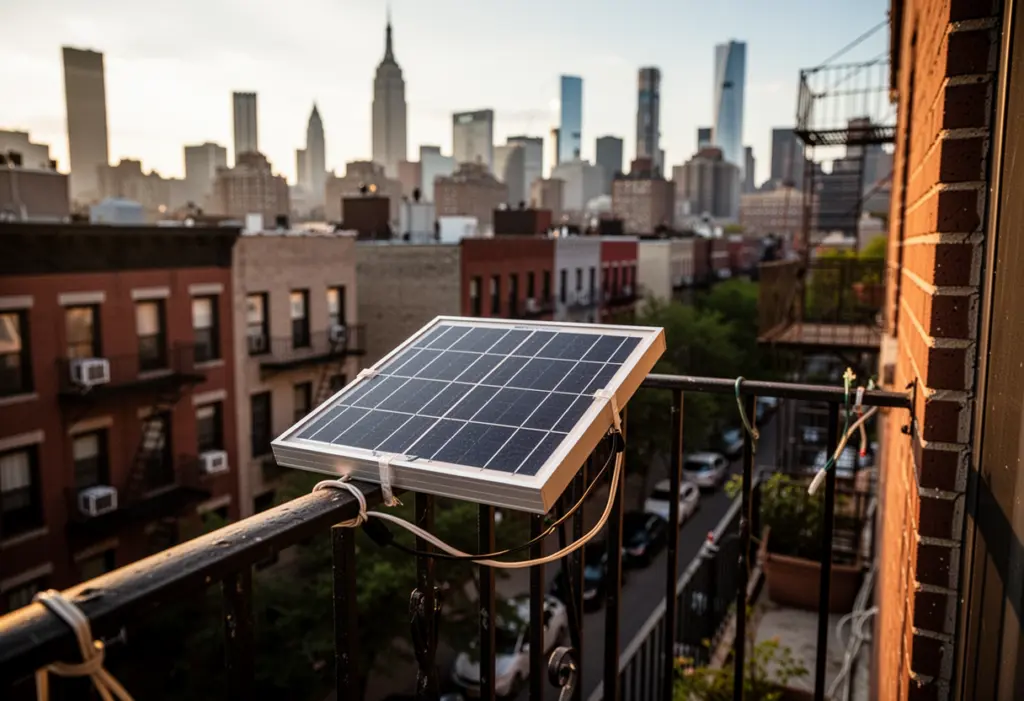
A portable panel on a balcony is an appliance. It is not a grid-tied solar installation, and most of the difficulty people run into comes from treating the two as the same thing. Before comparing products, settle two questions: what your lease and building rules permit, and whether anything is being fed back into the building wiring.
The distinction that decides everything
- A panel charging a portable power station that you then plug devices into is a self-contained appliance. Nothing connects to the building electrical system, and the questions are about permission, mounting and expectations.
- A setup that back-feeds a socket pushes power into the building wiring. That raises electrical code questions, landlord and building consent, and utility questions, and it is not something to assume is permissible because a product is sold with a plug on it.
New York state net metering and the state interconnection process are built around a system interconnected with the utility, with its approval, on an account in the customer’s name. A balcony panel sits outside that framework. If a product description implies otherwise, ask your building department and your utility directly before buying rather than after.
Set expectations with arithmetic, not enthusiasm
Do this before you spend anything. Watch the balcony for several days and write down the hours it actually receives direct sun — not daylight, direct sun. Balconies typically face one direction, are shaded by the building above and by neighbouring structures, and many receive far less than people assume.
Then compare the panel rated wattage against what you want to run. A panel of the size that fits a railing charges phones, laptops, a fan or a light. It does not run a household, and it will not visibly change a monthly electricity bill. Judged as a resilience purchase or a hobby, a balcony setup can be entirely reasonable. Judged as a way of cutting your bill, it disappoints almost everyone who buys it that way.
The physical risks are real at height
- Wind. A panel is a sail. Attachment to a railing several storeys up is a safety matter for people below, and it is the single thing most worth over-engineering.
- Weight and railing condition, especially on an older balcony where the railing may not be designed for an attached load.
- Battery storage indoors, which has its own handling, charging and ventilation considerations. Read what the manufacturer says and follow it.
- Egress and fire access, which building rules take seriously and which a balcony installation should not obstruct.
Ask your landlord or managing agent in writing, and keep the answer. A written permission is worth having when the building changes managing agent.
What incentives apply: none of them
Be clear about this before you buy rather than disappointed afterwards. NY-Sun only ever covered an installed system, through a contractor, and as of September 2026 NYSERDA has no open NY-Sun block for homes in any utility territory in any case. The 25% state credit capped at $5,000 on Form IT-255 is for solar energy system equipment installed and used at your principal residence, claimed against a real installation. RPTL 487 exempts added property value, which a portable appliance does not create. New York exempts residential solar energy system equipment from state sales tax, and you should not assume that reaches a portable consumer product — ask before you count on it. And the 30% federal residential credit is gone in any case, terminated for expenditures made after 31 December 2025.
The route that does reduce a renter bill
Community solar is the arrangement designed for households without a suitable roof. The subscription is in your own name, the credits arrive on your own utility bill, and there is no equipment on your balcony to secure against a February gale. Subscribers also pay no Customer Benefit Contribution — the monthly charge that a rooftop owner pays on DC capacity regardless of production. On a 5 kW rooftop array in Con Edison territory that charge is 5 x $1.29, about $6.45 a month; on Central Hudson the same array pays about $100 a year. A subscriber pays none of it.
Read any subscription for its cancellation terms, notice period and what happens when you move, and confirm from your own bill which utility serves the building — a municipal electric utility sits outside the state framework entirely. Programme terms change, so check the current position with NYSERDA before signing.
Frequently Asked Questions
Can I put a solar panel on my apartment balcony in New York?
It depends on your lease and building rules, and on whether anything feeds back into the building wiring. A panel charging a portable power station is self-contained; anything that back-feeds a socket raises code, consent and utility questions to settle first.
Will a balcony panel reduce my electricity bill?
Very little. A railing-sized panel charges devices rather than running a household, and balconies usually get limited direct sun. Count the hours of direct sun your balcony actually receives before deciding what to expect.
Do any New York incentives cover portable solar?
No. The IT-255 credit and RPTL 487 attach to an installed system at a residence, and NY-Sun, which also did, has no open block for homes as of September 2026. Do not assume the equipment sales tax exemption reaches a portable consumer product, and the federal residential credit ended after 2025.
What is the better option for a renter?
Community solar. The subscription is in your own name, credits arrive on your own utility bill, and subscribers pay no Customer Benefit Contribution. Check the cancellation terms and what happens if you move.
This article is general information, not tax, legal or financial advice. Incentive amounts, eligibility rules and deadlines change and depend on your utility, your tax situation and your property. Confirm current terms with NYSERDA, your utility and a qualified tax professional before making a decision.
NY Solar Incentives
Independent New York solar research. We summarise NYSERDA, NY-Sun and federal programme rules from published sources and state plainly when a figure is an estimate. We are not a government agency and do not sell equipment.
Run the arithmetic on your own system
Check the dated program table and your arrangement before counting an incentive. Standard residential NY-Sun blocks are closed; Long Island Affordable Solar has a conditional income-verification route. The NY credit depends on qualified costs and tax liability, while the NYC abatement reduces future property-tax bills. The estimator keeps those timings separate.