Solar Panels in Cloudy Weather: What New York Loses
Panels keep working under overcast skies, at a reduced rate. The question worth asking is not whether clouds hurt but whether the estimate you were shown already accounts for them.
On this page 7 sections
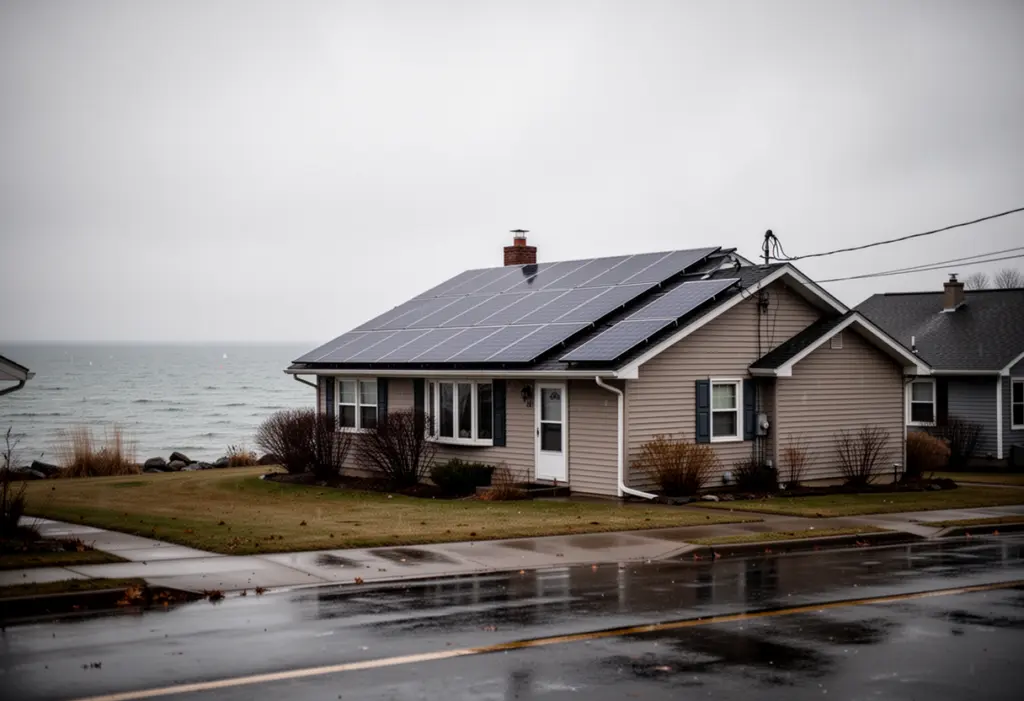
Solar panels produce under cloud. They produce less, because there is less light, and they run on diffuse light rather than direct beam. So the useful question is not whether New York’s grey months hurt output. They do, and everybody knows it. The question is whether the production estimate you were handed already accounts for them, or whether it was generated somewhere sunnier.
Ask what data the estimate was built on
A credible production estimate for a New York roof is built from long-run irradiance data for your location, and it already contains every grey November in that record. If it does, cloud is not a risk you are carrying. It is an input.
So ask three things and read the answers carefully. Which weather data set was used and for which nearby station. Whether the model was given a shading assessment taken on the roof or only a satellite outline. And whether you can see the month by month production table rather than the annual total.
That monthly table is where a weak estimate reveals itself. New York production is strongly seasonal, and an estimate whose December figure looks close to its June figure was not built for this state.
What genuinely changes output, in order of size
- Shading. A tree or a chimney that blocks a portion of the array during peak hours costs more across the year than the difference between a good and a mediocre module. It is also the one thing that is site specific and cannot be inferred from a map.
- Orientation and pitch. Which plane the modules sit on sets the shape of the daily curve, and in a diffuse-light climate the penalty for a less than ideal orientation is smaller than people assume.
- Season. Short days and a low sun angle matter more than the cloud itself. December is short before it is grey.
- Snow cover. Days when the array is partly or wholly covered land in the months of least production, which is why they show up so sharply on a monthly chart.
- Soiling. On most pitched New York roofs, rain handles it.
Net metering is what makes a cloudy month survivable
The mechanism that carries New York homeowners through a poor stretch of weather is Phase One net metering, which credits exported energy at the full retail rate and holds that structure for 20 years from interconnection. A sunny week builds credit and a grey week draws it down, so what matters is the annual balance rather than any individual month.
Most residential rooftop customers are on this arrangement. The Value Stack, sometimes called VDER, is the framework for community distributed generation and larger or commercial projects rather than mass-market residential, so a residential proposal that talks about value stack pricing is worth questioning.
The bill line that ignores the weather entirely
The Customer Benefit Contribution is charged on DC system capacity every month, on systems interconnected on or after 1 January 2022, and it does not care what the sky did. At the 2026 LIPA and PSEG Long Island residential rate of $1.13 per kW-month, a 9 kW array pays $10.17 a month, about $122 a year. That is the same $10.17 in a week of solid overcast as in a cloudless July. Rates are recalculated annually and are not fixed at interconnection.
It is a small number, and it is worth saying plainly rather than hiding: the fixed component of owning solar in New York is unaffected by how well the array performs. That is an argument for sizing honestly, and against buying capacity on the theory that more panels will compensate for a shaded roof. They will not; they will simply raise the fixed charge.
What not to buy on the strength of cloud
Two upsells commonly ride on the grey-weather worry. The first is a premium module sold on marginally better low-light behaviour. Compare the difference against what the same money does if spent on removing a shading problem instead. The second is a battery sold as insurance against poor weather. Under full retail rate net metering the grid is already doing the storage job at par, so a battery in New York is a resilience purchase for outages, not an economic one. That can be a perfectly good reason to buy one. It is not the reason usually given.
Incentives in 2026
Net metering is itself the largest ongoing benefit in this article, and it is the one to confirm in writing: ask the installer to state which tariff your system will interconnect under, and check the utility name on your own bill, because a municipal electric customer is outside the Public Service Commission framework and gets no state net metering at all.
On top of that, the 25% New York State credit capped at $5,000 on Form IT-255 applies to equipment at your principal residence, and the state sales tax exemption applies to the equipment. NY-Sun does not add to that in 2026: as of September 2026 NYSERDA has no open NY-Sun block for homes in any utility territory; check NYSERDA’s NY-Sun dashboard for a new one. The 30% federal residential credit no longer exists for a 2026 buyer, having been terminated for expenditures made after 31 December 2025 with the test being when the original installation was completed. Programmes and tariffs both change, so verify with NYSERDA and your utility before signing rather than after.
Frequently Asked Questions
Do solar panels work on cloudy days in New York?
Yes, at a reduced rate, running on diffuse light rather than direct beam. A properly built production estimate already contains New York's cloud in its long-run irradiance data, so it is an input to the forecast rather than a risk on top of it.
How do I tell whether an estimate accounts for New York weather?
Ask for the month by month production table rather than the annual total, ask which weather data set and station were used, and ask whether shading came from an on-roof assessment or only a satellite outline.
Does a cloudy month cost me more on the bill?
The Customer Benefit Contribution does not change. It bills on DC capacity, so a 9 kW array on LIPA or PSEG Long Island pays 10.17 dollars a month at the 2026 rate of 1.13 dollars per kW-month whatever the weather did.
Should I buy a battery because of cloudy weather?
Not for that reason. Under full retail rate net metering the grid already stores your surplus at par, so a battery in New York is a resilience purchase against outages rather than an economic one against grey weeks.
This article is general information, not tax, legal or financial advice. Incentive amounts, eligibility rules and deadlines change and depend on your utility, your tax situation and your property. Confirm current terms with NYSERDA, your utility and a qualified tax professional before making a decision.
NY Solar Incentives
Independent New York solar research. We summarise NYSERDA, NY-Sun and federal programme rules from published sources and state plainly when a figure is an estimate. We are not a government agency and do not sell equipment.
Run the arithmetic on your own system
Check the dated program table and your arrangement before counting an incentive. Standard residential NY-Sun blocks are closed; Long Island Affordable Solar has a conditional income-verification route. The NY credit depends on qualified costs and tax liability, while the NYC abatement reduces future property-tax bills. The estimator keeps those timings separate.