Removing and Reinstalling Solar Panels for a New Roof
Taking an array off so a roof can be replaced, then putting it back, is two full mobilisations that leave you exactly where you started. It is the reason roof age is the first question in any solar decision.
On this page 7 sections
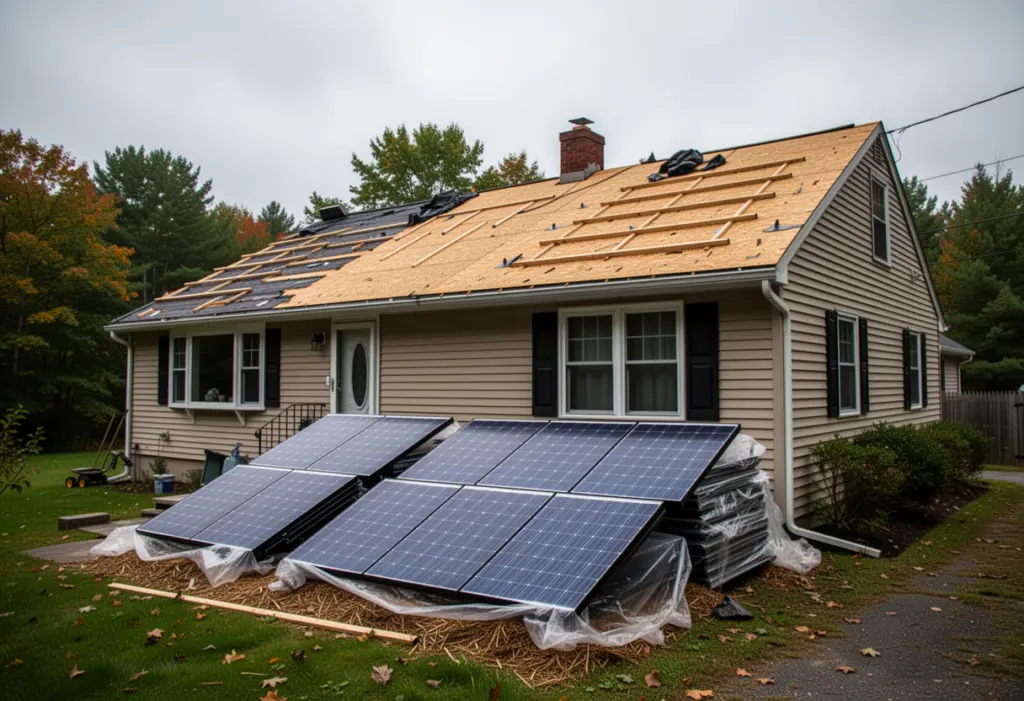
Detaching an array so the roof underneath can be replaced, and then resetting it, is one of the few jobs in home ownership that costs a substantial sum and leaves you exactly where you started. It is two crew mobilisations, two sets of roof work and an electrical recommissioning, and at the end of it you have the same system you had before on a newer roof. That is the whole reason roof age is the first question anybody should ask before installing solar, and not the last.
Decide roof age before the array, not after
If the covering is near the end of its life, replacing it while the roof is bare is far cheaper than replacing it later with modules in the way. The comparison to make is not roof now versus roof later; it is roof now versus roof later plus a detach and reset that adds nothing to your energy production.
Ask the solar installer what they observed about the roof during the survey and ask them to put it in writing. Ask a roofer separately, because the roofer has no reason to give the answer that gets the solar job signed.
Who actually does the work
Roofers do not normally handle the electrical side of an array, and solar crews do not normally lay roof covering. So the job is a coordination between two trades, and the coordination is where things fall between the chairs.
Settle these before anybody starts:
- Who removes and stores the modules, and where they are stored while the roof is open. Panels stacked in a driveway in weather are panels at risk.
- Who re-flashes the mount penetrations, and who warrants that flashing afterwards. This is the classic gap: the roofer warrants the roof except where the solar mounts are, and the solar company warrants the mounts but not the covering. Ask both, in writing, before either starts.
- Whether the array comes back in the same layout. If the count or arrangement changes, ask whether the utility needs to be notified and whether any permit or interconnection paperwork has to be updated.
- What happens to the warranties. Ask the module and inverter manufacturers, through the installer, whether a detach and reset performed by a third party affects coverage.
- Who recommissions and confirms production after the reset, and how you will know the system is performing as it did before.
Get the price in the original contract
The best time to agree a detach and reset price is when you are still deciding who installs the system. Ask for it as a written line in the original proposal — what it would cost, what it includes, and how long the price holds. A company that has quoted it in advance is a company that has thought about it.
Prices move with the market and with your county, so obtain a current figure locally when you need the work, and get it as a range with the assumptions stated: number of modules, roof access, whether scaffolding is required, and whether new flashings and mounting hardware are included or extra.
If the system is leased or on a power purchase agreement
You do not own the equipment, so you cannot simply hire somebody to take it off. The third party owner controls who touches the system, what the fee is, and how far ahead it must be scheduled. Find that clause before you sign the agreement, not when the roofer is booked, and ask specifically what the notice period is and what happens if the roof work overruns.
Two costs that keep running
While the array is down it produces nothing, and under Phase One net metering the exports you are not making would have been credited at the full retail rate, so schedule the work for a low production window rather than for June if you have any choice about timing.
The Customer Benefit Contribution is charged on the DC size of a system interconnected on or after 1 January 2022, rather than on output, and a system interconnected before that date is outside it — a 10 kW array in Orange & Rockland territory is 10 × $1.00, $10.00 a month or $120 a year, and the same 10 kW is $12.90 a month on Con Edison. Whether that charge pauses during a temporary removal is a question for your own utility, and it is worth asking rather than assuming, because the rates are set annually and the billing is on capacity, not on production.
What this does and does not do to your incentives
A detach and reset is not a new installation. There is no federal credit to look for in any case: section 25D was terminated for expenditures made after 31 December 2025, treating an expenditure as made when the original installation is completed. On the state side, Form IT-255 gives 25% of qualified solar energy system equipment expenditure capped at $5,000 at a principal residence, and the cap is a lifetime figure that the original installation may already have used — whether any part of a reset qualifies at all is a question for the form instructions and a tax preparer.
RPTL 487 exempts the added assessed value of the system for 15 years where the municipality, the county and the school district have each not opted out; replacing the roof underneath does not restart that clock, and the exemption requires the system to have been constructed before 1 January 2030. Confirm the current position with your assessor and with NYSERDA before relying on any of it.
Frequently Asked Questions
How much does it cost to remove and reinstall solar panels for a new roof?
It varies with module count, roof access and whether new flashings are included, so get a current local figure with those assumptions stated. Better still, agree a written price in the original solar contract before you sign it.
Should I replace my roof before installing solar?
If the covering is near the end of its life, yes. Replacing it while the deck is bare is far cheaper than replacing it later with modules in the way, and a detach and reset adds nothing to your production.
Who warrants the roof where the solar mounts are?
This is the gap to close in writing before work starts. Roofers commonly warrant the covering except at the mounts, and solar companies warrant the mounts rather than the covering. Ask both parties directly.
Can I do this if my system is leased?
Not on your own. The third party owner controls who touches the equipment, sets the fee and sets the scheduling notice. Read that clause before signing the agreement, not when the roofer is already booked.
This article is general information, not tax, legal or financial advice. Incentive amounts, eligibility rules and deadlines change and depend on your utility, your tax situation and your property. Confirm current terms with NYSERDA, your utility and a qualified tax professional before making a decision.
NY Solar Incentives
Independent New York solar research. We summarise NYSERDA, NY-Sun and federal programme rules from published sources and state plainly when a figure is an estimate. We are not a government agency and do not sell equipment.
Run the arithmetic on your own system
Check the dated program table and your arrangement before counting an incentive. Standard residential NY-Sun blocks are closed; Long Island Affordable Solar has a conditional income-verification route. The NY credit depends on qualified costs and tax liability, while the NYC abatement reduces future property-tax bills. The estimator keeps those timings separate.