Solar Panel Setbacks on a New York Roof: What Applies
Roof setbacks are why the array on the proposal is often larger than the array you end up with. The layout drawing, not the satellite image, is the document that tells the truth.
On this page 8 sections
- 01Where the rule comes from, and who interprets it
- 02What actually eats the roof
- 03Ask for the dimensioned layout, and compare it to the headline
- 04When flexibility exists
- 05Ground mounts and canopies are a different body of rules
- 06The permit route, and where it does not apply
- 07What a smaller array changes in the arithmetic
- 08Frequently Asked Questions
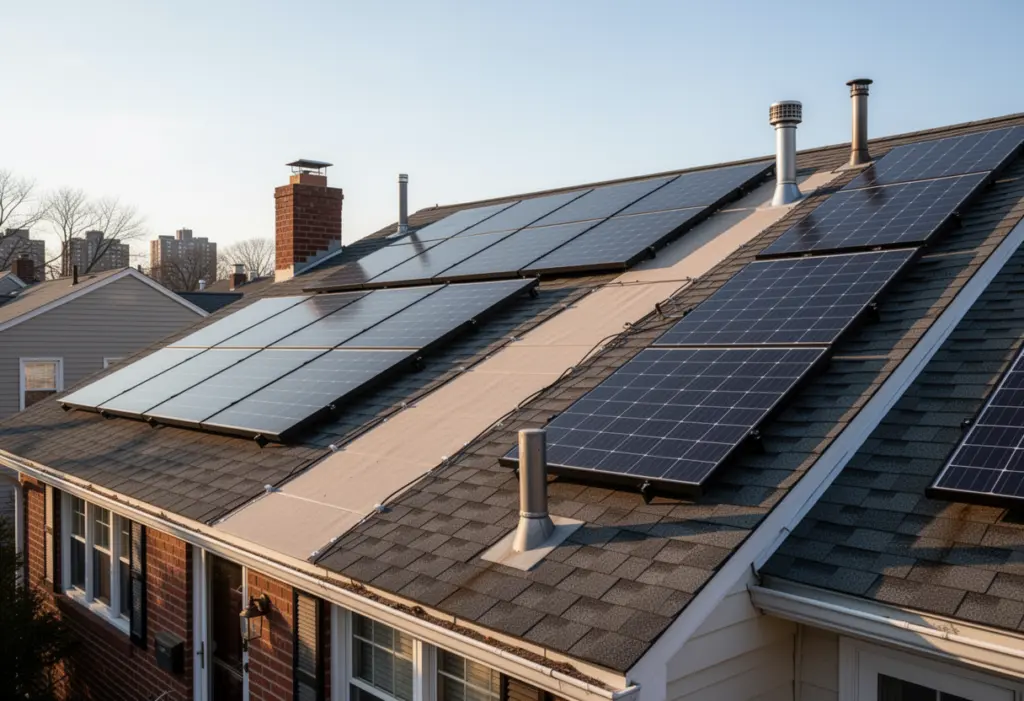
Setbacks and access pathways come from the fire code as adopted in New York and as applied by your authority having jurisdiction. They exist so that firefighters can get onto a roof and ventilate it, and they take usable area away from the array. That is the honest reason a satellite-based proposal is frequently larger than the system you end up with.
Where the rule comes from, and who interprets it
The requirement is codified rather than invented by the installer, but the interpretation belongs to the authority having jurisdiction — your building department or, in the five boroughs, the Department of Buildings. Two neighbouring towns can read the same provision with different degrees of flexibility. The only answer that counts is your own authority’s, in writing, on your own drawing. Ask the installer which authority they are submitting to and whether they have permitted there before.
What actually eats the roof
- Clearance at the ridge, which usually removes the best-oriented row on a pitched roof.
- Access pathways to and around the array, which fragment a large plane into smaller ones.
- Eaves and rakes, where a margin is generally required.
- Obstructions: plumbing vents, chimneys, skylights, dormers, satellite dishes and rooftop mechanical equipment, each with its own shadow and its own clearance.
- Hips and valleys on a complicated roof, which can leave several small planes that individually cannot hold a full row.
Ask for the dimensioned layout, and compare it to the headline
Before signing anything, ask for the layout drawing that will be submitted for permit: dimensioned, with setbacks and pathways marked, obstructions shown and the module count stated. Then compare the kilowatts on that drawing with the kilowatts in the proposal and in the savings estimate. If the estimate was built on a number the roof cannot hold, every figure downstream of it — production, bill saving, payback — is wrong by the same proportion. This is also the moment to ask what happens contractually if the permitted layout comes back smaller: does the price fall with it, and by how much per module.
When flexibility exists
Some provisions allow a different arrangement where the roof geometry or other measures justify it, and some authorities will discuss alternatives. Treat that as a question for the authority, asked before the equipment is ordered, and get any accommodation in writing. Verbal reassurance from a sales representative that the town is relaxed about setbacks has no standing at plan review.
Ground mounts and canopies are a different body of rules
A ground-mounted array is a structure on your lot, so it meets zoning rather than roof access rules: setbacks from lot lines, height limits, coverage, sometimes screening, and in some municipalities a special permit. Those are decided by the zoning code and the planning board, not by the fire code, and the review can take considerably longer than a rooftop permit. If the roof cannot take the system you need, establish the zoning position early rather than treating a ground mount as a simple fallback.
The permit route, and where it does not apply
The NYS Unified Solar Permit standardises residential and small commercial permitting for systems of 25 kW DC and under and has been adopted by over 300 New York authorities having jurisdiction. It does not apply in the five boroughs, where the Department of Buildings runs its own process. Where it is in force, the submission requirements are predictable, which removes a category of avoidable rejection.
What a smaller array changes in the arithmetic
Less than people fear on the incentive side, and that is worth saying plainly. The Customer Benefit Contribution is billed on DC capacity, so a smaller array costs less every month: on NYSEG at $1.19 per kW-month for 2026, a 10 kW system is $11.90 a month while an 8 kW system is $9.52, a difference of roughly $29 a year. Under full retail rate Phase One net metering an oversized array is the worse error anyway — it builds credits you never consume while you keep paying the monthly charge on capacity you paid to install.
Confirm the rest for yourself. RPTL 487 exempts the added value from property tax for fifteen years where the municipality, the county and the school district have each not opted out, for systems constructed before 1 January 2030, and your assessor holds that answer. The New York State credit is 25 percent capped at $5,000 on Form IT-255 for a principal residence. And the 30 percent federal residential credit is gone: section 25D was terminated for expenditures made after 31 December 2025.
Frequently Asked Questions
What are solar setbacks on a roof for?
They are fire access provisions, so that firefighters can reach and ventilate the roof. They come from the fire code as adopted in New York and are applied by your local authority having jurisdiction, which is also the body that interprets them.
Why is the permitted array smaller than the one I was quoted?
Setbacks at the ridge and eaves, access pathways and clearances around vents, chimneys and skylights all remove usable area that a satellite layout does not show. Ask for the dimensioned drawing that will be submitted for permit.
Do setbacks apply to a ground-mounted array?
Not the roof access rules. A ground mount is a structure on your lot, so it meets zoning setbacks from lot lines, height limits and sometimes a special permit, decided by the zoning code and planning board rather than the fire code.
Does a smaller array cost me much?
Less than most people expect. The Customer Benefit Contribution falls with DC size — on NYSEG at $1.19 per kW-month, 10 kW is $11.90 a month against $9.52 for 8 kW — and under full retail net metering an oversized array is the worse error.
This article is general information, not tax, legal or financial advice. Incentive amounts, eligibility rules and deadlines change and depend on your utility, your tax situation and your property. Confirm current terms with NYSERDA, your utility and a qualified tax professional before making a decision.
NY Solar Incentives
Independent New York solar research. We summarise NYSERDA, NY-Sun and federal programme rules from published sources and state plainly when a figure is an estimate. We are not a government agency and do not sell equipment.
Run the arithmetic on your own system
Check the dated program table and your arrangement before counting an incentive. Standard residential NY-Sun blocks are closed; Long Island Affordable Solar has a conditional income-verification route. The NY credit depends on qualified costs and tax liability, while the NYC abatement reduces future property-tax bills. The estimator keeps those timings separate.