Solar for a Church in New York: What Changes
The defining fact for a church project is that tax credits and depreciation have no direct value to an organisation that owes no tax. Everything else follows from that.
On this page 7 sections
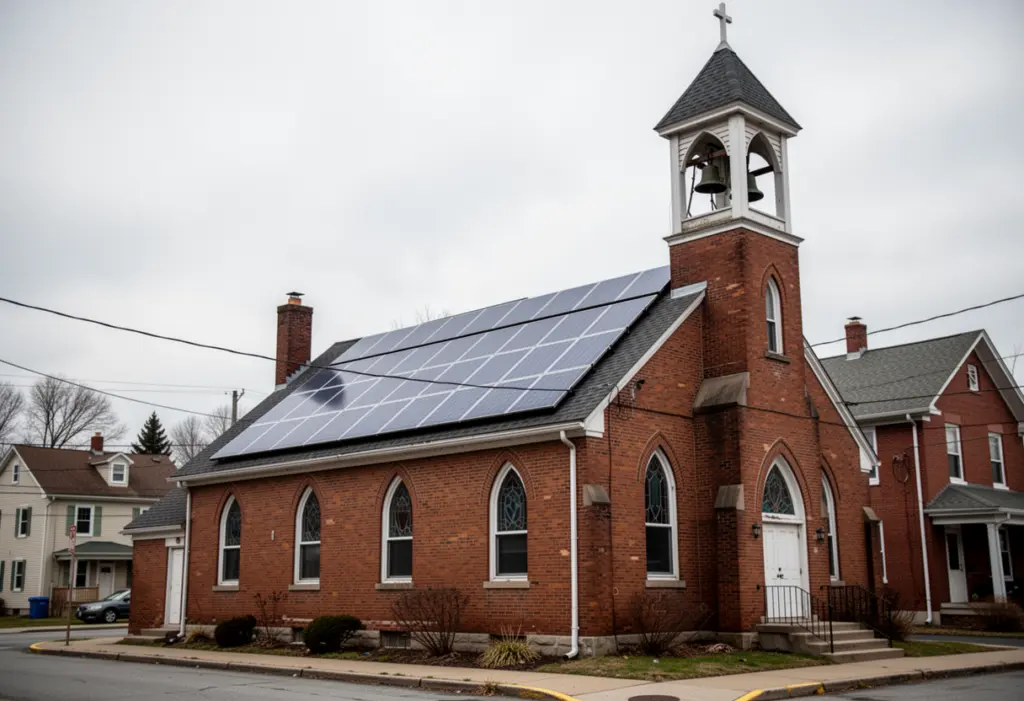
The single fact that reorders a church solar project is that a tax credit is worth nothing to an organisation that owes no tax. Most of the arithmetic circulating about solar assumes a taxpayer who can use a credit and a depreciation deduction. A congregation usually cannot use either directly, so a proposal built on that arithmetic is describing somebody else’s project.
That does not mean solar does not work for a church. It means the route is different, and the first conversation is about ownership rather than equipment.
Ownership is the decision, not the panels
Broadly there are two shapes. The congregation buys and owns the system, in which case the benefit is simply the electricity and there is no tax benefit to model. Or a third party owns it and the congregation buys the output or leases the equipment, in which case the owner is a taxable business that can use the federal business-side provisions, and the question becomes how much of that value is reflected in the price you are offered.
There are also mechanisms in federal law intended to let tax-exempt entities benefit from clean energy provisions. Whether any of them fit your organisation, what they require and what they are worth is a question for a tax adviser and counsel, working from your actual filings. It is not something to take from a vendor presentation, and it is not something this page will guess at.
The property tax line that may already be zero
RPTL 487 exempts the added value of a solar installation from property tax for fifteen years, where the town or city, the county and the school district have each not opted out, for systems constructed before 1 January 2030. That is a real benefit for a taxable owner.
But if the parcel is already exempt from property tax, an exemption on added value may add nothing you were going to pay anyway. Ask your assessor what the parcel’s current exemption status is before that line appears in a proposal as a saving, and ask specifically whether the assessor treats the installation as affecting it. A saving you were never going to incur is not a saving.
The consumption pattern nobody models properly
A building used intensively on one or two days a week, and lightly the rest of the time, has an unusual load shape: low weekday daytime consumption, exactly when an array produces most. That makes the compensation framework the decisive question rather than a footnote. Phase One net metering credits exports at the full retail rate and holds for twenty years from interconnection, and it is what most mass-market residential rooftop customers are on; the Value Stack, or VDER, is the framework for community distributed generation and for larger and commercial projects. Establish which one your project falls under before the array is sized, because an export-heavy profile is a very different proposition under each.
Do not size to the roof. Size to the consumption, and ask what happens to credits the building never draws down.
What to check on the building
- Roof age and material. Slate, tile and older membranes each carry their own constraints, and a reroof after installation costs the removal and refitting on top of the roofing.
- Structure. Older buildings frequently need a structural assessment before any array is designed, not after.
- Shading from your own building. A steeple or tower casts a moving shadow across the very roof planes that face the sun.
- Landmark or historic status. If the building is designated, there is a review process, and it belongs at the start of the schedule.
- An accessory building or ground area. A hall, a garage or unused land can carry the array where the sanctuary roof cannot.
Governance, contracts and the long term
Establish early who is authorised to sign, what congregational or denominational approvals are needed, and whether any property rules restrict long-term agreements or liens. A twenty-year contract signed by a committee whose authority is later questioned is a problem that outlasts everyone who was in the room.
Ask for references from comparable buildings, and ask the installer directly what happens to service obligations if they cease trading. And run the numbers over the full contract term rather than the first year, especially where a power purchase agreement carries an annual escalator.
The monthly charge, and the incentives that do reach you
The Customer Benefit Contribution is billed on DC system size regardless of production, on systems interconnected on or after 1 January 2022. On Orange & Rockland’s 2026 small commercial rate of $0.88 per kW-month, a 30 kW array pays 30 x $0.88 = $26.40 a month, about $317 a year. Commercial accounts with a demand charge are not subject to it, and a building served by a municipal electric utility sits outside the state framework altogether, with terms set by the municipality.
NY-Sun does reach a project like this, applied by the contractor as a reduction in price rather than claimed by you, stepping down as each regional megawatt block fills. What does not reach it is anything residential: the 30% federal credit under section 25D is gone and was never available to an organisation, and New York’s 25% credit capped at $5,000 on Form IT-255 requires an individual taxpayer’s principal residence. Confirm the current position with NYSERDA and with your own advisers before any figure goes to a board.
Frequently Asked Questions
Can a church claim a solar tax credit?
Not directly, because a credit is worth nothing to an organisation that owes no tax. Federal law contains mechanisms intended to let tax-exempt entities benefit from clean energy provisions, and whether any fits your organisation is a question for a tax adviser and counsel.
Does RPTL 487 help a church?
It exempts added value from property tax for fifteen years where the municipality, county and school district have each not opted out. If the parcel is already exempt, that may add nothing. Ask the assessor for the parcel's current status before it is counted as a saving.
How should a church size its system?
To consumption rather than to available roof. A building used heavily one or two days a week has low weekday daytime load, so most production exports, which makes the compensation framework the decisive question. Establish whether the project is on net metering or the Value Stack first.
What should the congregation settle before signing?
Who is authorised to sign, what congregational or denominational approvals are required, whether property rules restrict long-term agreements or liens, what happens to service obligations if the installer ceases trading, and how any annual escalator behaves over the full term.
This article is general information, not tax, legal or financial advice. Incentive amounts, eligibility rules and deadlines change and depend on your utility, your tax situation and your property. Confirm current terms with NYSERDA, your utility and a qualified tax professional before making a decision.
NY Solar Incentives
Independent New York solar research. We summarise NYSERDA, NY-Sun and federal programme rules from published sources and state plainly when a figure is an estimate. We are not a government agency and do not sell equipment.
Run the arithmetic on your own system
Check the dated program table and your arrangement before counting an incentive. Standard residential NY-Sun blocks are closed; Long Island Affordable Solar has a conditional income-verification route. The NY credit depends on qualified costs and tax liability, while the NYC abatement reduces future property-tax bills. The estimator keeps those timings separate.