Battery Storage in a New York Apartment Building
In an apartment building, storage is a building systems project rather than a household purchase. Two questions settle most of it: who owns the meter, and who controls the space the battery would sit in.
On this page 7 sections
- 01Who owns the meter decides who benefits
- 02Siting, and the fire official you have not spoken to yet
- 03Board, landlord and lease
- 04If you rent and cannot get any of that, community solar is the honest answer
- 05If you are the building owner asking
- 06The incentives that reach a building
- 07Frequently Asked Questions
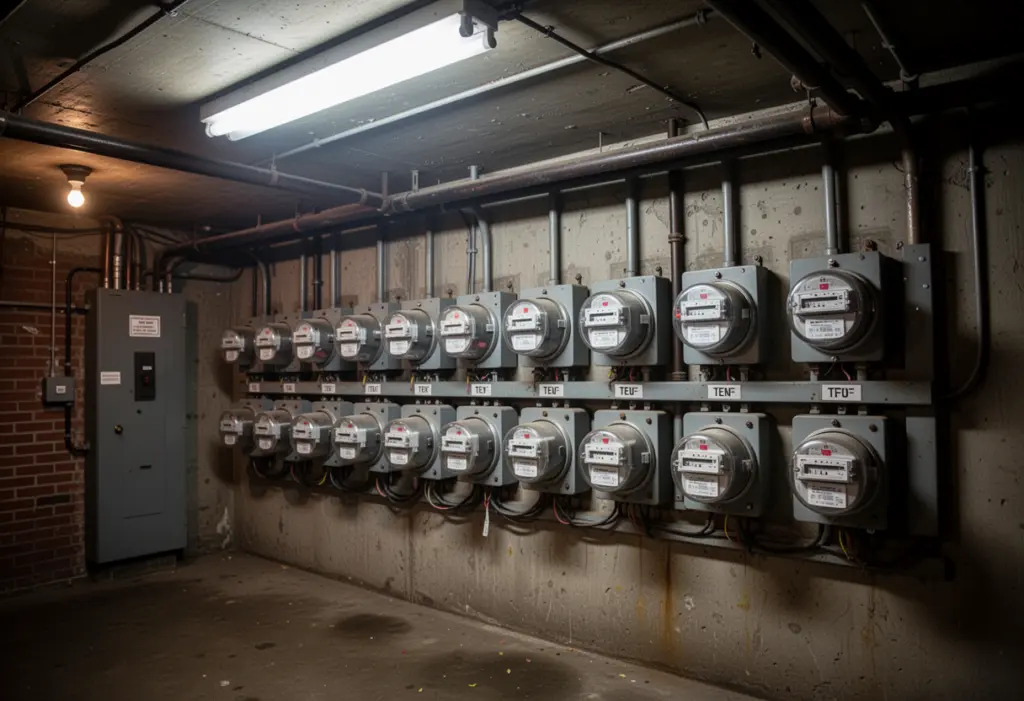
In an apartment building, storage is a building systems project rather than a household purchase, and two questions settle most of the outcome before equipment is discussed at all: who owns the meter the battery would sit behind, and who controls the room it would sit in. A resident can answer neither alone, which is why so many enquiries about this end nowhere.
Who owns the meter decides who benefits
If the building is individually metered, each apartment has its own account and its own bill, and a battery installed in a shared plant room sits behind the building’s house meter. It serves common loads: hallway lighting, the lift, pumps, the boiler controls. It does not reduce your apartment’s bill, because your apartment is a different customer of the utility. That is not a technicality, it is the whole economics of the project.
If the building is master-metered, the owner buys the electricity and recovers it through the rent or through a charge, so the owner is the party with the incentive and the party who has to be persuaded. Establish which arrangement you are in by looking at whether an electricity bill arrives in your own name.
Siting, and the fire official you have not spoken to yet
Where the battery may be placed is decided locally, and in a multi-unit residential building that decision involves the fire official as well as the building department. Ask early, in writing, because a room that seems obvious to an installer may not be acceptable, and relocating the equipment changes the cost of the conduit runs, the ventilation and the electrical work far more than it changes the price of the battery.
Permitting differs sharply by where you are. The New York State Unified Solar Permit standardises residential and small commercial solar permitting for systems of 25 kW DC and under and has been adopted by over 300 authorities having jurisdiction, but it does not apply in the five boroughs, which permit through the New York City Department of Buildings. And a solar permit is not automatically a storage permit. Ask your authority having jurisdiction directly whether the battery is covered by the same application or needs its own.
Board, landlord and lease
Ownership of the structure decides who signs. In a co-op or condominium the board controls common elements, so the plant room, the roof and the risers are theirs and not yours, and any project runs at board pace. In a rental, the landlord owns the building and has no obligation to install anything. A tenant who pays for equipment attached to somebody else’s building has usually just improved that building.
Before spending money on a proposal, get three things settled: written permission to use the space, written agreement on who owns the equipment at the end of the lease or on sale, and written agreement on who is responsible for maintenance and for any damage during installation.
If you rent and cannot get any of that, community solar is the honest answer
Community solar needs no roof, no board approval and no equipment in the building. You subscribe, a share of a project’s output is credited to your utility account, and the credit appears on your own bill in your own name. Subscribers pay no Customer Benefit Contribution at all, because that charge falls on net-metered systems rather than on subscriptions. It does not give you backup power during an outage, which is the one thing a battery does and community solar cannot, so be clear with yourself about which of the two problems you are actually solving.
The part to read carefully is the cancellation and transfer language. Ask what notice period applies, what happens if you move within the same utility territory, and what happens if you move outside it.
If you are the building owner asking
The tax treatment of a system owned by a business or by a building entity runs through a different provision from the residential credit, and it is not something to guess at from a homeowner page. Take that to your accountant with the ownership structure in front of them, before the depreciation and credit assumptions get baked into a proposal.
The incentives that reach a building
RPTL 487 is the one most likely to matter at building scale, because it exempts the added value of the system from property tax for 15 years, requires construction before 1 January 2030, and depends on the municipality, the county and the school district each not having opted out. In New York City, Buffalo, Rochester, Syracuse and Yonkers there is no separate school district check, because those districts are fiscally dependent and levy no separate property tax. Inside New York City the exemption is administered by the Department of Finance, and the city’s separate solar abatement filed with the Department of Buildings layers on top of it rather than replacing it.
The state sales tax exemption applies to residential solar energy systems equipment, NY-Sun comes off the price through the contractor, and the 30% federal residential credit no longer exists in 2026 for anyone. Ask your assessor how storage equipment would be treated in your specific municipality before assuming the exemption follows the battery, and confirm your building’s utility from an actual bill.
Frequently Asked Questions
Can a tenant install a battery in an apartment?
Only with the owner's written permission, and usually the economics do not work. In an individually metered building a battery in a shared plant room sits behind the house meter and serves common loads, not your apartment, because your apartment is a separate utility customer.
Does the Unified Solar Permit cover storage in a building?
Not automatically. The state Unified Solar Permit standardises solar permitting for systems 25 kW DC and under across more than 300 authorities having jurisdiction, and does not apply in the five boroughs, which use the NYC Department of Buildings. Ask your AHJ whether the battery needs its own permit.
What is the alternative for a renter with no roof?
Community solar. You subscribe, credits appear on your own utility bill, and subscribers pay no Customer Benefit Contribution. It gives no outage backup, so decide first whether you want a lower bill or power during a blackout.
Does a building get a property tax exemption for solar and storage?
RPTL 487 exempts the added value for 15 years where the municipality, county and school district have each not opted out, with construction before 1 January 2030. Ask your assessor how storage specifically is treated in your jurisdiction.
This article is general information, not tax, legal or financial advice. Incentive amounts, eligibility rules and deadlines change and depend on your utility, your tax situation and your property. Confirm current terms with NYSERDA, your utility and a qualified tax professional before making a decision.
NY Solar Incentives
Independent New York solar research. We summarise NYSERDA, NY-Sun and federal programme rules from published sources and state plainly when a figure is an estimate. We are not a government agency and do not sell equipment.
Run the arithmetic on your own system
Check the dated program table and your arrangement before counting an incentive. Standard residential NY-Sun blocks are closed; Long Island Affordable Solar has a conditional income-verification route. The NY credit depends on qualified costs and tax liability, while the NYC abatement reduces future property-tax bills. The estimator keeps those timings separate.