Solar Incentives in Johnstown, NY: What Is Left in 2026
The federal credit that carried most solar quotes has ended. What remains in Johnstown is entirely a New York State and local package, and one part of it has three separate opt-outs to check.
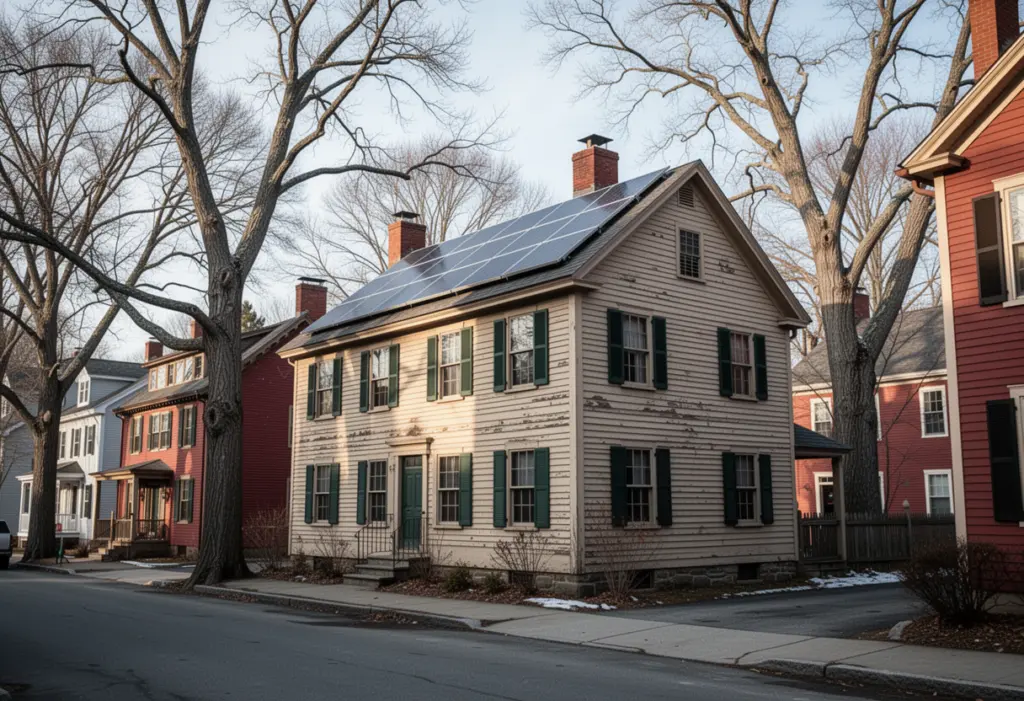
Johnstown is a city in Fulton County, with a separate Town of Johnstown around it. ZIP code 12095. The incentive picture here changed completely at the start of 2026, and a proposal built from an older template will get it wrong by several thousand dollars.
Begin with what has ended
The 30% federal residential credit no longer exists. Section 25D was terminated for expenditures made after 31 December 2025, and an expenditure is treated as made when the original installation is completed — not when the system is switched on, and not when the utility approves it. There is no phase-down, no transition rule and no carryover of a credit that was never earned. If a 2026 quote shows a 30% federal line, the payback, the monthly cost and the net price on that document are all wrong together. Ask for it to be rebuilt rather than adjusted over the phone.
The state credit, and the ten-year rule inside it
New York’s solar energy system equipment credit is 25% of qualified expenditure, capped at $5,000, on Form IT-255, for equipment installed and used at your principal residence in New York State. A seasonal, second or rental property does not qualify. The credit is not refundable, but unused amounts carry forward for up to five years, and it is limited by your actual state tax liability in the year you claim it.
What most quotes handle badly is that the credit is not restricted to buyers. It also reaches:
- a lease of at least ten years; and
- a written agreement of at least ten years to buy the power generated by equipment somebody else owns — a power purchase agreement.
The ten-year minimum applies to the lease exactly as it applies to the PPA. A five-year or seven-year lease does not qualify, however it is presented in a sales meeting, and that is worth stating plainly because summaries of this credit routinely attach the ten-year test only to the PPA.
Three further mechanics sit behind it. On an agreement running more than 15 years, no credit is allowed after the fifteenth year even if the $5,000 has not been used up. The $5,000 is a lifetime ceiling for that agreement rather than an annual allowance, so IT-255 requires you to subtract what you have already claimed against it. And the annual arithmetic differs by arrangement: for a PPA it is 25% of that year’s payments, while for a lease it is the payments made that year, capped by 25% of the total contracted payments or by $5,000, whichever is smaller. A flat “25% a year” describes the PPA and not the lease.
NY-Sun and Affordable Solar
NY-Sun arrived as a reduction on the contractor’s price, not as something you claimed. The amount depended on system size and on region, and it was structured in megawatt blocks whose per-watt value stepped down as each block filled, by design. The last standard upstate residential block (Block 14, $0.15/W, NYSEG, RG&E and National Grid territories) closed on 17 December 2025. As of September 2026 NYSERDA has no open NY-Sun block for homes in any utility territory; check NYSERDA’s NY-Sun dashboard for a new one. A 2026 quote that still shows a NY-Sun line should name the open block it relies on.
Affordable Solar was NYSERDA’s higher per-watt NY-Sun block for lower-income households, delivered the same way, through the contractor. The upstate block paid $0.80 per watt from 18 December 2025 until it closed on 9 March 2026, so it is not available on a Fulton County installation today either.
RPTL 487 and three separate decisions
RPTL 487 exempts the added value a solar system brings to a property from real property tax for 15 years. The catch is that the exemption survives only where nobody in your particular stack has opted out, and there are three:
- the city or town — the City of Johnstown and the Town of Johnstown are separate municipalities and decide separately, by local law;
- Fulton County, also by local law; and
- your school district, by resolution.
Many across the state have. Check all three against your own address instead of accepting a general claim that New York exempts solar from property tax. Section 487 also has an end date: the system must be constructed before 1 January 2030. And it is not automatic: file form RP-487 with the assessor by the taxable status date.
Sales tax, and which utility you are on
New York exempts residential solar energy systems equipment from state sales tax, and localities may separately elect to exempt their own share, so the total relief differs between counties and cities.
The utility question is more consequential here than the incentive tables suggest. Most of this area is National Grid, whose 2026 residential Customer Benefit Contribution is $0.97 per kW-month of DC capacity, the lowest residential rate in New York — $9.70 a month on a 10 kW system, about $116 a year, or $13.58 on 14 kW, about $163. It applies to systems interconnected on or after 1 January 2022, follows capacity rather than production, and is recalculated annually. Phase One net metering credits exports at the full retail rate and holds for 20 years from interconnection.
Read your own bill to confirm it, though. Municipal electric utilities are unusually common in this part of the state — Ilion, Mohawk, Frankfort, Sherrill and Boonville among them — and their customers are outside Public Service Commission jurisdiction, so none of the three rules in the previous paragraph reaches them.
Two local things that decide timing
Historic character. Johnstown has a colonial-era core, and where architectural or historic review applies it is a municipal step ahead of the building permit that can restrict street-visible placement. Design for approval rather than arguing after refusal, and ask when the board sits, because a monthly cycle turns a missed deadline into four weeks.
Older housing. Three ordinary conditions shift the net number here further than any incentive line does, and not one of them is a subsidy: a roof near the end of its shingle life that ought to be renewed before an array goes on it, a frame old enough that an engineer has to sign off the loading, and a 100 amp panel with no spare room for another breaker. Have all three priced before you weigh a proposal, not afterwards.
Every figure on this page is a programme rule the state can change. Verify each one at NYSERDA and at the Department of Taxation and Finance before a contract is signed.
Frequently Asked Questions
Is there still a federal solar tax credit in 2026?
Not for a homeowner buying a system. Section 25D was terminated for expenditures made after 31 December 2025, and an expenditure counts as made when the original installation is completed. There is no phase-down and no carryover of a credit never earned.
Does a solar lease qualify for the New York credit?
Only a lease of at least ten years. The ten-year minimum applies to a lease exactly as it does to a power purchase agreement, so a five-year or seven-year lease does not qualify however it is presented.
How is the credit calculated on a PPA compared with a lease?
On a power purchase agreement it is 25% of that year's payments. On a lease it is the payments made that year, capped by 25% of the total contracted payments or by $5,000, whichever is smaller. The $5,000 is a lifetime ceiling for that agreement.
Will solar raise my property taxes in Johnstown?
RPTL 487 exempts the added value for 15 years, but only where the city or town, Fulton County and your school district have each declined to opt out. Check all three, and note that the system must be constructed before 1 January 2030.
This article is general information, not tax, legal or financial advice. Incentive amounts, eligibility rules and deadlines change and depend on your utility, your tax situation and your property. Confirm current terms with NYSERDA, your utility and a qualified tax professional before making a decision.
NY Solar Incentives
Independent New York solar research. We summarise NYSERDA, NY-Sun and federal programme rules from published sources and state plainly when a figure is an estimate. We are not a government agency and do not sell equipment.
Run the arithmetic on your own system
Check the dated program table and your arrangement before counting an incentive. Standard residential NY-Sun blocks are closed; Long Island Affordable Solar has a conditional income-verification route. The NY credit depends on qualified costs and tax liability, while the NYC abatement reduces future property-tax bills. The estimator keeps those timings separate.