Solar Panel Installation in Whitesboro, NY
Whitesboro sits on flat low ground where Sauquoit Creek meets the Mohawk. That single fact decides where the inverter and any battery are allowed to go.
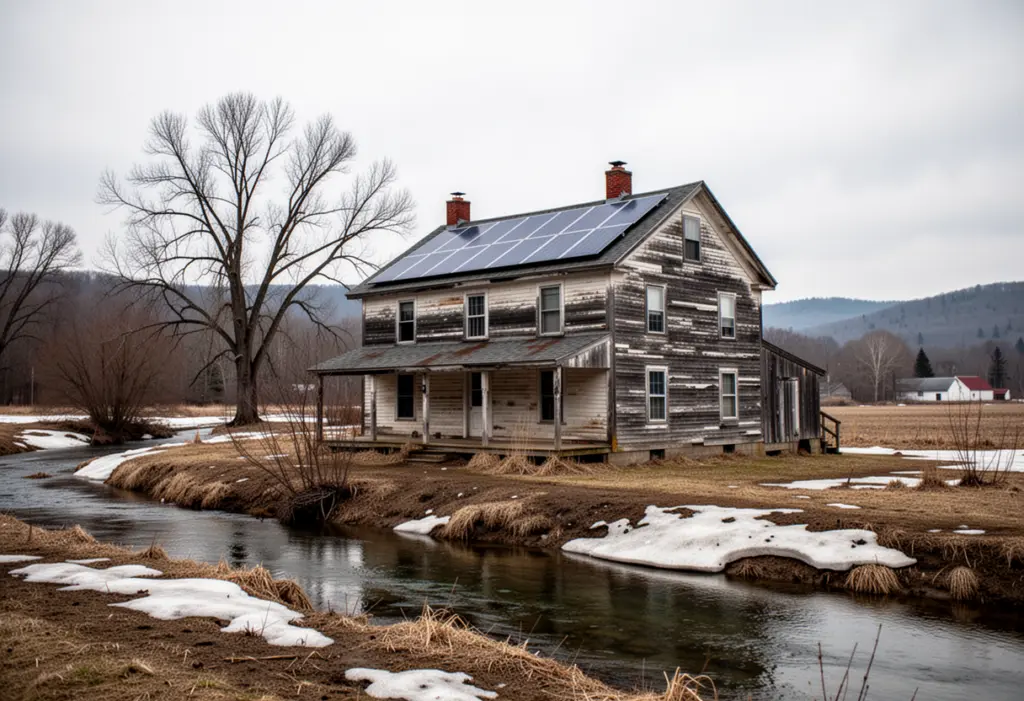
Whitesboro is a village in Oneida County, west of Utica, inside the Town of Whitestown. ZIP code 13492. It occupies flat, low ground near the point where Sauquoit Creek reaches the Mohawk River, and on a flat flood-plain village the design constraint arrives before the roof survey does.
Where the electrical equipment is allowed to sit
Inside a mapped flood zone the array itself is rarely the difficulty. The rules bite on the balance of system, and they bite in four places:
- the inverter, which may not be able to go on the wall the installer would choose by default;
- the AC and DC disconnects, which have to remain reachable while also clearing the required elevation;
- the production meter, which follows the same elevation rule; and
- any battery, which on a low-lying Whitesboro lot is the component most likely to be turned away from the tidy basement corner where it would otherwise live.
Exterior penetrations and conduit routing also draw closer attention on these parcels. All of that is workable, but only if it is known at design stage — relocating equipment once an inspector has been is an expensive way to learn the rule. Put the question to the building department before you sign, not after a layout has been drawn around the wrong wall.
Four villages and a town
The Village of Whitesboro and the Town of Whitestown permit separately, and Whitestown also contains Yorkville, New York Mills and Oriskany, each an authority in its own right. A small area therefore holds several possible filing destinations, and neighbouring streets can answer to different offices. Settle which one covers your address first, then ask whether it uses New York’s Unified Solar Permit — the standardised residential form for systems of 25 kW DC and under, adopted by over 300 authorities having jurisdiction statewide.
A two-line check on your bill
Read the supplier name at the top of your electricity bill before you read anything else about incentives. Most of Whitestown is National Grid, but Sherrill and Boonville run municipal electric systems inside Oneida County, and Ilion, Mohawk and Frankfort do the same nearby in Herkimer County. Municipal accounts fall outside Public Service Commission jurisdiction, which removes state net metering, the Customer Benefit Contribution and the standardised state interconnection process in one go and replaces them with whatever the village has decided. The figures in the next section belong to a National Grid account and to no other.
National Grid’s 2026 charge
The Customer Benefit Contribution reaches systems interconnected on or after 1 January 2022 and is levied on DC capacity at $0.97 per kW-month, the lowest residential rate of any New York utility for 2026.
- 5 kW — $4.85 a month, close to $58 over a year.
- 8 kW — $7.76 a month, close to $93 over a year.
The rate is republished annually and is not locked in when you interconnect. On the other side of the ledger, Phase One net metering values exported kilowatt-hours at the full retail rate and holds that treatment for 20 years.
Old village roofs
Slate
Common on housing of this age and entirely workable, but only with hardware and experience the average crew does not carry. Ask what they have mounted on slate and ask to see the photographs.
Standing-seam metal
The easiest old roof there is. Racking clamps to the seams, nothing pierces the covering, and the roof will usually outlive the modules.
Asphalt shingle
Under roughly ten years of remaining life, replace it first. Lifting an array and re-fitting it later costs substantially more than mounting on a bare deck.
What is behind the walls
Older wood frame draws a structural engineer’s letter more often than newer construction, and 100 amp service is widespread here, where adding a solar breaker can force a panel upgrade or a line-side tap. Ask what your service is and whether the busbar has room, and get the answer into the written quote rather than into a change order.
Snow, and the land beyond the village
Ask for the ground snow load the racking, attachments and roof structure are specified for, and ask where the array discharges — an array sheds as a slab, so snow guards above a door, a walkway or a driveway are a safety item.
Village lots here are small and well shaded by street trees, so a ground mount is rarely realistic on them. Out in Whitestown it often is, and where there is open land it is worth pricing: tilt and orientation become choices rather than inheritances, roof age stops mattering, and snow clearing happens at standing height. The questions that decide whether it works are setbacks, site plan review, foundation depth below the frost line and the clearance under the lowest row, since an array set too close to the ground disappears under drifted snow for weeks at a time.
2026: start with the property tax exemption
RPTL 487 exempts the added value a solar system brings to a property from real property tax for 15 years — but the exemption is not a single decision. A county, a city, a town or a village may opt out by local law and a school district may opt out by resolution, which in this part of Whitestown means up to three separate answers for one address: your village or the town, Oneida County, and your school district. A general statement that New York exempts solar from property tax is worth nothing until all three have been checked for your parcel. Note also that section 487 reaches only systems constructed before 1 January 2030, and that the exemption has to be claimed by filing form RP-487 with the assessor by the taxable status date.
The rest of what survives, for a principal residence in New York: the 25% state credit capped at $5,000 on Form IT-255, which reaches purchases, leases of at least ten years and power purchase agreements of at least ten years, and which is limited by your state tax liability with a five-year carry-forward; and the state sales tax exemption on residential solar equipment, where localities may separately elect to exempt their own share. NY-Sun and its Affordable Solar block for lower-income households are no longer on the list: as of September 2026 NYSERDA has no open NY-Sun block for homes in any utility territory; check NYSERDA’s NY-Sun dashboard for a new one.
There is no 30% federal credit for a 2026 buyer. Congress terminated section 25D for expenditures made after 31 December 2025, and the statute treats the expenditure as made at the moment the original installation is finished. None of this is fixed, either: check whether NYSERDA has opened a new NY-Sun block and what the state credit rules say on the day you sign, at NYSERDA and at the Department of Taxation and Finance.
Frequently Asked Questions
Does being in a flood zone rule out solar in Whitesboro?
No. It relocates the electrical equipment. The inverter, both disconnects, the production meter and any battery normally have to clear a specified elevation, which is why a basement battery is often refused on low-lying lots. Settle it with the building department at design stage.
Do I file with the village or with Whitestown?
Whichever holds your address. The Village of Whitesboro and the Town of Whitestown permit separately, and Whitestown also contains Yorkville, New York Mills and Oriskany, so neighbouring streets can answer to different offices.
Can panels go on a slate roof?
Yes, with the right hardware and a crew that has done it before, so ask for photographs of their slate work. Standing-seam metal is easier still, because the racking clamps to the seams and nothing penetrates the roof covering.
Do I have to check the property tax exemption in more than one place?
Yes. RPTL 487 can be opted out of by a county, city, town or village by local law and by a school district by resolution, so your village or town, Oneida County and your school district each need a separate answer for your address.
This article is general information, not tax, legal or financial advice. Incentive amounts, eligibility rules and deadlines change and depend on your utility, your tax situation and your property. Confirm current terms with NYSERDA, your utility and a qualified tax professional before making a decision.
NY Solar Incentives
Independent New York solar research. We summarise NYSERDA, NY-Sun and federal programme rules from published sources and state plainly when a figure is an estimate. We are not a government agency and do not sell equipment.
Run the arithmetic on your own system
Check the dated program table and your arrangement before counting an incentive. Standard residential NY-Sun blocks are closed; Long Island Affordable Solar has a conditional income-verification route. The NY credit depends on qualified costs and tax liability, while the NYC abatement reduces future property-tax bills. The estimator keeps those timings separate.