Solar Panel Cost in Manlius, NY
The Town of Manlius contains three villages and sits at the foot of a rising escarpment. Both change what a system costs and what it is worth.
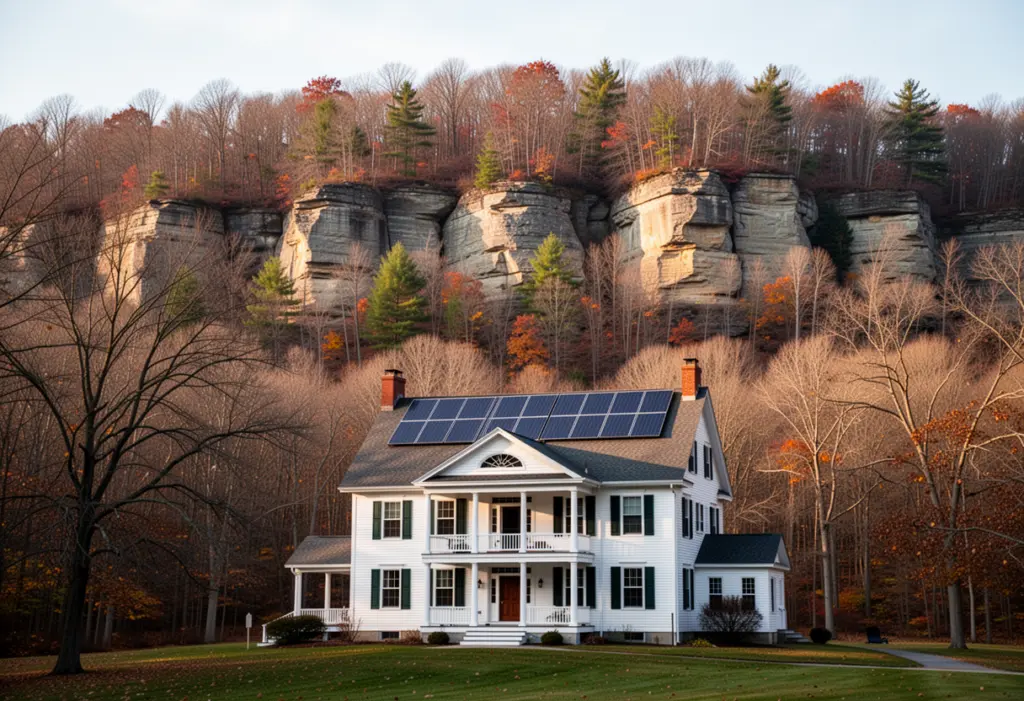
Manlius is a town in Onondaga County east and south-east of Syracuse, and also a village of the same name inside it. ZIP code 13104. Cost here is decided far less by the price per watt than by three local facts: how many building departments are in play, what the ground to the south does to winter yield, and a state credit that stops growing at $5,000 while the house keeps getting bigger.
Four authorities, four fee schedules
The Town of Manlius contains three incorporated villages, and each of the four runs its own building department:
- the Town of Manlius,
- the Village of Manlius,
- the Village of Fayetteville,
- and the Village of Minoa.
Treat that as a line in the budget rather than a formality. Fees differ, turnarounds differ, and a project parked in the wrong queue carries the cost of held equipment and a rescheduled crew. On the older village streets design review can also sit ahead of the building permit and restrict street-visible placement; ask when the board meets, because a monthly cycle turns one missed submission into four more weeks of carrying cost.
The rising ground south of the villages
Why do two installers quote such different annual production for the same roof? South of the villages the land climbs onto the limestone escarpment at the northern edge of the Allegheny Plateau, and a house at the foot of that rise can have its southern sky closed off by terrain rather than by trees. Terrain is not trimmable and it does not show up in a satellite estimate. Insist on an on-site horizon assessment, and ask for the December and January figures rather than the annual total alone, because those are the months when the sun sits lowest, the ridge reaches furthest and the net metering credit bank is being drawn down. Where terrain and mature trees combine, a smaller array or a community solar subscription is sometimes the honest answer.
The cap that binds on a large array
Large houses take large arrays, and that is where the arithmetic turns: one cost scales with system size and one benefit does not.
The Customer Benefit Contribution is charged on DC size. At National Grid’s 2026 residential rate of $0.97 per kW-month:
- 16 kW: $15.52 a month, about $186 a year.
- 20 kW: $19.40 a month, about $233 a year.
New York’s credit does the opposite. It is 25% of qualified expenditure but capped at $5,000 whatever the system costs, it is limited by your actual New York State tax liability, and it is not refundable, so unused credit carries forward for up to five years rather than being paid out. On a 20 kW array the cap is reached long before a quarter of the cost is, and the credit therefore covers a smaller share of the total than the headline 25% suggests. Read any proposal that applies 25% to the whole contract price as an error rather than an offer.
Snow specification shows up in the price
Equipment specified for a generic New York installation may not meet the ground snow load this county sees off Lake Ontario, and three consequences land on the invoice: racking and attachments rated for the load rather than the lowest-priced on the shelf, a structural engineer’s letter that is needed here more often than downstate, and snow guards wherever the array discharges over a door, a walkway or a driveway. Ask which snow-cover assumption sits in the production model as well, because on a system this size a downstate profile compounds into a savings figure that is materially wrong.
Roofs decide what is left
Slate and standing-seam metal both appear on the older village housing. Standing seam is the best case, since racking clamps to the seams with no penetrations at all and the covering commonly outlives the panels; slate needs an installer who has done slate, so ask for photographs of their work on your roof type. On asphalt, under roughly ten years of shingle life left means re-roof first. Newer subdivision housing east and north of the village usually clears all of this with engineered trusses, 200 amp service and large simple planes, and substitutes a different obstacle: a covenant or homeowner association rule, which is a private agreement no building department can waive.
2026 incentives on an expensive system
The 30% federal residential credit no longer exists. Section 25D was terminated for expenditures made after 31 December 2025, with an expenditure treated as made when the original installation is completed. On an array this size that is the largest single change to the arithmetic in years, and a proposal that still shows the line has simply not been repriced.
What remains, in the order it matters on a large job: the $5,000-capped state credit described above, which is the reason a bigger system does not bring a bigger credit; the state sales tax exemption on residential solar equipment, where localities elect separately on their own share (Onondaga County has not: its 4% local sales tax still applies, per the Tax Department’s Publication 718-S); and RPTL 487, a 15-year exemption on the added assessed value, which on a large array is the largest number on the list. It is available only where the town or village, Onondaga County and your school district have each not opted out, only for construction before 1 January 2030, and only if you file form RP-487 with each assessor by the taxable status date. NY-Sun and its Affordable Solar blocks are no longer on the list. As of September 2026 NYSERDA has no open NY-Sun block for homes in any utility territory; check NYSERDA’s NY-Sun dashboard for a new one. Check the current position with NYSERDA and the state tax department before signing.
Frequently Asked Questions
Why do Manlius production estimates differ so much?
Usually the horizon. The land climbs onto the limestone escarpment south of the villages, so a property at the foot of the rise can be obstructed by terrain rather than trees. Insist on an on-site assessment and ask for the December and January figures separately.
Is the New York credit worth less on a large Manlius system?
Proportionally, yes. It is 25% of qualified expenditure but capped at $5,000 whatever the system costs, limited by your actual state tax liability and not refundable. On a 20 kW array the cap is reached long before a quarter of the cost is.
Which building department handles my permit?
One of four. The Town of Manlius contains the Villages of Manlius, Fayetteville and Minoa, and each runs its own department with its own fees and turnaround. A project parked in the wrong queue carries cost while equipment sits.
What does National Grid charge on a large array here?
The Customer Benefit Contribution at $0.97 per kW-month of DC system size for 2026: $15.52 a month on 16 kW, about $186 a year, and $19.40 on 20 kW, about $233. It is billed on capacity regardless of production and reset annually.
This article is general information, not tax, legal or financial advice. Incentive amounts, eligibility rules and deadlines change and depend on your utility, your tax situation and your property. Confirm current terms with NYSERDA, your utility and a qualified tax professional before making a decision.
NY Solar Incentives
Independent New York solar research. We summarise NYSERDA, NY-Sun and federal programme rules from published sources and state plainly when a figure is an estimate. We are not a government agency and do not sell equipment.
Run the arithmetic on your own system
Check the dated program table and your arrangement before counting an incentive. Standard residential NY-Sun blocks are closed; Long Island Affordable Solar has a conditional income-verification route. The NY credit depends on qualified costs and tax liability, while the NYC abatement reduces future property-tax bills. The estimator keeps those timings separate.