Tesla Powerwall Cost in New York: What Drives the Number
The figure quoted online is a hardware price, and no New York homeowner pays a hardware price. The gap is electrical work, permits and decisions about your particular house.
On this page 8 sections
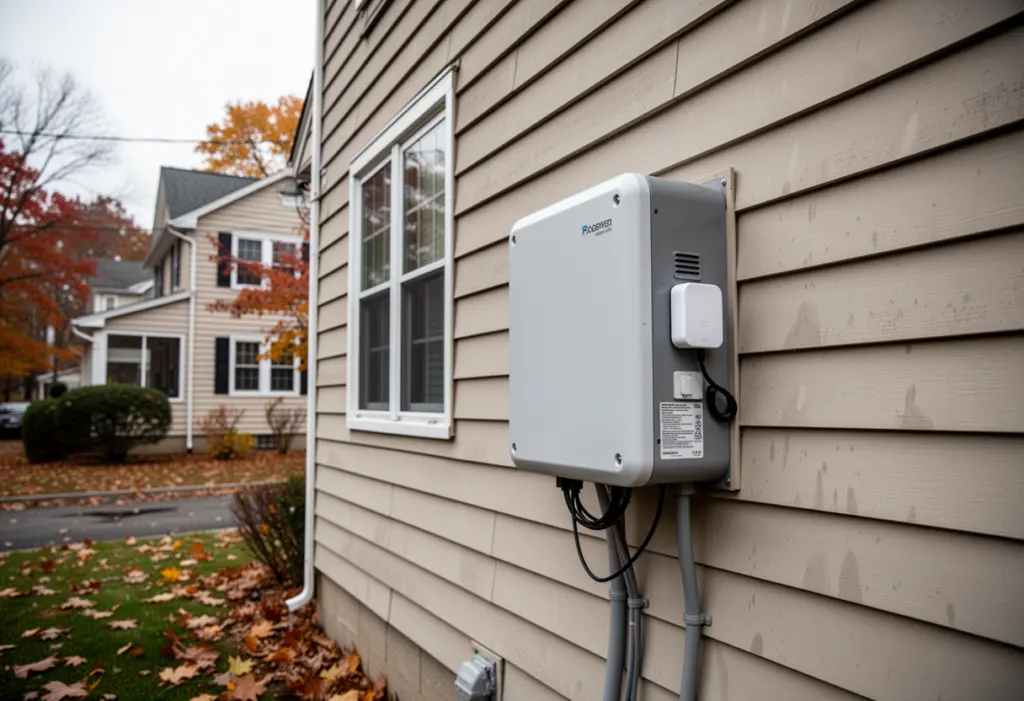
The figure people find online for a named home battery is a hardware price, and no New York homeowner pays a hardware price. What you pay is an installed price, and the gap between the two is made of electrical work, permits, and decisions about your particular house. This page is about reading that number. It does not recommend a product, and no page on this site names a best one.
Take the quote apart into lines
Ask for the proposal itemised, and expect to see at least these lines: the battery hardware, the gateway or transfer equipment that disconnects you from the grid during an outage, electrical labour, any subpanel work, permit and inspection fees, commissioning, and the sales tax treatment. A single bundled number cannot be compared with another single bundled number, because you have no way of telling whether the two cover the same scope.
How many units, and why the answer is about motors
Whole home backup and selected circuit backup are different products at different prices. The variable that usually decides how many units you need is not stored energy but continuous power. A well pump, a septic pump, a central air compressor or an electric range draw far more at start up than they draw running. Write the list of what must work, identify the largest motor on it, and ask the installer to state the continuous and surge ratings of the proposed configuration against that specific load.
Your house is most of the variance
- Service size. Much of the New York housing stock predates modern loads and still runs a 100 amp service. If a service upgrade is required, ask for it priced separately so you can actually see it.
- Where it mounts. Garage, basement or exterior wall, each with a different temperature range requirement. In a flood plain a basement location may be ruled out entirely.
- Distance. Conduit and conductors between the battery, the main panel and the meter are priced by the metre and by the difficulty of the route through the building.
- Cold. An outdoor installation in the Adirondacks or the Tug Hill snow belt has to be specified for the temperatures it will really see, and low temperature behaviour affects usable capacity in exactly the season you want it most.
Comparing two quotes fairly
Specify the comparison yourself rather than letting each company define its own. Give both the same brief: the same usable kilowatt-hours, the same continuous power, the same list of backed up circuits, and the same question about whether the array can recharge the battery during a grid outage. Then the difference between the two numbers is a price difference. Without that, it is a scope difference wearing a price tag.
Financing changes the price, not just the payment
A very low advertised interest rate on a storage loan is generally paid for by a dealer fee built into the system price. Ask for the cash price and the financed price on the same sheet, and compare the totals. A payment that fits your month is not the same thing as a price that makes sense.
What it will not do to your bill
Under Phase One net metering New York credits exports at the full retail rate for 20 years from interconnection, so storing energy to use later saves about what the credit would have saved anyway. Expect resilience, not a smaller bill. The Customer Benefit Contribution is charged monthly on the DC size of the solar array and not on storage, so a battery does not increase it: a 12 kW array pays 12 x $1.00 = $12.00 a month on Orange & Rockland and 12 x $1.31 = $15.72 a month on RG&E under the 2026 residential rates. Those rates are recalculated annually rather than fixed at interconnection.
2026 incentives, stated plainly
There is no 30% federal residential credit in 2026. Section 25D was terminated for expenditures made after 31 December 2025, with an expenditure treated as made when the original installation is completed, so a quote still showing a federal line is materially wrong and should be sent back for correction. What survives federally is the business side credit claimed by the company that owns a leased or power purchase agreement system, which is why third party offers still price in an incentive you will never see on your own return.
At state level the 25% credit capped at $5,000 on Form IT-255 remains for solar energy system equipment installed and used at your principal residence, limited by your actual New York tax liability and carried forward up to five years. Whether storage costs fall inside that definition is a question for the form instructions and your preparer, not for a salesperson. NY-Sun used to be applied by the contractor as a price reduction rather than claimed by you, but as of September 2026 NYSERDA has no open NY-Sun block for homes in any utility territory; check NYSERDA’s NY-Sun dashboard for a new one, and if one opens, ask to see it as a line. Verify all of it at the NYSERDA and state tax websites on the day you sign, because these programmes move.
Frequently Asked Questions
Why is the installed price higher than the price listed online?
The online figure is hardware. An installed price adds gateway or transfer equipment, electrical labour, any subpanel or service work, permits, inspection and commissioning, which together are frequently the larger share.
How do I compare two battery quotes?
Give both companies the same brief: identical usable kilowatt-hours, identical continuous power, the same list of backed up circuits, and the same question about recharging from the array during an outage.
Will a home battery lower my electricity bill in New York?
Not meaningfully. Phase One net metering credits exports at the full retail rate for 20 years, so energy stored for later use saves about what the export credit would have saved.
Is there a federal tax credit on a battery in 2026?
Not for a homeowner. Section 25D ended for expenditures made after 31 December 2025, measured by when the original installation is completed. Any 2026 proposal showing 30% federal is wrong.
This article is general information, not tax, legal or financial advice. Incentive amounts, eligibility rules and deadlines change and depend on your utility, your tax situation and your property. Confirm current terms with NYSERDA, your utility and a qualified tax professional before making a decision.
NY Solar Incentives
Independent New York solar research. We summarise NYSERDA, NY-Sun and federal programme rules from published sources and state plainly when a figure is an estimate. We are not a government agency and do not sell equipment.
Run the arithmetic on your own system
Check the dated program table and your arrangement before counting an incentive. Standard residential NY-Sun blocks are closed; Long Island Affordable Solar has a conditional income-verification route. The NY credit depends on qualified costs and tax liability, while the NYC abatement reduces future property-tax bills. The estimator keeps those timings separate.