Solar Shingles vs Panels in New York: What to Compare
Solar shingles are a roofing decision before they are an energy decision. If your roof has years left in it, that single fact settles most of the comparison.
On this page 7 sections
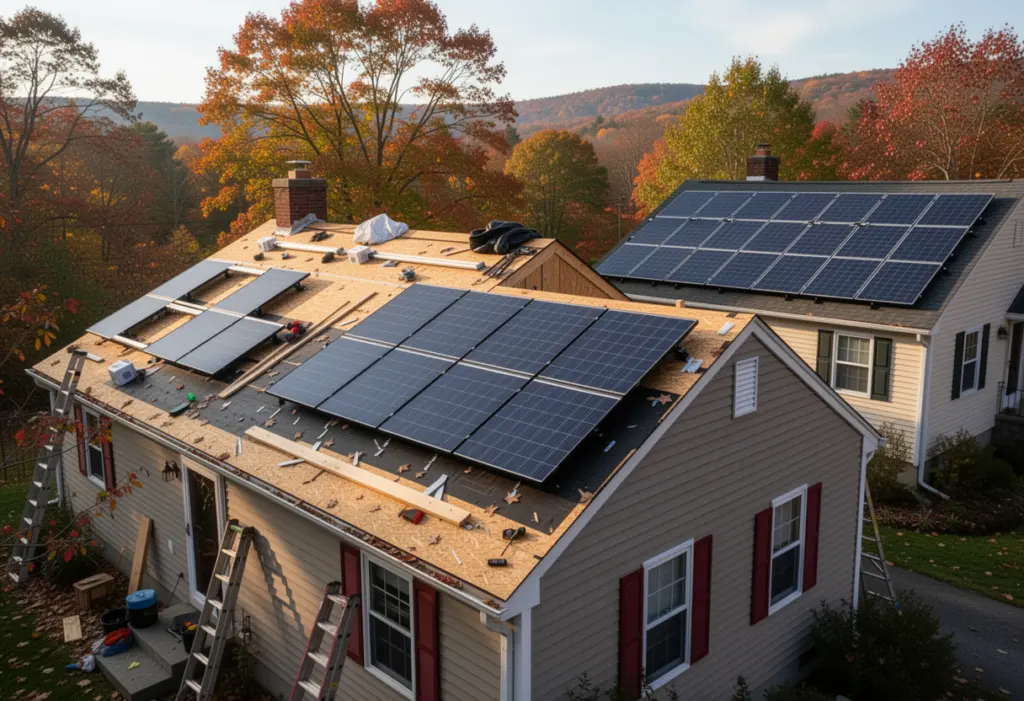
The comparison turns on one question, and it is not an energy question: is the roof being replaced anyway? Solar shingles are a roof covering that generates electricity, so they only make sense at the moment you are buying a roof. If the covering above your head has ten good years left, rail mounted panels put generation on it without throwing that away, and most of the rest of the argument becomes secondary.
What the two products are
Rail mounted panels attach to a mounting system that is lagged through the existing covering into the rafters, and they sit above it in their own plane. Solar shingles are building integrated: they take the place of the covering, so the generating surface and the weatherproofing surface are the same surface.
That single structural difference produces every practical consequence below. One product has a roofer and an electrician working on separate layers. The other has one layer doing two jobs, and one warranty conversation covering both.
Compare modelled production, not nameplate capacity
Integrated products generally cover more roof area to reach the same capacity, and some of that area sits on planes a panel installer would have skipped. So a straight kW to kW comparison flatters whichever quote used the worse roof planes.
Ask both bidders for modelled annual kWh for your specific roof, then divide by the DC capacity to get kWh per kW. That ratio exposes the difference orientation and shading make, and it is the number your bill responds to.
Capacity still matters for one thing: the Customer Benefit Contribution is billed monthly on DC size regardless of what the system produces, on systems interconnected on or after 1 January 2022. On NYSEG the 2026 residential rate is $1.19 per kW-month, so a 7.2 kW system pays 7.2 x $1.19, about $8.57 a month or roughly $103 a year, and that rate is recalculated annually rather than locked in at interconnection. Capacity you added only to compensate for poor roof planes costs that charge every month while returning less energy than the same capacity on a good plane.
Questions that separate the two quotes
- Where does the roofing warranty end and the electrical warranty begin? On an integrated roof, get both in writing from named parties, and ask who you call when water appears and the cause is unclear.
- Who services it in five years? Ask how many installers within reasonable driving distance are certified on that specific product, and what happens to service if the manufacturer withdraws it.
- How is a single failed unit replaced? On a panel array a module is unbolted. On an integrated roof, replacement means opening the weather surface.
- What is the cost to remove and reinstate for a roof repair? Ask for a written figure now, not a reassurance.
- What is the price per watt DC on each quote, before any incentive? If either quote deducts a NY-Sun reduction, ask which open block it comes from: as of September 2026 NYSERDA has no open NY-Sun block for homes in any utility territory. Then note separately what roofing cost the integrated quote genuinely avoids, because that is the only part of the roofing spend that belongs in the solar comparison.
New York weather is the part a brochure skips
Freeze and thaw cycling works on every penetration and every flashing detail through a New York winter, and ice damming loads the eaves of a house that was already marginal on ventilation. Both products live with that. Ask each bidder what it does about ice at the eaves, how snow slides or fails to slide off the finished surface, and whether the attic ventilation behind the assembly changes.
Permitting and interconnection do not change
Either product is a residential photovoltaic system to the reviewing authority. The New York State Unified Solar Permit standardises the process for systems of 25 kW DC and under and has been adopted by over 300 authorities having jurisdiction; the five boroughs work through the New York City Department of Buildings instead. Interconnection and net metering run through your utility, and most residential rooftop customers are on Phase One net metering, which credits exports at the full retail rate and holds that structure for 20 years from interconnection.
One exception matters: if your electricity comes from a municipal electric utility, you are outside Public Service Commission jurisdiction entirely, so there is no state net metering rule, no Customer Benefit Contribution and no state interconnection process. Read the utility name on your own bill before assuming any of this applies.
Incentives, and the one that used to favour panels
NY-Sun depended on system size and on your region, and was paid through the contractor as a price reduction rather than claimed by you. It is structured as a megawatt block, so the per-watt figure stepped down as each regional block filled, and because it scaled with size, a lower capacity integrated roof earned a smaller reduction than a higher capacity panel array on the same house. For homes that difference is gone for now: as of September 2026 NYSERDA has no open NY-Sun block for homes in any utility territory; check NYSERDA’s NY-Sun dashboard for a new one. If a bidder’s price still assumes a NY-Sun reduction, ask which open block it comes from before you compare the two quotes.
New York State also still offers 25% of qualified solar energy system equipment expenditure, capped at $5,000, on Form IT-255, for a principal residence in the state. On an integrated roof, part of the invoice is a roof and part is a generating system. Ask the installer for a line item split and ask your own tax preparer what qualifies rather than accepting a number written on a proposal. The residential sales tax exemption covers solar energy system equipment, and RPTL 487 exempts the added value of the system, so on an integrated roof the same split question arises again: ask your assessor and your own tax preparer which part of a roof-and-generator invoice each one reaches rather than assuming the product is treated as one thing. RPTL 487 runs 15 years, requires that your municipality, your county and your school district have each not opted out, and applies only to systems constructed before 1 January 2030.
The 30% federal residential credit is gone. Section 25D was terminated for expenditures made after 31 December 2025, and an expenditure is treated as made when the original installation is completed. Any 2026 quote for either product showing a 30% federal line is materially wrong, and you should ask why it is there. Programmes move, so confirm NY-Sun and the state credit at NYSERDA and the New York State Department of Taxation and Finance on the day you sign.
Frequently Asked Questions
Are solar shingles worth it in New York?
They are worth pricing when the roof is being replaced anyway, because they replace the covering rather than sit on it. If your existing roof has years of life left, rail mounted panels avoid paying for a roof you did not need.
Do solar shingles produce less than panels?
Compare modelled annual kWh for your own roof, then divide by DC capacity to get kWh per kW. Integrated products often cover more area, including planes a panel installer would skip, so a straight capacity comparison can mislead.
Does a bigger system cost more every month in New York?
Yes, on any system interconnected on or after 1 January 2022. The Customer Benefit Contribution is billed on DC size regardless of production. On NYSEG at $1.19 per kW-month for 2026, a 7.2 kW system pays about $8.57 a month, roughly $103 a year.
Who is responsible if an integrated solar roof leaks?
Get that in writing before signing. Ask where the roofing warranty ends and the electrical warranty begins, which named party you call when water appears, and what removing and reinstating the surface for a repair costs.
This article is general information, not tax, legal or financial advice. Incentive amounts, eligibility rules and deadlines change and depend on your utility, your tax situation and your property. Confirm current terms with NYSERDA, your utility and a qualified tax professional before making a decision.
NY Solar Incentives
Independent New York solar research. We summarise NYSERDA, NY-Sun and federal programme rules from published sources and state plainly when a figure is an estimate. We are not a government agency and do not sell equipment.
Run the arithmetic on your own system
Check the dated program table and your arrangement before counting an incentive. Standard residential NY-Sun blocks are closed; Long Island Affordable Solar has a conditional income-verification route. The NY credit depends on qualified costs and tax liability, while the NYC abatement reduces future property-tax bills. The estimator keeps those timings separate.