NYSERDA Smart Energy Loan: What It Actually Requires
The Smart Energy Loan has three sets of requirements — the contractor, the borrower and the work — and only one of them is about you.
On this page 6 sections
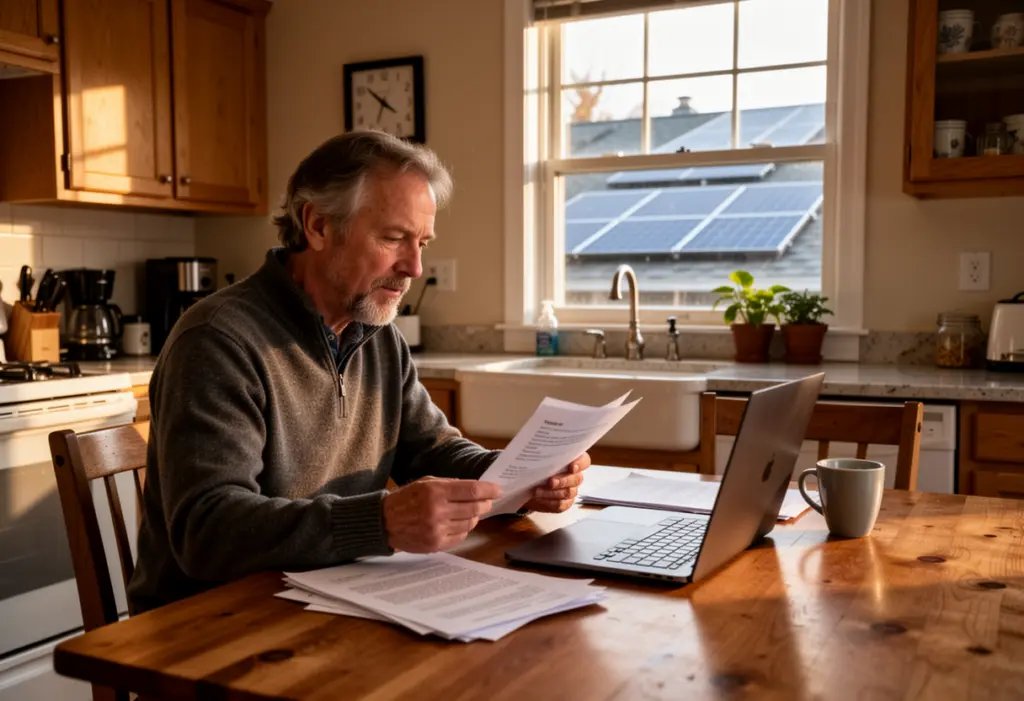
The Smart Energy Loan is the conventional half of New York’s state-supported residential financing: you borrow, and you repay a lender every month, exactly as with any other instalment loan. Before the interest rate matters, three sets of requirements do — the contractor, the borrower, and the work itself. Only one of the three is about you.
Key facts
- The Smart Energy Loan is a traditional loan repaid monthly, by check or automatic payment (ACH). (Source: NYSERDA, checked )
- NYSERDA’s On-Bill Recovery Loan is repaid as part of the utility bill instead. (Source: NYSERDA, checked )
- NYSERDA loans are not incentives or rebates and must be paid back. (Source: NYSERDA, checked )
- Smart Energy Loan approval follows published credit criteria, which NYSERDA can change at its discretion. (Source: NYSERDA, checked )
The contractor requirement is settled first
The loan attaches to work carried out by a participating contractor, so the pool of installers who can quote you against it is narrower than the pool advertising in your area. Establish that before a proposal is worth reading closely. Ask each company in writing whether they participate in the NYSERDA programme and whether the measures on your proposal are eligible under it. Enthusiasm about the financing combined with vagueness about participation is an answer to a different question.
This follows from how the rest of New York’s support is built. The NY-Sun incentive, when a block for homes is open, is applied by the contractor as a reduction in the price rather than claimed by you at tax time, which already makes the contractor the party that has to sit inside the programme. As of September 2026 NYSERDA has no open NY-Sun block for homes in any utility territory; check NYSERDA’s NY-Sun dashboard for a new one. Incentive and financing travel together, and both narrow your choice of installer in the same way.
The borrower requirement is a credit assessment, and it is revised
NYSERDA’s residential lending is administered by Energy Finance Solutions, and it involves a credit review. The criteria are published by the programme and they are revised over time, which is precisely why no article should print a threshold and no salesperson should recite one from memory. Ask what is being assessed and whether more than one route through the assessment exists, then confirm the answer on the programme’s own pages rather than on a finance sheet printed by the company selling you the panels.
Understand also what an approval is not. It is a statement about your credit file. It says nothing about whether the array is the right size, whether the price is reasonable, or whether the production estimate behind the monthly payment is honest.
The amount follows the price after the incentive
Ask for the project price with any incentive already applied, and then ask what figure is being financed. A proposal showing a gross price, an incentive line, and a loan amount that quietly matches the gross is not a rounding error. With no NY-Sun block open for homes, a NY-Sun line on a 2026 quote should name the block it comes from, and the income-qualified Affordable Solar incentive has closed as well: in Con Edison territory on October 15, 2025, and Upstate on March 9, 2026.
- Get the cash price in the same document. A loan is not an incentive, and a low rate on an overpriced system is still an overpriced system.
- Ask which measures are inside the eligible scope. A roof replacement, a service upgrade or storage may or may not qualify, and that changes what you are financing elsewhere and on what terms.
- Ask about prepayment and about the other product. The On-Bill Recovery Loan is repaid through your utility bill instead, and the choice between them is about where the repayment lives, not about which is cheaper by definition.
The charge that survives every financing decision
The Customer Benefit Contribution is billed monthly on the DC size of the array, on systems interconnected on or after 1 January 2022, and it is entirely indifferent to how the system was paid for. A 7 kW array in NYSEG territory is 7 x $1.19 = $8.33 a month, a little over $99 a year. The 2026 residential rates run from $0.97 per kW-month on National Grid to $1.67 on Central Hudson, they are recalculated annually, and they are not locked in at interconnection. Community solar subscribers pay none of it at all.
If your power comes from a municipal electric utility — a village or city electric department rather than one of the seven investor-owned utilities — you are outside Public Service Commission jurisdiction entirely: no PSC net metering, no Customer Benefit Contribution and no state interconnection process. Confirm the utility name printed on your own bill before assuming any of this applies.
What is live in 2026, and what is not
The 30 percent federal residential credit under section 25D is gone. It was terminated for expenditures made after 31 December 2025, and an expenditure is treated as made when the original installation is completed. A finance illustration that still carries a federal line has a monthly figure underneath it that is wrong. New York’s own credit is unaffected by which loan you choose: 25 percent of qualifying expenditure, capped at $5,000, claimed on Form IT-255 for a principal residence in New York, limited by your actual state tax liability and carried forward up to five years. The state sales tax exemption applies to residential equipment, and RPTL 487 exempts the added value from property tax for 15 years, on a system constructed before 1 January 2030, where the municipality, the county and the school district have each not opted out.
Loan criteria, block incentives and tax rules all move. Read NYSERDA’s current pages for the loan terms and for the megawatt block position in your region on the day you sign, rather than trusting a printout from a sales visit.
Frequently Asked Questions
Who administers the NYSERDA Smart Energy Loan?
NYSERDA's residential lending is administered by Energy Finance Solutions. The same administrator handles the On-Bill Recovery Loan, which is repaid through your utility bill rather than to a lender directly.
Do I have to use a particular installer?
The work has to be done by a participating contractor, so the loan narrows your choice of installer. Ask in writing whether a company participates before you take its proposal seriously, because the answer changes which quotes are comparable.
Does loan approval mean the price is fair?
No. Approval is a statement about your credit file and nothing else. A low rate on an overpriced or oversized system is still an overpriced system, so get the cash price and the financed price in the same document.
Is the loan itself an incentive?
No. NY-Sun is the incentive, applied by the contractor as a price reduction when a block for homes is open, and as of September 2026 none is. The loan is borrowing, and it should be compared against a credit union loan or a home equity product on rate, term and fees.
This article is general information, not tax, legal or financial advice. Incentive amounts, eligibility rules and deadlines change and depend on your utility, your tax situation and your property. Confirm current terms with NYSERDA, your utility and a qualified tax professional before making a decision.
NY Solar Incentives
Independent New York solar research. We summarise NYSERDA, NY-Sun and federal programme rules from published sources and state plainly when a figure is an estimate. We are not a government agency and do not sell equipment.
Run the arithmetic on your own system
Check the dated program table and your arrangement before counting an incentive. Standard residential NY-Sun blocks are closed; Long Island Affordable Solar has a conditional income-verification route. The NY credit depends on qualified costs and tax liability, while the NYC abatement reduces future property-tax bills. The estimator keeps those timings separate.