Solar Payback: Upstate vs Downstate New York
Payback is net cost divided by annual saving, and moving a house from Nassau County to St. Lawrence County changes both halves of that fraction at once.
On this page 8 sections
- 01The denominator: your own retail rate is the biggest single input
- 02The denominator, part two: production is not just latitude
- 03The numerator: what makes the job cost more in each place
- 04The recurring charge differs by utility, not by region
- 05Property tax: three checks, and five cities where there are two
- 06The check that voids the whole calculation
- 07Incentives that apply either way in 2026
- 08Frequently Asked Questions
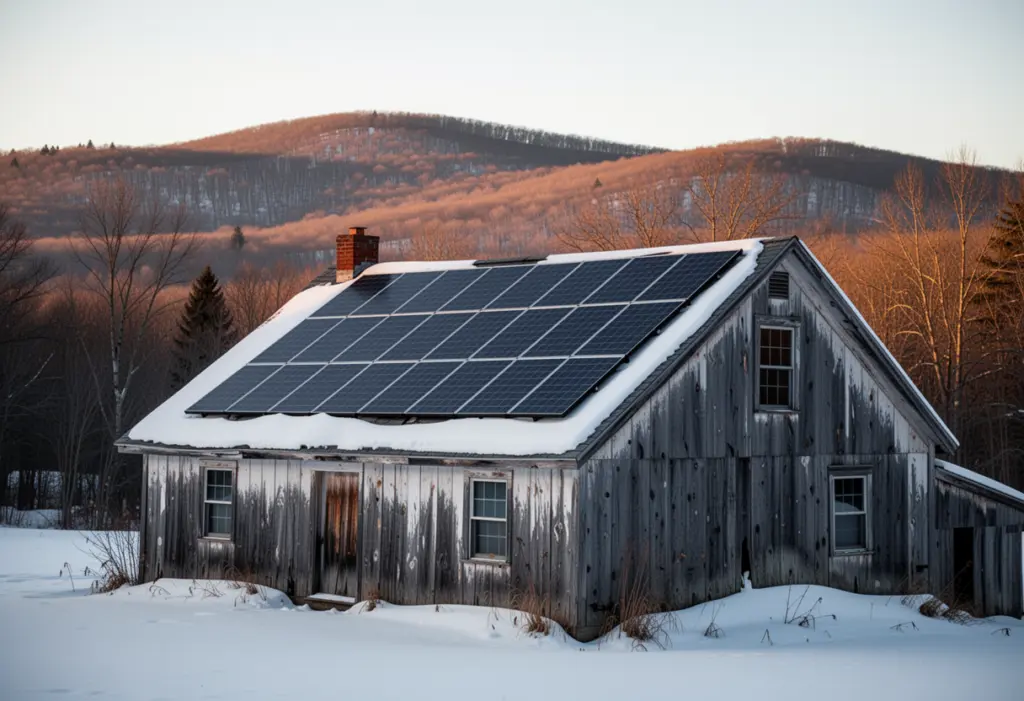
Payback is net cost divided by annual saving. Both numbers change as you move across New York, and they do not change in the same direction, which is why an upstate and a downstate homeowner can reach similar answers by completely different routes. Here is what actually differs.
The denominator: your own retail rate is the biggest single input
Every kilowatt-hour the array offsets is worth exactly what you would otherwise have paid for it. So the single most important figure in any payback calculation is your own delivered rate — supply plus delivery, not supply alone. Take it off your own bill: total dollars billed divided by total kilowatt-hours, over twelve months. Downstate and upstate delivered rates are not the same, and a proposal using a statewide average is producing a number about a household that does not exist.
Under Phase One net metering exports are credited at the full retail rate, and the structure holds for 20 years from interconnection. That is what makes the delivered-rate figure the right one to use, and it is also why a battery does not shorten payback in New York — storing a kilowatt-hour to use later saves what the grid would have credited you anyway. Buy storage for resilience if you want resilience; do not put it in the payback arithmetic.
The denominator, part two: production is not just latitude
Downstate roofs are more likely to be shaded by mature street trees and by neighbouring buildings on tight lots, and in the city more likely to be flat, ballasted and set back from parapets, which limits how much capacity actually fits. Upstate roofs are more likely to be steep, unshaded and snow-loaded, with December and January production suppressed in the lake-effect belts east of Ontario and Erie. Ask for the modelled output month by month, not just the annual total — the annual figure hides both problems.
The numerator: what makes the job cost more in each place
- Permitting. Most of the state uses the NYS Unified Solar Permit for systems 25 kW DC and under, adopted by over 300 authorities having jurisdiction. The five boroughs are outside it and file with the NYC Department of Buildings, which is a different timeline and a different cost.
- Access. A city row house or a Long Island lot with no side access changes staging, scaffolding and crane decisions. A rural property with a long driveway changes them differently.
- Housing age. Older upstate stock brings 100 amp services, slate and standing-seam roofs and rafters at wide spacing. Slate and standing-seam both need specific attachment methods and a contractor who has done them.
- Snow country detailing. Snow guards, higher standoffs and mechanical loading calculations are real costs in the snow belts and are not in a generic proposal.
The recurring charge differs by utility, not by region
The Customer Benefit Contribution is billed monthly on DC size for systems interconnected on or after 1 January 2022. On an 8 kW array at 2026 residential rates the spread is:
- National Grid — $7.76 a month, $93.12 a year
- Orange & Rockland — $8.00 a month, $96.00 a year
- PSEG Long Island — $9.04 a month, $108.48 a year
- NYSEG — $9.52 a month, $114.24 a year
- Con Edison — $10.32 a month, $123.84 a year
- RG&E — $10.48 a month, $125.76 a year
- Central Hudson — $13.36 a month, $160.32 a year
Same array, same production, and roughly $67 a year of difference between the highest and the lowest, decided by nothing but which utility the roof sits under. Rates are recalculated annually rather than fixed at interconnection.
Property tax: three checks, and five cities where there are two
RPTL 487 exempts the added value of the system from real property tax for 15 years, and the exemption is only as good as three separate opt-out checks: the municipality, the county and the school district must each not have opted out. Upstate that usually means calling a town or village assessor, a county office and a school district. In New York City, Buffalo, Rochester, Syracuse and Yonkers the school districts are fiscally dependent and levy no separate property tax, so there is no separate school check in those five. In New York City, ask the Department of Finance how section 487 applies to your property; the city's own four-year solar abatement is a separate programme, applied for through the Department of Buildings together with the building permit. Systems must be constructed before 1 January 2030.
The check that voids the whole calculation
Some New Yorkers are outside all of it. Municipal electric utility customers sit outside Public Service Commission jurisdiction: no PSC net metering, no Customer Benefit Contribution and no state interconnection process, with terms set by the utility and available only by asking it. Upstate that includes places such as Massena, Plattsburgh, Jamestown, Sherrill and Skaneateles, and in Monroe County the villages of Fairport, Spencerport and Churchville are outside RG&E. Downstate, Freeport and Rockville Centre in Nassau and Greenport and Fishers Island in Suffolk are outside PSEG Long Island, and the Rockaway Peninsula in Queens is served by PSEG Long Island rather than Con Edison. Read the utility name on your own bill before trusting any payback estimate at all.
Incentives that apply either way in 2026
The state credit is the one that closes the gap in both halves of the state: 25% of qualified expenditure capped at $5,000 on Form IT-255, requiring a principal residence in New York, and reaching leases and power purchase agreements of ten years or longer. Nothing federal remains for a 2026 residential buyer, section 25D having ended for expenditures made after 31 December 2025 — an expenditure treated as made when the original installation is completed. NY-Sun no longer reduces a home’s contract price in either half of the state. As of September 2026 NYSERDA has no open NY-Sun block for homes in any utility territory; check NYSERDA’s NY-Sun dashboard for a new one. Check the current position yourself before committing to a payback number.
Frequently Asked Questions
Is solar payback faster upstate or downstate in New York?
Neither by default. Delivered electricity rates, shading, roof type, permitting and the utility's capacity charge all differ, so the honest answer comes from your own bill and your own roof.
What rate should I use in a payback calculation?
Your delivered rate, meaning supply plus delivery. Divide twelve months of total dollars billed by twelve months of kilowatt-hours. A statewide average describes a household that does not exist.
Does snow ruin solar payback in upstate New York?
It suppresses December and January output rather than ruining the year. Ask for modelled production month by month, and ask what snow assumption the model uses, instead of accepting an annual total.
Does a battery shorten payback in New York?
No. Under full retail rate net metering, a stored kilowatt-hour saves what the grid would have credited anyway. A battery is a resilience purchase, and a proposal presenting it as payback should be questioned.
This article is general information, not tax, legal or financial advice. Incentive amounts, eligibility rules and deadlines change and depend on your utility, your tax situation and your property. Confirm current terms with NYSERDA, your utility and a qualified tax professional before making a decision.
NY Solar Incentives
Independent New York solar research. We summarise NYSERDA, NY-Sun and federal programme rules from published sources and state plainly when a figure is an estimate. We are not a government agency and do not sell equipment.
Run the arithmetic on your own system
Check the dated program table and your arrangement before counting an incentive. Standard residential NY-Sun blocks are closed; Long Island Affordable Solar has a conditional income-verification route. The NY credit depends on qualified costs and tax liability, while the NYC abatement reduces future property-tax bills. The estimator keeps those timings separate.