Solar Panels and Home Appraisal in New York
An appraiser can only credit what is documented and what the local market supports. Whether you own the system decides most of the answer before anyone climbs a ladder.
On this page 7 sections
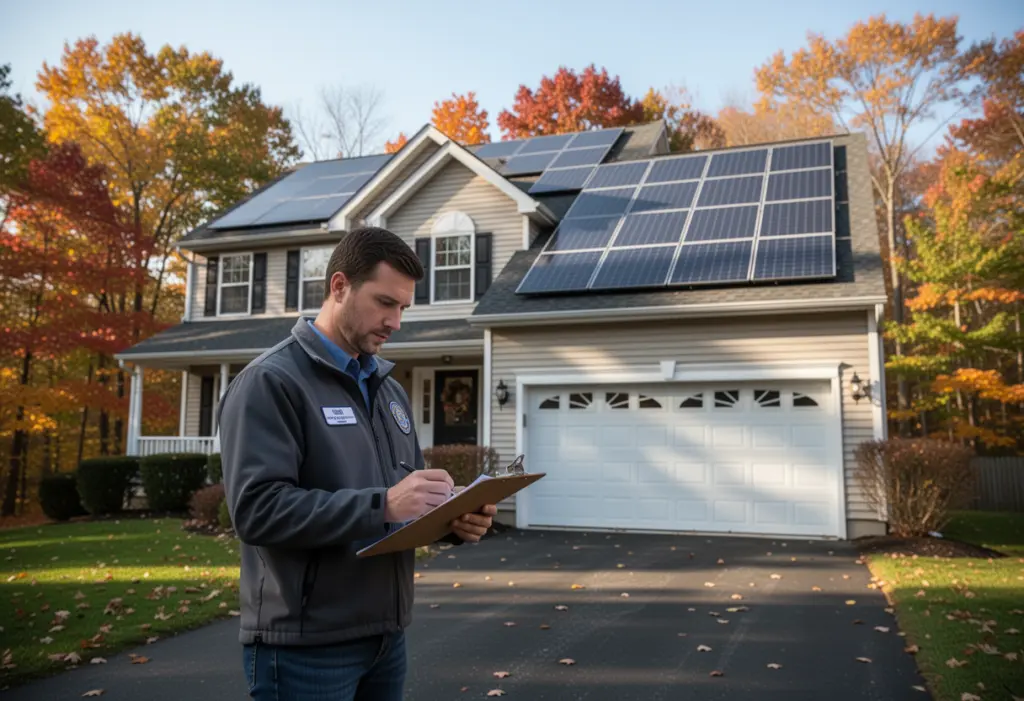
Two things determine how a solar array is treated in a New York home appraisal, and neither is the quality of the panels. The first is whether you own the system. The second is whether there is local market evidence to support an adjustment. Everything else is detail on top of those two.
Ownership decides most of it before anyone visits
An owned system, whether paid in cash or financed, is part of the real property and can be considered in the valuation. A leased system or one supplied under a power purchase agreement is not your asset — it is a contract a buyer would have to assume, and it is generally treated as an obligation to be disclosed and reviewed rather than as value to be added.
That distinction is uncomfortable for households who were sold a lease on the strength of what it would do to their home value. It is better to know it before the appraisal than during a sale.
What to hand the appraiser
An appraiser cannot credit what nobody documents. Assemble this and give it to them at the visit rather than promising to send it later:
- System size in kW DC, module and inverter make, and the number of panels.
- The installation date and the permission to operate date from the utility.
- The interconnection agreement and the name of the utility serving the property.
- Production history from the monitoring portal, ideally a full twelve months.
- Warranty documents — panels, inverters, workmanship and roof penetrations — with their transferability terms.
- Ownership status in one sentence, plus any UCC filing, lease or PPA documents.
- Permit sign-off and the electrical inspection certificate.
Why nobody can promise you a number
An appraiser looks for evidence in the local market — comparable sales with and without solar in the same area — and in a market where few solar homes have changed hands recently, there may simply not be enough evidence to support a large adjustment. An energy addendum recording the system details helps only when there is data behind it.
Treat any installer’s statement about how much value an array will add as marketing, not as an appraisal input. Appraisers do not take sales literature as evidence, and neither should you when you are deciding what to spend.
What is being valued is the saving, net of the charge
The economic case an appraiser is weighing is the reduced electricity bill. That bill is reduced by production and increased by the Customer Benefit Contribution, a monthly charge on the DC size of the system for anything interconnected on or after 1 January 2022. A 12 kW array on Central Hudson pays 12 x $1.67, which is $20.04 a month or about $240 a year, before a single kilowatt-hour is produced. The same array in Con Edison territory pays about $186 a year.
This is where oversizing stops helping. An array larger than your consumption builds net metering credits you never draw down, and pays the capacity charge on every kilowatt anyway. It buys no appraisal value that the market can see, and it costs money every month.
Appraisal and assessment are different processes
An appraisal is an opinion of market value for a lender or a sale. An assessment is your municipality valuing the property for tax. They can move independently, and confusing them causes avoidable alarm.
On the tax side, RPTL 487 exempts the added value of a solar system from property tax for 15 years, but only where your municipality, county and school district have each not opted out, which is three separate checks with your assessor and school district. The exemption requires construction before 1 January 2030. In New York City, Buffalo, Rochester, Syracuse and Yonkers there is no separate school check, because those school districts levy no separate property tax.
The 2026 incentive position behind the number
If the appraisal is part of a purchase or refinance, keep the incentive arithmetic straight. The 30% federal residential credit is gone — section 25D was terminated for expenditures made after 31 December 2025, an expenditure being treated as made when the original installation is completed. New York still gives 25% capped at $5,000 on Form IT-255, and the condition that matters most here is principal residence: a seasonal home, a second home or a rental never qualified, however good the appraisal. The state sales tax exemption on residential solar equipment also still applies. NY-Sun does not: as of September 2026 NYSERDA has no open NY-Sun block for homes in any utility territory; check NYSERDA’s NY-Sun dashboard for a new one. Programmes change, so verify the current terms with NYSERDA and the New York State Department of Taxation and Finance rather than relying on a document written last year.
Frequently Asked Questions
Do solar panels increase a home appraisal in New York?
An owned system can be considered, but the size of any adjustment depends on local comparable sales. Where few solar homes have sold nearby there may be too little market evidence to support a large adjustment.
How are leased solar panels treated in an appraisal?
A leased or PPA system is not your asset. It is a contract a buyer would have to assume, so it is generally disclosed and reviewed as an obligation rather than added as value.
What documents should I give the appraiser?
System size in kW DC, install and permission to operate dates, the interconnection agreement, twelve months of production history, warranty documents with transfer terms, ownership status and any UCC, lease or PPA paperwork.
Will my property taxes go up because of the appraisal?
Appraisal and assessment are separate processes. On the tax side, RPTL 487 exempts the added value for 15 years where the municipality, county and school district have each not opted out, so check all three with your assessor.
This article is general information, not tax, legal or financial advice. Incentive amounts, eligibility rules and deadlines change and depend on your utility, your tax situation and your property. Confirm current terms with NYSERDA, your utility and a qualified tax professional before making a decision.
NY Solar Incentives
Independent New York solar research. We summarise NYSERDA, NY-Sun and federal programme rules from published sources and state plainly when a figure is an estimate. We are not a government agency and do not sell equipment.
Run the arithmetic on your own system
Check the dated program table and your arrangement before counting an incentive. Standard residential NY-Sun blocks are closed; Long Island Affordable Solar has a conditional income-verification route. The NY credit depends on qualified costs and tax liability, while the NYC abatement reduces future property-tax bills. The estimator keeps those timings separate.