Solar Panel Installation in Chester, NY
Chester is a village inside a town, with muckland farms and hamlets around it. The permit, the tax exemption and the utility all depend on which part you are in.
On this page 8 sections
- 01Town of Chester or Village of Chester
- 02RPTL 487: three levels, or four inside the village
- 03Ground mounts on flat farmland
- 04Farm meter or house meter
- 05Which utility, and what it charges
- 06Older housing in the village and the hamlets
- 07What is left in 2026, starting with the school district
- 08Frequently Asked Questions
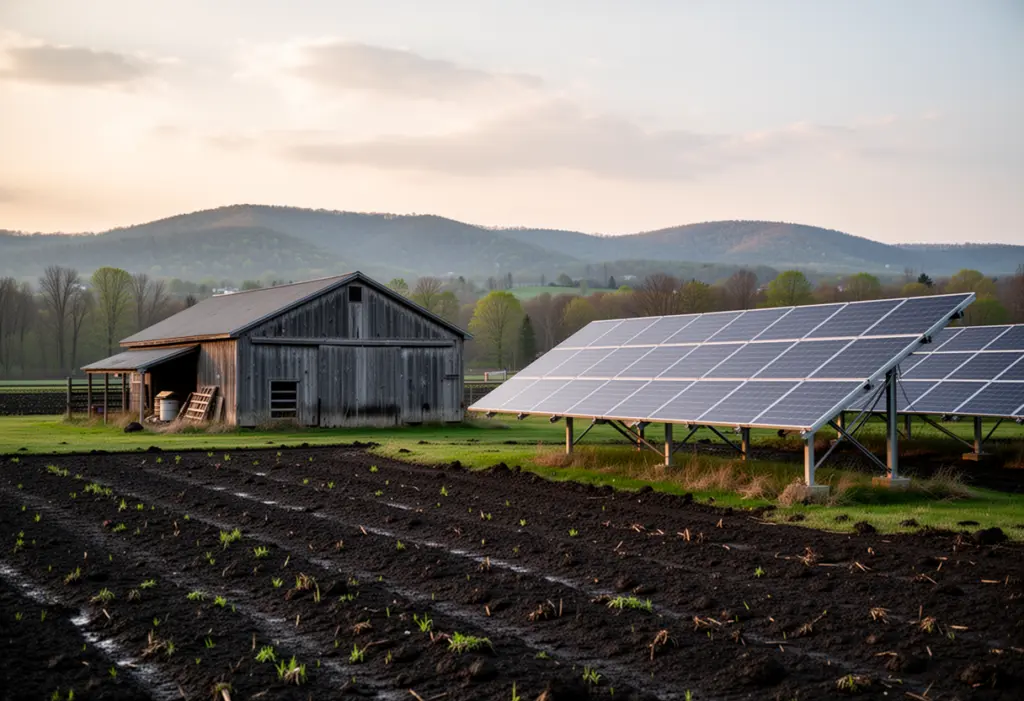
Chester is a town in central Orange County containing an incorporated village of the same name and the hamlet of Sugar Loaf, with black dirt farmland on its flat western side. ZIP code 10918. Three practical questions come before any conversation about panels.
Town of Chester or Village of Chester
They are separate authorities with separate building departments, separate schedules and separate fees, and a Chester mailing address covers both. The hamlets in the town, Sugar Loaf among them, are permitted by the town rather than the village. Establish which department covers your parcel before an installer files anything.
RPTL 487: three levels, or four inside the village
RPTL 487 exempts the added value of a solar system from property tax for fifteen years, but only where the taxing authority has not opted out, and each one decides on its own account:
- The Village of Chester, if your parcel sits inside it. Village taxes are the smallest of the bills, which is exactly why this level gets skipped.
- The Town of Chester.
- Orange County.
- Your school district, which reaches the decision by resolution instead of by local law, and therefore on a different calendar from the other three.
Ask for the position on each for your specific parcel rather than a general statement about New York State. One opt-out out of four still leaves part of the added value taxable, and the exemption is only open to systems constructed before 1 January 2030, which stops being a distant deadline the moment a project slips past a year boundary.
Ground mounts on flat farmland
Much of the western side of the town is flat, open agricultural land. On a parcel with room the array belongs on the ground rather than on the house: the tilt and the bearing become design decisions instead of inherited ones, nothing depends on the age of the roof, and washing or clearing the modules is done from the ground. Before it is priced, ask how far the trench runs from the array back to the house, since that scales with distance and is the line most often understated. Ask what the foundation design assumes about soil and frost depth, and whether anyone tested the ground on your parcel, because the black dirt muckland and the firmer ground on the slopes are not interchangeable and a template design is not an answer. Ask how much clearance sits under the lowest row, since an array set low is buried in drifted snow for weeks. And ask whether site plan review or a setback variance applies, which is a schedule cost as much as a money one.
Farm meter or house meter
The $5,000 ceiling on the state credit is not the constraint that bites on a farm; the residence test is. Form IT-255 wants equipment installed and used at your principal residence in New York State, so an array behind the farm business meter sits outside it while an array serving the house sits inside — provided the house is where you actually live rather than a second or seasonal property. Where a property carries more than one meter, settle which one the array connects behind before a design is drawn, because a system offsets only the meter it sits behind and moving that decision later is expensive. Take the tax treatment to your own accountant, not to the sales proposal.
Which utility, and what it charges
Orange County is split between two utilities and the difference is large, so read the name off your own bill and check that the proposal in front of you used the matching rate. The Customer Benefit Contribution is charged monthly on DC system size for anyone interconnecting on or after 1 January 2022, on capacity rather than output, and recalculated annually rather than locked in. At Orange & Rockland’s 2026 residential rate of $1.00 per kW-month, a 12 kW ground mount costs $12.00 a month, about $144 a year, and an 18 kW array $18.00 a month, about $216. At Central Hudson’s $1.67 the same two systems cost $20.04 and $30.06 a month, roughly $240 and $361 a year. One nuance worth raising if you are expanding an existing array rather than building a new one: the current version of NYSERDA’s Customer Benefit Contribution fact sheet places later expansions of a system interconnected before 1 January 2022 outside the charge, where earlier versions of the same document said the opposite, so ask which version your installer is working from. Phase One net metering credits exports at the full retail rate and holds for twenty years from interconnection.
Older housing in the village and the hamlets
The roof is the usual gate. If the shingles have under a decade in them, replace them before the panels go on, since lifting an array and resetting it is labour nobody wants to pay for twice. Older housing here frequently has 100 amp service, where fitting a solar breaker can require a panel upgrade or a line-side tap — get it into the quote rather than a change order. And where the older streets carry historic character, architectural review can apply ahead of the building permit, so design for approval with a rear plane, all-black modules, flush mounting and concealed conduit.
What is left in 2026, starting with the school district
Of the four RPTL 487 levels above, the school district is the one to establish first, because the school levy is usually the largest single line on a tax bill in this part of Orange County, so a district that has opted out removes more of the exemption’s value than a village opt-out would. It also decides differently from the others: a county, city, town or village opts out by local law, while a school district does it by resolution, which is a different meeting, a different calendar and a different clerk to ask.
What else remains in 2026 is short enough to list. A quarter of qualified expenditure, ceiling $5,000, on Form IT-255, usable against your New York State liability in the year and carried forward up to five years where the liability will not absorb it, and reaching a lease or power purchase agreement of at least a decade as readily as a purchase. Not NY-Sun: NYSERDA’s last standard Upstate residential block for Central Hudson and Orange & Rockland customers (Block 13, $0.15/W) closed on 4 August 2025; the last for NYSEG, RG&E and National Grid customers (Block 14, $0.15/W) closed on 17 December 2025 and the Upstate Affordable Solar block on 9 March 2026, and as of September 2026 NYSERDA has no open NY-Sun block for homes in any utility territory; check NYSERDA’s NY-Sun dashboard for a new one. And the sales tax exemption on residential solar equipment, with each locality deciding on its own share.
The federal residential credit has ended. Section 25D was terminated for expenditures made after 31 December 2025, and an expenditure counts as made when the original installation is completed rather than when the system is approved for operation, so a 2026 buyer earns nothing federally and no phase-down or carryover applies. Programmes change, so check where each of these stands before you sign.
Frequently Asked Questions
Town of Chester or Village of Chester for the permit?
They are separate authorities with separate building departments and fees, and the hamlets in the town, Sugar Loaf among them, are permitted by the town. A Chester mailing address covers both, so confirm the parcel before anything is filed.
Which RPTL 487 level should I check first?
The school district, because the school levy is usually the largest line on a tax bill in this part of Orange County. It also opts out by resolution rather than by local law, so it is a different meeting and a different clerk from the village, town and county.
Does the black dirt change a ground mount design?
It can. Ask what soil and frost depth the foundation design assumes and whether anyone tested the ground on your own parcel, because the muckland on the flat and the firmer ground on the slopes are not interchangeable and a template design is not an answer.
Which utility serves Chester, and what does it charge?
Orange County is split between Orange and Rockland and Central Hudson, so read the name off your bill. The 2026 Customer Benefit Contribution is $1.00 per kW-month against $1.67, so a 12 kW ground mount costs about $144 a year on one and $240 on the other.
This article is general information, not tax, legal or financial advice. Incentive amounts, eligibility rules and deadlines change and depend on your utility, your tax situation and your property. Confirm current terms with NYSERDA, your utility and a qualified tax professional before making a decision.
NY Solar Incentives
Independent New York solar research. We summarise NYSERDA, NY-Sun and federal programme rules from published sources and state plainly when a figure is an estimate. We are not a government agency and do not sell equipment.
Run the arithmetic on your own system
Check the dated program table and your arrangement before counting an incentive. Standard residential NY-Sun blocks are closed; Long Island Affordable Solar has a conditional income-verification route. The NY credit depends on qualified costs and tax liability, while the NYC abatement reduces future property-tax bills. The estimator keeps those timings separate.