Solar Panel Installation in Utica and Oneida County
Utica sits in one of the snowier parts of the state with some of its oldest housing. Here is what that means for an installation and what it is worth.
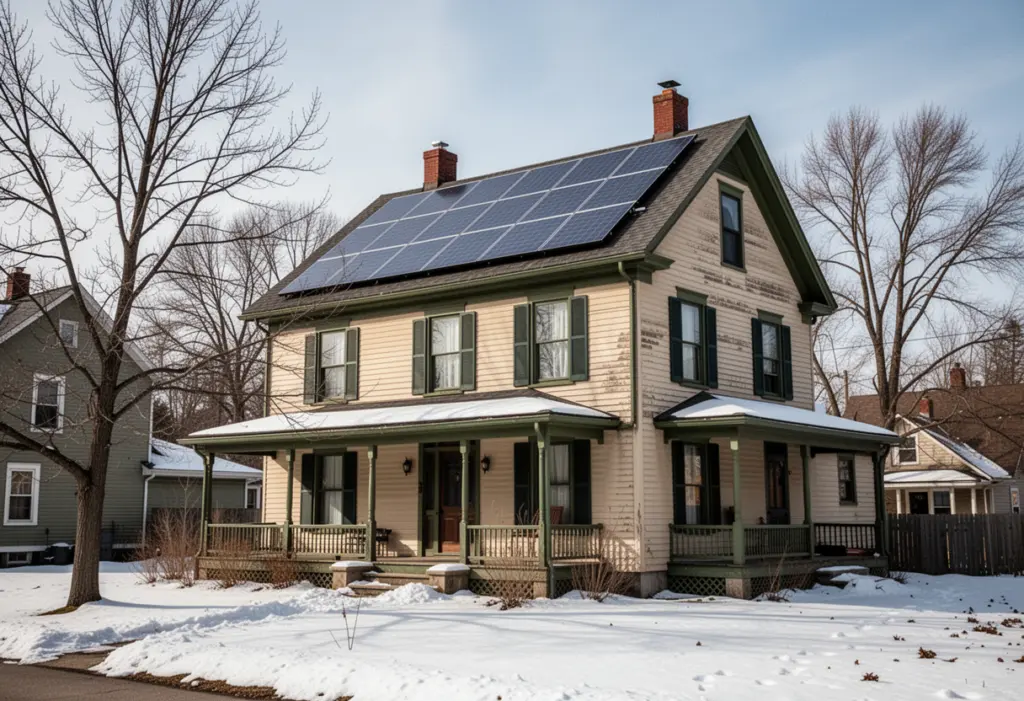
Utica sits in the Mohawk Valley between the Adirondacks and the Tug Hill, in a part of New York that gets serious winter. Combined with housing stock that is old even by upstate standards, that makes the engineering questions here more prominent than the sunlight ones.
Snow load is a design input, not a worry
Oneida County design snow loads are among the higher ones in the state. That does not make solar unsuitable — it makes the racking specification load-bearing, in the literal sense. Ask what load the system is designed to and who verified the roof can carry it in addition to the snow.
Panels themselves shed snow faster than shingles do, because the glass is smooth and dark. The lost production falls in December and January, the weakest months of the year, and net metering carries the summer surplus across to cover them. The requirement is honest sizing and honest production modelling that includes a snow assumption.
Where an array sits above an entrance, a driveway or a neighbour’s property, snow guards are a safety item. A full sheet releasing at once from a steep array is a real hazard in a Utica winter.
Old housing means roof and structure come first
Much of Utica’s housing predates 1940. Two implications:
- Roof age. Under roughly ten years of shingle life left means re-roof first. Doing it later, with an array to remove and reinstall, costs considerably more.
- Structure. A structural engineer’s letter is requested more often here than downstate, and it is a genuine cost when a building department asks.
System size follows the bill
Twelve months of National Grid usage, before any design. Utica has a lot of older housing with mixed heating, and the winter draw in a house with electric supplementary heat is much higher than a template assumes.
National Grid and the sequence
- Interconnection application filed with National Grid, ideally before installation.
- Approval to install.
- Permit from the City of Utica or your town — New Hartford, Whitesboro, Rome, Marcy, Deerfield and others each run their own.
- Installation, then municipal electrical inspection.
- Certificate to National Grid, meter exchange, permission to operate.
The system may not be switched on before permission to operate, and the wait is mostly municipal rather than utility.
National Grid’s Customer Benefit Contribution for 2026 is $0.97 per kW-month on the DC size of the system, for anyone interconnecting on or after 1 January 2022 — the lowest rate in the state. An 8 kW system pays $7.76 a month, about $93 a year.
2026 incentives
The 30% federal residential credit ended for expenditures made after 31 December 2025, with the expenditure treated as made when the original installation is completed. A December 2025 completion still qualifies even where PTO came later; a purchase now does not.
Still available: New York’s 25% credit capped at $5,000 on Form IT-255; the state sales tax exemption; and RPTL 487’s 15-year property tax exemption where the municipality has not opted out. The RPTL 487 exemption is not automatic: file form RP-487 with your assessor by the taxable status date (March 1 in most towns; January 2 in Nassau towns; May 1 or June 1 in Westchester towns; set by charter in cities; usually January 1 in villages), and the system must be built before January 1, 2030 (RP-487 instructions). Oneida County’s towns have each decided that separately, as has each school district. As of September 2026 NYSERDA has no open NY-Sun block for homes in any utility territory; check NYSERDA’s NY-Sun dashboard for a new one.
What to ask
- What snow load is the racking specified for, and who verified the roof structure?
- Does the production estimate include a snow-cover assumption?
- Where will snow discharge, and are snow guards included?
- How much shingle life does my roof have left, assessed by someone not selling panels?
- Is there a federal credit in the net-cost figure? There should not be.
Frequently Asked Questions
Is Utica too snowy for solar panels?
No, but snow load is a real design input. Oneida County design loads are among the higher in the state, so racking specification and roof structure verification matter more here. Panels shed snow faster than shingles, and the lost days fall in the weakest production months.
Which utility connects solar in Utica?
National Grid, which handles the interconnection application and permission to operate. Its 2026 residential Customer Benefit Contribution rate is $0.97 per kW-month, the lowest in New York.
Do older Utica houses need extra work for solar?
Frequently. Much of the housing predates 1940, so roof age often decides the timing, and a structural engineer's letter is requested more often here than downstate.
What can a Utica homeowner claim in 2026?
New York's 25% credit capped at $5,000 on Form IT-255, the state sales tax exemption, and RPTL 487's property tax exemption where the municipality has not opted out. The federal 30% credit is no longer available, and as of September 2026 NYSERDA has no open NY-Sun block for homes in any utility territory; check NYSERDA's NY-Sun dashboard for a new one.
This article is general information, not tax, legal or financial advice. Incentive amounts, eligibility rules and deadlines change and depend on your utility, your tax situation and your property. Confirm current terms with NYSERDA, your utility and a qualified tax professional before making a decision.
NY Solar Incentives
Independent New York solar research. We summarise NYSERDA, NY-Sun and federal programme rules from published sources and state plainly when a figure is an estimate. We are not a government agency and do not sell equipment.
Run the arithmetic on your own system
Check the dated program table and your arrangement before counting an incentive. Standard residential NY-Sun blocks are closed; Long Island Affordable Solar has a conditional income-verification route. The NY credit depends on qualified costs and tax liability, while the NYC abatement reduces future property-tax bills. The estimator keeps those timings separate.