Solar Panel Installation in Monticello NY: What Applies
Sullivan County has a lot of second homes, and the New York State solar credit requires a principal residence. That single test decides whether a Monticello project earns five thousand dollars or nothing.
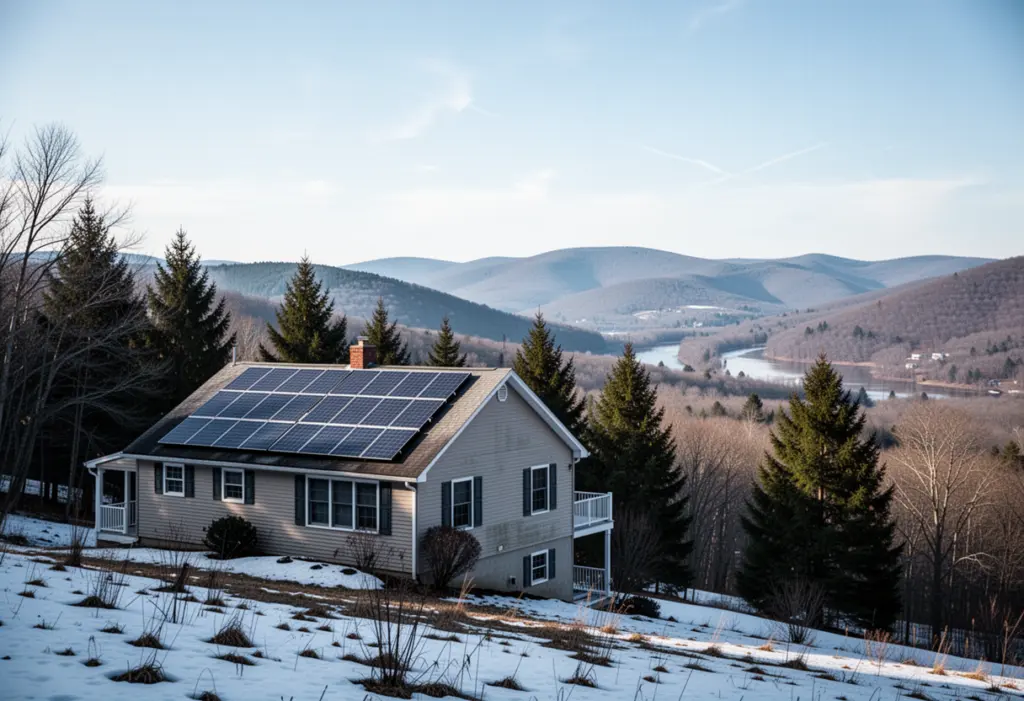
The most expensive question in a Monticello solar project is not about panels. It is whether the house is your principal residence. New York’s solar energy system equipment credit, worth 25% of qualified expenditure up to $5,000 on Form IT-255, requires the equipment to be installed and used at the taxpayer’s principal residence in New York State. Sullivan County has a large stock of seasonal and second homes, and on those the credit is simply not available. Establish which category your house is in before you evaluate any proposal that leans on it.
Village of Monticello or Town of Thompson
Monticello is an incorporated village inside the Town of Thompson, and the two are separate permitting authorities. The 12701 ZIP code spreads well beyond the village line, so the address is not the answer. Ask your installer to state the authority having jurisdiction on the proposal, and ask whether that authority has adopted the New York State Unified Solar Permit, which standardises residential applications for systems of 25 kW DC and under and has been adopted by over 300 authorities across the state.
Catskill weather is a design input, not a footnote
- Snow load and shedding. This is not the lower Hudson Valley. Ask what snow loading the mounting design assumes and where a sliding sheet of snow lands, because an entrance, a walkway or a propane tank underneath a shedding roof plane is a real problem rather than a theoretical one.
- Winter production assumptions. Ask for the December and January production figures the model uses, not just the annual total. Those are the months with the least sun and the most roof cover, and they are where an optimistic estimate hides.
- Ground mount clearance. If a ground mount is on the table, ask how far the lower edge sits above expected snow depth. A ground array buried to its bottom row for six weeks is producing nothing during the weeks you are heating the house.
- Tree line. Steep wooded lots here often lose the low winter sun to a ridge or a stand of evergreens rather than to anything on the property.
The utility, and the charge that follows the array size
Sullivan County is served largely by Central Hudson, with Orange & Rockland serving parts of it. The boundary is not tidy and it is not worth guessing at, because the utility name on your bill determines the interconnection process and the monthly capacity charge.
That charge, the Customer Benefit Contribution, is billed on the DC size of the array regardless of production, on systems interconnected on or after 1 January 2022. For 2026 the residential rate is $1.67 per kW-month at Central Hudson and $1.00 at Orange & Rockland. A 6.5 kW system pays $10.86 a month, about $130 a year, on Central Hudson, against $6.50 a month or $78 a year on Orange & Rockland. The rates are recalculated annually rather than fixed at interconnection.
Where a household is served by a municipal electric utility instead, none of the state framework applies. Municipal utilities are outside Public Service Commission jurisdiction, so there is no state net metering, no capacity charge and no state interconnection process, and the terms have to be asked for from the utility itself.
Four taxing jurisdictions, four opt-outs
RPTL 487 exempts the added assessed value of a solar installation for 15 years and requires construction before 1 January 2030. A county, city, town or village may opt out by local law and a school district by resolution. A village parcel in Monticello is levied by the village and by the Town of Thompson, which means four separate checks rather than three. The list of jurisdictions that tax your parcel is printed on your own tax bill, so start there and ask each one by name.
Where a second home leaves you
If the Monticello house is not your principal residence, three things change. The state credit is unavailable, so any proposal quoting it is wrong for you. The federal residential credit cannot fill the gap either, because section 25D was terminated for expenditures made after 31 December 2025, with an expenditure treated as made when the original installation is completed. What remains is the exemption from state sales tax on residential solar equipment (Sullivan County still charges its own local sales tax on it, according to Publication 718-S) and the RPTL 487 property tax exemption where nobody has opted out. The NY-Sun contractor-applied price reduction is not there either: as of September 2026 NYSERDA has no open NY-Sun block for homes in any utility territory; check NYSERDA’s NY-Sun dashboard for a new one. That is a materially different case from the one most solar arithmetic assumes, and it is better to know it at the quotation stage than at the tax filing. Check the current terms with NYSERDA and with the Department of Taxation and Finance rather than with a sales document.
Frequently Asked Questions
Can I claim the New York solar credit on a Sullivan County second home?
No. The state credit requires the equipment to be installed and used at your principal residence in New York State. A seasonal or second home does not qualify, which matters in a county with a large stock of them.
Who issues the permit in Monticello?
The Village of Monticello and the Town of Thompson are separate permitting authorities and the 12701 ZIP code covers both. Have the authority having jurisdiction named on the proposal, and ask whether it uses the NYS Unified Solar Permit.
How much snow can the mounting handle?
Ask what snow loading the design assumes and where a shedding sheet of snow will land. An entrance, a walkway or a propane tank under a shedding roof plane is a design problem worth solving before installation.
What is the monthly charge on a 6.5 kW array here?
For 2026 it is $10.86 a month at Central Hudson's residential rate of $1.67 per kW-month, or $6.50 at Orange & Rockland's $1.00 — roughly $130 a year against $78, billed on system size regardless of production.
This article is general information, not tax, legal or financial advice. Incentive amounts, eligibility rules and deadlines change and depend on your utility, your tax situation and your property. Confirm current terms with NYSERDA, your utility and a qualified tax professional before making a decision.
NY Solar Incentives
Independent New York solar research. We summarise NYSERDA, NY-Sun and federal programme rules from published sources and state plainly when a figure is an estimate. We are not a government agency and do not sell equipment.
Run the arithmetic on your own system
Check the dated program table and your arrangement before counting an incentive. Standard residential NY-Sun blocks are closed; Long Island Affordable Solar has a conditional income-verification route. The NY credit depends on qualified costs and tax liability, while the NYC abatement reduces future property-tax bills. The estimator keeps those timings separate.