Solar Panel Installation in Goshen NY: A Practical Guide
Orange County is split between two utilities, and in Goshen that split is worth about seventy dollars a year on the same array. The permit office splits too, between village and town.
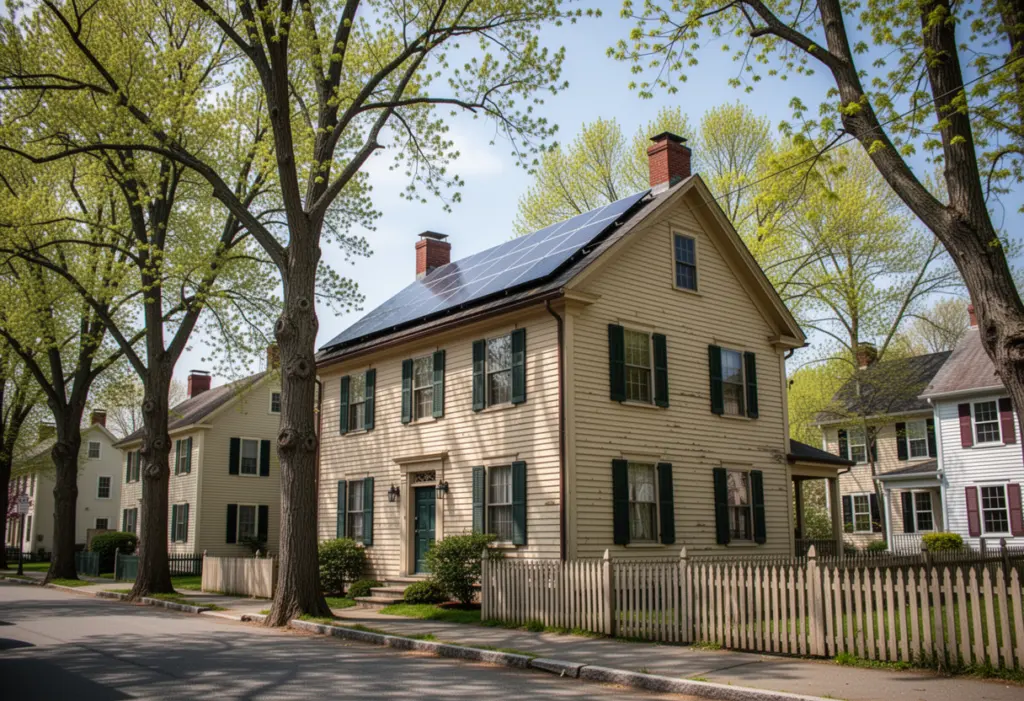
Goshen is an incorporated village inside a town of the same name, and the Orange County seat besides. That produces the first practical question of any solar project here: the Village of Goshen and the Town of Goshen are separate permitting authorities, and a 10924 address tells you nothing about which one holds your file. Establish that before comparing quotes, because the submittal requirements are not identical.
Ask which authority, and ask about review boards
Ask your installer to name the authority having jurisdiction on the proposal, and ask whether it has adopted the New York State Unified Solar Permit. That standardised permit covers residential systems of 25 kW DC and under and has been adopted by more than 300 authorities statewide, which makes the process predictable where it applies.
Then ask a second question that a generic New York guide never raises. Goshen has an older village core built around its nineteenth century streets and the historic harness racing track, and villages of that kind frequently maintain architectural or historic review. Ask the village clerk directly whether your parcel falls inside any designated district, and if it does, ask what that means for a street-facing array. The answer is often that a rear or side roof plane is uncontroversial while a front elevation is not, which is a design decision, not a rejection.
Two utilities, one county, a real difference
Orange County is not served by a single company. Central Hudson covers much of it and Orange & Rockland covers parts, and the boundary does not follow municipal lines cleanly. Read the utility name off your own bill.
The Customer Benefit Contribution shows why. It is a monthly charge on the DC size of the array, applied to systems interconnected on or after 1 January 2022, and it is charged whether the sun shines or not. For 2026 the residential rate is $1.67 per kW-month on Central Hudson and $1.00 on Orange & Rockland. A 9 kW system pays $15.03 a month, roughly $180 a year, under Central Hudson, against $9.00 a month or $108 a year under Orange & Rockland. Rates are recalculated annually and are not locked in at interconnection, so treat them as a current figure rather than a twenty-year assumption.
Roofs, barns and the farm question
- Old frame houses. Village stock includes plenty of nineteenth century construction. Slate and old cedar are not ordinary mounting surfaces, and a roof with under ten years of life left should be replaced before the array goes on, not after.
- Structural review. Ask whether the design requires a structural engineer letter and who pays for it. On older rafters rather than modern trusses this is common and it is cheaper to know at quotation.
- Barns and outbuildings. A south-facing barn roof can beat the house, but the run back to the meter is a cost, and the metering arrangement needs to be established rather than assumed.
- Farm and business projects are a different tax question entirely. The black dirt farms west of the village are commercial operations, and a commercial or agricultural array falls under a different provision from the residential rules discussed here. Take that to your accountant rather than to a solar proposal.
Property tax, and the four opt-outs
RPTL 487 exempts the added assessed value of a solar system for 15 years and requires construction before 1 January 2030. The exemption can be declined separately by a county, city, town or village by local law, and by a school district by resolution. A parcel inside the village is levied by both the village and the town, so a Goshen homeowner has four separate opt-out questions rather than the usual three. Take the list of taxing jurisdictions from your own tax bill and ask about each one by name.
The 2026 position on incentives
The federal residential credit is not part of this arithmetic any more. Section 25D was terminated for expenditures made after 31 December 2025, and an expenditure counts as made when the original installation is completed. What survives is the business-side credit claimed by whoever owns a leased or third-party system, which is why lease and power purchase offers still price in an incentive a buyer never sees.
New York State still offers 25% of qualified expenditure capped at $5,000 on Form IT-255 for a principal residence, and it reaches leases and power purchase agreements of ten years or more. The NY-Sun incentive, which used to arrive as a contractor-applied price reduction, is not available for a home: as of September 2026 NYSERDA has no open NY-Sun block for homes in any utility territory; check NYSERDA’s NY-Sun dashboard for a new one. The state sales tax exemption on residential solar equipment does apply, and there one detail is worth raising: localities may separately elect whether to exempt their own local share, so the total exemption differs by county and by city. Orange County is one that exempts it, according to Publication 718-S. Ask for the tax line on your proposal to be itemised rather than folded into a single price, then verify the current position with NYSERDA and the Department of Taxation and Finance before signing.
Frequently Asked Questions
Which utility serves Goshen NY?
Orange County is split. Central Hudson covers much of it and Orange & Rockland covers parts, and the boundary does not follow municipal lines. The utility name on your own bill is the only reliable answer.
How much is the capacity charge on a 9 kW array in Goshen?
For 2026 it is $15.03 a month, about $180 a year, at Central Hudson's residential rate of $1.67 per kW-month, or $9.00 a month, about $108 a year, at Orange & Rockland's $1.00.
Do I need village or town approval?
Whichever jurisdiction your parcel sits in. The Village of Goshen and the Town of Goshen are separate permitting authorities and a 10924 address covers both, so have the authority having jurisdiction named on the proposal.
Will a historic district stop me installing solar?
Not usually, but it can affect placement. Ask the village clerk whether your parcel falls inside a designated district and what that means for a street-facing array, since a rear roof plane is often uncontroversial where a front elevation is not.
This article is general information, not tax, legal or financial advice. Incentive amounts, eligibility rules and deadlines change and depend on your utility, your tax situation and your property. Confirm current terms with NYSERDA, your utility and a qualified tax professional before making a decision.
NY Solar Incentives
Independent New York solar research. We summarise NYSERDA, NY-Sun and federal programme rules from published sources and state plainly when a figure is an estimate. We are not a government agency and do not sell equipment.
Run the arithmetic on your own system
Check the dated program table and your arrangement before counting an incentive. Standard residential NY-Sun blocks are closed; Long Island Affordable Solar has a conditional income-verification route. The NY credit depends on qualified costs and tax liability, while the NYC abatement reduces future property-tax bills. The estimator keeps those timings separate.