Solar Panel Installation in Glens Falls, NY
Glens Falls sits at the edge of the Adirondacks. Snow design matters here, and a short drive north adds a review body that does not apply in the city.
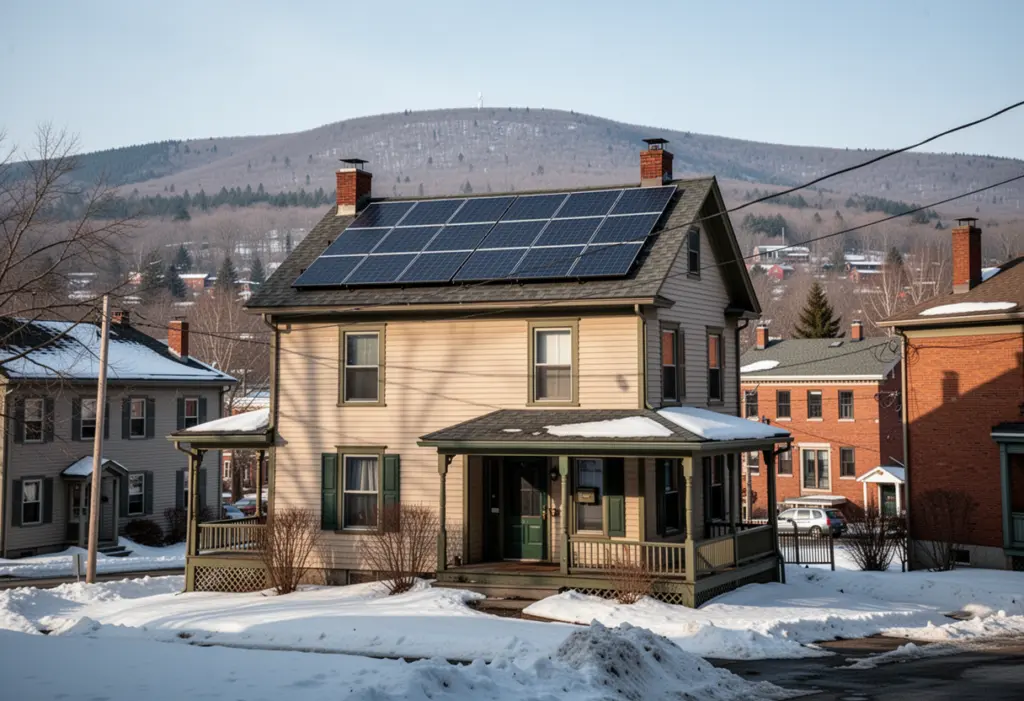
Glens Falls is a small city in Warren County at the southern edge of the Adirondacks. ZIP code 12801. Three things shape a solar project here: snow, the age of the housing, and where the Park boundary falls.
Snow is a design input, not a footnote
This is genuine snow country, and it changes three specific things:
- Structural load. Ask what ground snow load the racking and attachments are specified for. Where the roof is older or the framing light, a structural engineer’s letter may be required — budget for it rather than discovering it after contract.
- Shedding. Panels are slicker than shingle, so a full array can discharge at once. Snow guards where the array sits above a door, a walkway or a driveway are a safety item, not an upsell.
- Production modelling. Ask what snow-cover assumption is in the estimate. A model built on a downstate snow profile will overstate a Glens Falls winter.
What snow does not justify is tilting the array steeply to shed faster. A steeper tilt on a pitched roof raises wind load, complicates mounting and usually costs more production across the year than the snow it clears.
Older city housing
Glens Falls housing skews old, much of it late nineteenth and early twentieth century. Roof age is frequently the gate: under roughly ten years of shingle life left means re-roof first. Older wood-frame roofs draw a structural letter more often, and slate appears here — ask what the installer has mounted on your roof type before, and for photographs.
Service panels are the other common surprise. Older houses frequently have 100 amp service, and fitting a solar breaker can require a panel upgrade. Get it in the quote, not in a change order.
The Adirondack Park boundary
The City of Glens Falls is outside the Adirondack Park, so a project here needs no Adirondack Park Agency involvement. But the boundary is close: properties in Queensbury, Lake George and further north sit inside the Park, where the APA has jurisdiction alongside the town.
That is an ordinary process rather than an obstacle — a roof-mounted array on an existing house is a routine matter. But it is an extra body and extra weeks, and it is the single most common thing an installer from outside the region fails to build into a schedule. If your property is north of the city, establish early whether it is inside the Park.
National Grid
The Customer Benefit Contribution is $0.97 per kW-month of DC system size for 2026, the lowest residential rate of New York’s seven investor-owned utilities — about $5.82 a month on a 6 kW system, roughly $70 a year. Billed on capacity regardless of production and recalculated annually. Confirm your utility from your own bill.
2026 incentives
The 30% federal residential credit is gone — section 25D was terminated for expenditures made after 31 December 2025, with an expenditure treated as made when the original installation is completed. Note the interaction with schedule: a project held past a year boundary by a review body can lose an incentive that was open when it was quoted.
Still available for a principal residence: New York’s 25% credit capped at $5,000 on Form IT-255; the state sales tax exemption; and RPTL 487’s 15-year property tax exemption where the city, Warren County and your school district have not opted out, once you file form RP-487 with each assessor for your address by its taxable status date. NY-Sun is not on that list, and neither is its income-qualified Affordable Solar track: as of September 2026 NYSERDA has no open NY-Sun block for homes in any utility territory, Affordable Solar included; check NYSERDA’s NY-Sun dashboard for a new one.
Frequently Asked Questions
Does snow make solar impractical in Glens Falls?
No, but it is a design input. Ask what ground snow load the racking is specified for, insist on snow guards where the array discharges over a door or walkway, and check what snow-cover assumption is in the production estimate.
Should the array be tilted steeply to shed snow?
Generally not on a pitched roof. A steeper tilt raises wind load, complicates mounting and usually costs more production across the year than the snow it clears.
Does the Adirondack Park Agency review solar in Glens Falls?
Not in the city itself, which is outside the Park. But properties in Queensbury, Lake George and further north are inside it, where the APA has jurisdiction alongside the town — an ordinary process, but extra weeks that installers from outside the region often fail to schedule.
What does National Grid charge a Glens Falls solar customer?
The Customer Benefit Contribution at $0.97 per kW-month of DC system size for 2026 — about $70 a year on a 6 kW system, the lowest residential rate in the state.
This article is general information, not tax, legal or financial advice. Incentive amounts, eligibility rules and deadlines change and depend on your utility, your tax situation and your property. Confirm current terms with NYSERDA, your utility and a qualified tax professional before making a decision.
NY Solar Incentives
Independent New York solar research. We summarise NYSERDA, NY-Sun and federal programme rules from published sources and state plainly when a figure is an estimate. We are not a government agency and do not sell equipment.
Run the arithmetic on your own system
Check the dated program table and your arrangement before counting an incentive. Standard residential NY-Sun blocks are closed; Long Island Affordable Solar has a conditional income-verification route. The NY credit depends on qualified costs and tax liability, while the NYC abatement reduces future property-tax bills. The estimator keeps those timings separate.