Solar Panel Installation in Rome, NY
Rome has land, snow and National Grid's solar charge, the lowest of the major New York utilities. A few miles west, Sherrill has its own municipal electric utility, so ask it for its solar terms.
Rome is a city in Oneida County, in the Mohawk Valley. ZIP codes 13440 and 13441. It is one of the geographically largest cities in New York State by area, which turns out to matter for solar.
Land, and the ground-mount option
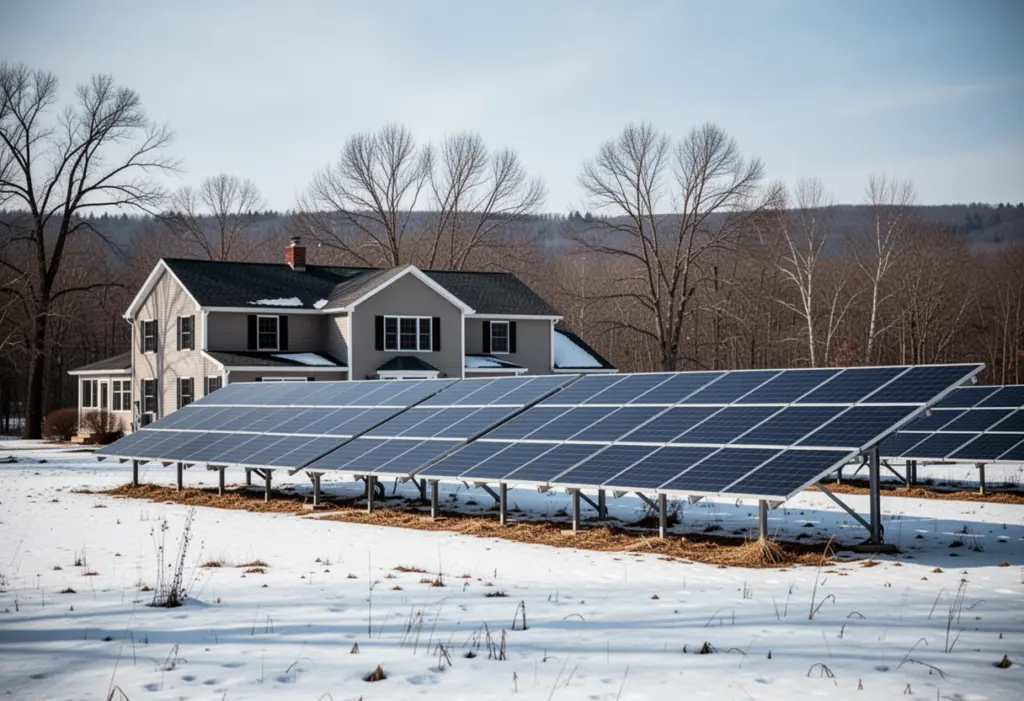
Rome covers a great deal of open ground, and many properties have space. A ground mount is a genuine alternative here rather than a fallback, and it solves several problems at once:
- Orientation and tilt are chosen rather than inherited from the roof.
- Shading is solved by siting the array where the sun is.
- The roof-age question disappears entirely — no re-roof first, no removal and reinstallation in fifteen years.
- Maintenance and snow clearing happen at ground level, which in this climate is worth more than it sounds.
Ask early about setbacks, whether a site plan review applies, and foundation depth below the frost line — that last one is a real cost item in the Mohawk Valley and it should be in the quote.
Snow
Rome gets substantial snow. Ask what ground snow load the racking is specified for, whether snow guards are needed where a roof array discharges over a door or a path, and what snow-cover assumption is in the production estimate. A model built on a downstate profile will overstate the winter here.
For a ground mount, ask how much clearance there is beneath the lowest row: an array set too low is buried by drifted snow for weeks at a time.
National Grid: the lowest charge in the state
The Customer Benefit Contribution — a monthly charge on the DC size of the system for anyone interconnecting on or after 1 January 2022 — is $0.97 per kW-month for 2026 on National Grid’s residential rate, the lowest of New York’s seven investor-owned utilities.
- An 8 kW system: $7.76 a month, about $93 a year.
- A 12 kW ground mount: $11.64 a month, about $140 a year.
Billed on capacity regardless of production and recalculated annually. Phase One net metering credits exports at the full retail rate and holds for 20 years from interconnection.
The municipal utility next door
A few miles west, the City of Sherrill runs its own municipal electric utility. That is not a detail — the state net metering rules, the Customer Benefit Contribution and the standardised interconnection process described here may not apply there, so ask Sherrill’s utility for its own metering and interconnection rules.
The same is true elsewhere in the region. If you are anywhere near a village or city that generates its own power, confirm your utility from your own bill before reading any general New York guidance — including this one.
2026 incentives
The 30% federal residential credit is gone — section 25D was terminated for expenditures made after 31 December 2025, with an expenditure treated as made when the original installation is completed.
Still available for a principal residence: New York’s 25% credit capped at $5,000 on Form IT-255, reaching leases and PPAs of ten years or more as well as purchases; the state sales tax exemption; and RPTL 487’s 15-year property tax exemption where the city, Oneida County and your school district have not opted out, once you file form RP-487 with each assessor for your address by its taxable status date. NY-Sun is not on that list, and neither is its income-qualified Affordable Solar track: as of September 2026 NYSERDA has no open NY-Sun block for homes in any utility territory, Affordable Solar included; check NYSERDA’s NY-Sun dashboard for a new one.
Frequently Asked Questions
Is a ground mount worth it in Rome?
Often. Rome covers a lot of open ground and many properties have space. A ground mount lets orientation and tilt be chosen, solves shading by siting, removes the roof-age question entirely and puts snow clearing at ground level.
Do New York solar rules apply everywhere near Rome?
Not necessarily. Sherrill runs its own municipal electric utility, where state net metering, the Customer Benefit Contribution and standardised interconnection may not apply; ask it for its own rules. Confirm your utility from your own bill.
How high should a ground mount sit in Rome?
Ask specifically about clearance beneath the lowest row. An array set too low is buried by drifted snow for weeks at a time in this climate, which no production model captures.
What does National Grid charge a Rome solar customer?
The Customer Benefit Contribution at $0.97 per kW-month of DC system size for 2026, the lowest residential rate in New York — about $93 a year on an 8 kW system and $140 on a 12 kW ground mount.
This article is general information, not tax, legal or financial advice. Incentive amounts, eligibility rules and deadlines change and depend on your utility, your tax situation and your property. Confirm current terms with NYSERDA, your utility and a qualified tax professional before making a decision.
NY Solar Incentives
Independent New York solar research. We summarise NYSERDA, NY-Sun and federal programme rules from published sources and state plainly when a figure is an estimate. We are not a government agency and do not sell equipment.
Run the arithmetic on your own system
Check the dated program table and your arrangement before counting an incentive. Standard residential NY-Sun blocks are closed; Long Island Affordable Solar has a conditional income-verification route. The NY credit depends on qualified costs and tax liability, while the NYC abatement reduces future property-tax bills. The estimator keeps those timings separate.