Solar Panel Cost in Canandaigua, NY
Canandaigua is a city, a town and a lakeshore, and which of the three you are in changes both the permit and the tax credit.
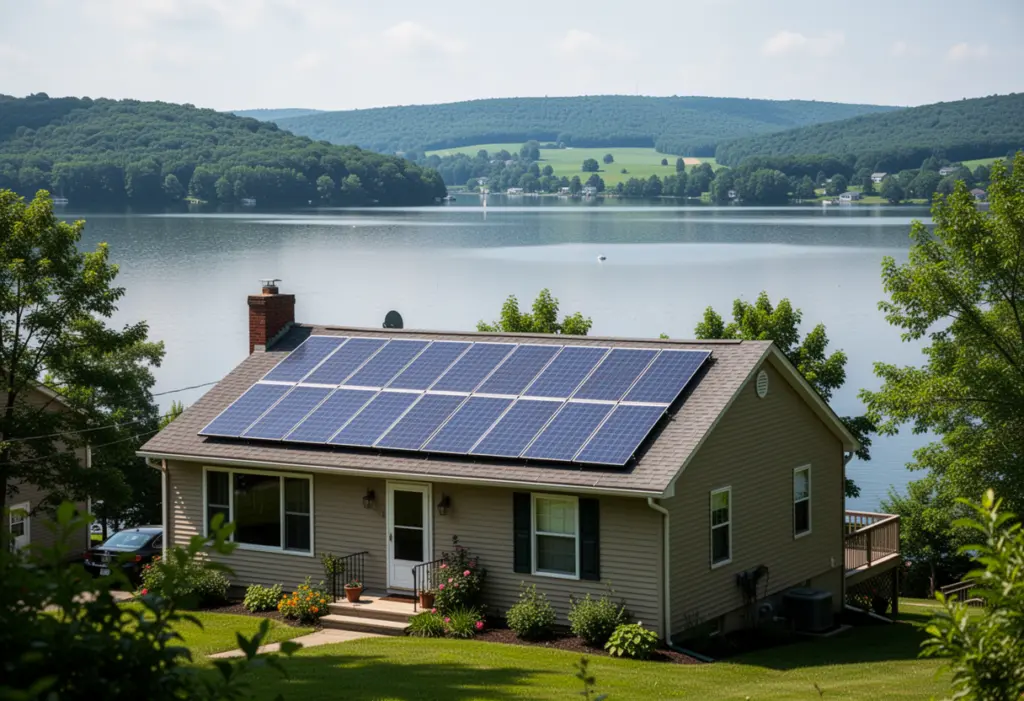
Canandaigua sits at the north end of Canandaigua Lake in Ontario County. ZIP code 14424. Three local things bear on the cost of a system here.
City or town
The City of Canandaigua and the Town of Canandaigua are separate authorities with their own building departments. City lots are smaller with older housing; town properties are larger and frequently have room for a ground mount. Establish which covers your address before an installer files anything.
The seasonal property question
The lakeshore has a substantial share of seasonal and second homes, and this decides more money than any equipment choice: New York’s 25% credit on Form IT-255 is for equipment installed and used at your principal residence in New York State. A lake house that is not your principal residence does not qualify.
Establish that before a proposal is built around a credit worth up to $5,000 that you cannot claim. Intermittent occupancy also changes sizing — a system designed from an annual average will not match a house used at weekends and in summer.
Lakefront conditions
Properties on or near the water carry two extras. Wind exposure across open water is greater, so ask what wind load the racking and attachments are specified for, not only the snow load. And shoreline setbacks and any local review can affect a ground mount’s siting — ask early rather than after a design is drawn.
The hills on both sides of the lake also mean the southern horizon varies sharply between properties. Insist on an on-site shading assessment and ask what the model says about December and January, not just the annual total.
RG&E
The Customer Benefit Contribution is $1.31 per kW-month of DC system size for 2026 — about $9.17 a month on a 7 kW system, roughly $110 a year, or $13.10 on 10 kW, about $157. Billed on capacity regardless of production and recalculated annually.
Confirm your utility from your own bill. Several villages in this part of the state run their own municipal electric utilities, and for a municipal customer state net metering, the Customer Benefit Contribution and standardised interconnection may not apply; ask your municipal utility for its own metering and interconnection rules.
Where RG&E does serve you, Phase One net metering credits exports at the full retail rate and holds for 20 years from interconnection.
Snow
Finger Lakes snow load is significant. Ask what load the racking is specified for, whether snow guards are needed where an array discharges over a door or a path, and what snow-cover assumption is in the production estimate.
2026 incentives
The 30% federal residential credit has ended — section 25D was terminated for expenditures made after 31 December 2025, with an expenditure treated as made when the original installation is completed. Any proposal still showing it is materially wrong, and on a Finger Lakes system that is usually the largest single line in the quote.
Still available for a principal residence: New York’s 25% credit capped at $5,000 on Form IT-255, reaching leases and PPAs of ten years or more as well as purchases; the state sales tax exemption; and RPTL 487’s 15-year property tax exemption where the city or town, Ontario County and your school district have not opted out, once you file form RP-487 with each assessor for your address by its taxable status date. NY-Sun is not on that list, and neither is its income-qualified Affordable Solar track: as of September 2026 NYSERDA has no open NY-Sun block for homes in any utility territory, Affordable Solar included; check NYSERDA’s NY-Sun dashboard for a new one.
Frequently Asked Questions
Can I claim the New York credit on a Canandaigua lake house?
Only if it is your principal residence. Form IT-255 covers equipment installed and used at your principal residence in New York State, so a seasonal or second home does not qualify — worth up to $5,000, so establish it before a proposal is built around it.
City or Town of Canandaigua — does it matter?
Yes. They are separate authorities with their own building departments. City lots are smaller with older housing; town properties are larger and frequently have room for a ground mount.
What does RG&E charge a Canandaigua solar customer?
The Customer Benefit Contribution at $1.31 per kW-month of DC system size for 2026 — about $110 a year on a 7 kW system and $157 on 10 kW. Confirm your utility from your own bill, as several villages in the region are municipal.
Does lakefront exposure change the installation?
Yes. Wind exposure across open water is greater, so ask what wind load the racking is specified for rather than only the snow load, and check shoreline setbacks before a ground mount is designed.
This article is general information, not tax, legal or financial advice. Incentive amounts, eligibility rules and deadlines change and depend on your utility, your tax situation and your property. Confirm current terms with NYSERDA, your utility and a qualified tax professional before making a decision.
NY Solar Incentives
Independent New York solar research. We summarise NYSERDA, NY-Sun and federal programme rules from published sources and state plainly when a figure is an estimate. We are not a government agency and do not sell equipment.
Run the arithmetic on your own system
Check the dated program table and your arrangement before counting an incentive. Standard residential NY-Sun blocks are closed; Long Island Affordable Solar has a conditional income-verification route. The NY credit depends on qualified costs and tax liability, while the NYC abatement reduces future property-tax bills. The estimator keeps those timings separate.