Solar Panel Installation in Brighton, NY
Brighton's tree canopy is its defining feature and its main solar constraint. Everything else follows from measuring it properly.
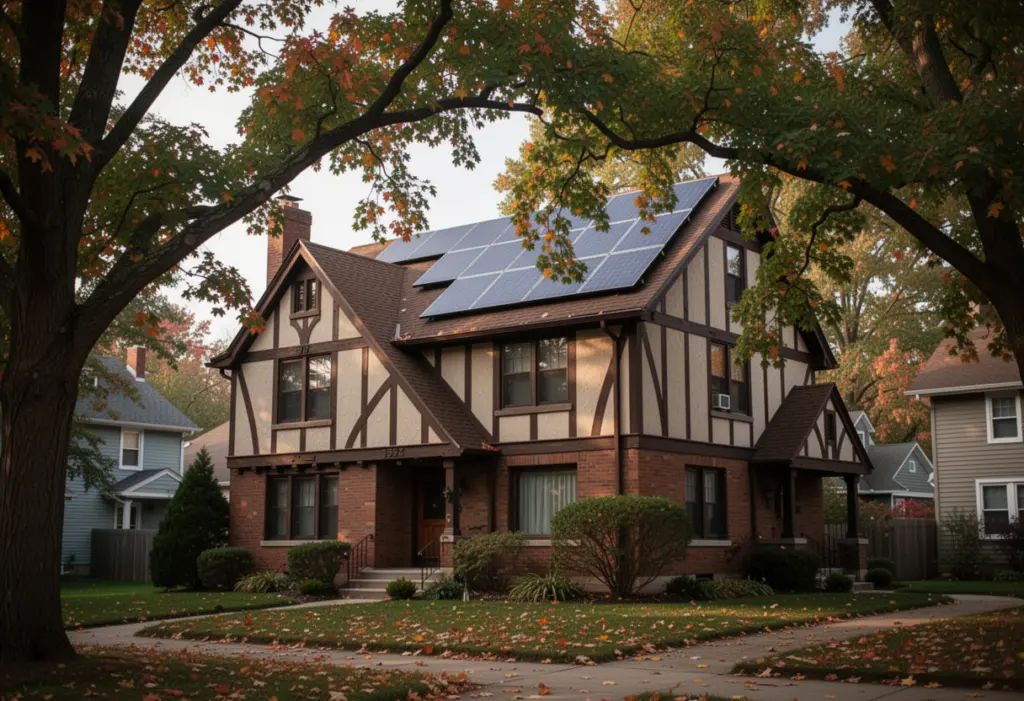
Brighton is an inner-ring town adjoining Rochester in Monroe County. ZIP codes 14618, 14610 and 14620. Its established streets carry some of the densest mature tree canopy in the region, and that is the single biggest variable in a solar project here.
How to tell a real shading assessment from a guess
On a heavily treed Brighton lot, the difference between a properly measured estimate and a satellite-derived one can be large enough to change whether the project is worth doing. Signs that an assessment is real:
- Someone came to the property and measured the horizon from the roof plane, not from the ground or from an aerial image.
- The output includes monthly figures, and you are shown December and January rather than only an annual total.
- Individual roof areas are assessed separately, because one plane can be usable while another is not.
- The installer says which trees are the problem, and whether they are on your land or a neighbour’s.
If two proposals differ substantially on annual production, one of them has almost certainly not been to the property. Ask each what the December figure is and how it was obtained.
Design choices that suit a shaded roof
Per-panel electronics. Microinverters or DC optimisers contain a shading loss to the affected panel rather than letting it drag on the rest of a string. On a Brighton roof this is close to essential rather than an upgrade.
Per-panel monitoring. It makes a growing shading problem visible years later, when a branch that cleared the roof at installation no longer does.
Fewer panels in better places. A smaller array on the genuinely unshaded plane frequently outperforms a larger one spread across compromised areas — and costs less.
Trees are a decision, not an assumption
If removal is proposed, it should be presented as your choice with its own cost, not folded silently into a production estimate. It may need a permit, and on Brighton’s streets the canopy is a large part of why people live there. Community solar, which needs no roof at all, is the alternative that keeps the trees.
Pre-war housing
Much of Brighton’s older stock is 1920s and 1930s. Three consequences: roof age is the usual gate, under roughly ten years of shingle life left meaning re-roof first; structural letters are needed more often on older framing; and 100 amp service is common, where fitting a solar breaker can require an upgrade or a line-side tap. All three belong in the quote rather than a change order.
Slate appears on some houses here and needs a mounting approach not every installer is equipped for — ask what they have done on your roof type and for photographs.
RG&E
The Customer Benefit Contribution is $1.31 per kW-month of DC system size for 2026 — about $7.86 a month on a 6 kW system, roughly $94 a year. Billed on capacity regardless of production and recalculated annually.
Because shading caps systems here, the charge is usually modest in absolute terms. Phase One net metering credits exports at the full retail rate and holds for 20 years from interconnection. Confirm your utility from your own bill.
Snow
Monroe County lake-effect snow is significant. Ask what ground snow load the racking and roof structure are specified for, whether snow guards are needed where the array discharges over a door or a walkway, and what snow-cover assumption is in the estimate.
2026 incentives
The 30% federal residential credit is gone — section 25D was terminated for expenditures made after 31 December 2025, with an expenditure treated as made when the original installation is completed.
Still available for a principal residence: New York’s 25% credit capped at $5,000 on Form IT-255; the state sales tax exemption; and RPTL 487’s 15-year property tax exemption where the town, Monroe County and your school district have not opted out, if you file form RP-487 with the assessor by the taxable status date. NY-Sun and its Affordable Solar blocks for lower-income households are not on that list: as of September 2026 NYSERDA has no open NY-Sun block for homes in any utility territory; check NYSERDA’s NY-Sun dashboard for a new one.
Frequently Asked Questions
How do I know a Brighton shading assessment is real?
Someone measured the horizon from the roof plane rather than the ground or an aerial image, the output gives monthly figures including December and January, each roof area is assessed separately, and the installer can say which trees are the problem.
Are microinverters necessary on a shaded roof?
On a heavily treed Brighton lot, per-panel electronics are close to essential rather than an upgrade — they contain a shading loss to the affected panel instead of letting it drag on a whole string, and they make a growing problem visible later.
Is a bigger array always better here?
No. A smaller array on the genuinely unshaded plane frequently outperforms a larger one spread across compromised areas, and costs less. Ask for both to be modelled.
What does RG&E charge a Brighton solar customer?
The Customer Benefit Contribution at $1.31 per kW-month of DC system size for 2026 — about $94 a year on a 6 kW system, billed on capacity regardless of production.
This article is general information, not tax, legal or financial advice. Incentive amounts, eligibility rules and deadlines change and depend on your utility, your tax situation and your property. Confirm current terms with NYSERDA, your utility and a qualified tax professional before making a decision.
NY Solar Incentives
Independent New York solar research. We summarise NYSERDA, NY-Sun and federal programme rules from published sources and state plainly when a figure is an estimate. We are not a government agency and do not sell equipment.
Run the arithmetic on your own system
Check the dated program table and your arrangement before counting an incentive. Standard residential NY-Sun blocks are closed; Long Island Affordable Solar has a conditional income-verification route. The NY credit depends on qualified costs and tax liability, while the NYC abatement reduces future property-tax bills. The estimator keeps those timings separate.