What Solar Panels Cost in Spring Valley, New York
Two answers decide what solar costs in Spring Valley: how much unshaded roof a village lot really has, and whose meter the array is allowed to feed.
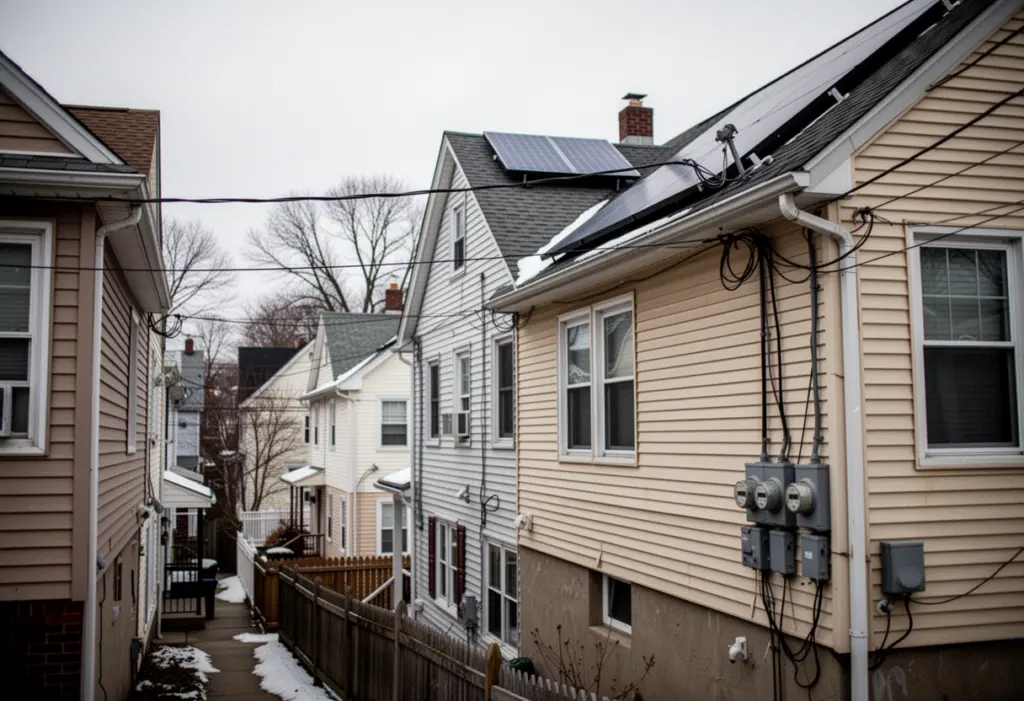
Solar cost in Spring Valley is decided by two things that have nothing to do with panel brand: how much unshaded roof a village lot actually has, and whose meter the array is allowed to feed. Answer those first and the rest of a quote becomes comparable.
The meter question comes before the price question
An array offsets the account it is wired to, and nothing else. In a village where a large share of the housing is two-family and a large share of it is rented, that single sentence decides who can buy solar at all. If a building has two meters, the array feeds one of them and the owner has to choose which: the tenant benefits, or the owner does, and the credit does not split itself afterwards. If you rent, you cannot install on a roof you do not own.
The arrangement that does work for a renter, or for anyone whose roof is too small or too shaded, is community solar. It needs no roof, no permit and no capital, and a subscriber pays no Customer Benefit Contribution at all, because that charge falls on systems behind your own meter rather than on front-of-the-meter projects. For a good many addresses in the 10977 ZIP code it is the only route that works.
What Orange & Rockland customers pay per kW
Most of Spring Valley is served by Orange & Rockland, whose residential Customer Benefit Contribution for 2026 is $1.00 per kW-month of DC size — the second lowest residential rate of the seven New York utilities in the 2026 table. A 6 kW array, a realistic size for a village lot, is charged 6 × $1.00 = $6.00 a month, or $72 a year. Only systems interconnected on or after 1 January 2022 pay it at all. The same array under Central Hudson, further north, would be billed $10.02 a month. Territory here does not follow town lines, so read the name on your own bill.
Village lots price differently from suburban ones
- Roof area is the binding constraint. On a narrow lot with neighbouring rooflines close by, the usable area may cap the system well below what the electricity bill would justify.
- Fixed costs do not shrink with the array. Permit, interconnection, mobilisation and inspection cost much the same on a small job as on a large one, so the price per watt rises as the system gets smaller. That is arithmetic rather than a markup, and it is why a village quote should not be compared straight against a suburban one.
- Shading comes from buildings, not only trees. Ask for the shade study at the winter sun angle, when the wall next door throws a far longer shadow than it does in June.
- Service equipment. Older multi-family buildings often have crowded service gear, and a panel change or meter reconfiguration can be the largest single line in the proposal.
Permits and property tax inside the village
A Spring Valley address is permitted by the village, not by the Town of Ramapo, even though the village sits within the town. Ask the village building department what it requires and whether it uses the New York State Unified Solar Permit for systems of 25 kW DC and under. For property tax, RPTL 487 exempts the added assessed value for fifteen years, but the village, Rockland County and your school district — East Ramapo for most village addresses — each hold their own right to opt out. That is three answers, and the assessor gives all three. The system must also be constructed before 1 January 2030.
What is left of the incentives in 2026
The federal residential credit is finished. Section 25D was terminated for expenditures made after 31 December 2025, with the expenditure treated as made when the original installation is completed, so a homeowner buying this year claims nothing on a federal return. Leases and power purchase agreements still price an incentive in, but it is claimed by the company that owns the equipment, not by you.
New York keeps its own credit: 25% of qualifying cost with a five thousand dollar ceiling on Form IT-255 at a principal residence, and it reaches a lease or a power purchase agreement of ten years or more. The ten-year minimum applies to the lease every bit as much as to the PPA, and for either the ceiling is a lifetime figure per agreement rather than an annual one. Add the state sales tax exemption on residential equipment. NY-Sun and its income-qualified Affordable Solar incentive, both applied by the contractor, are not available to homes at present: as of September 2026 NYSERDA has no open NY-Sun block for homes in any utility territory, the Affordable Solar blocks included; check NYSERDA’s NY-Sun dashboard for a new one.
All of this changes with time. Before you sign anything, check whether NYSERDA has opened a new NY-Sun block for homes, and confirm the opt-out answers and the utility name.
Frequently Asked Questions
Can a tenant in Spring Valley get solar panels?
Not on a roof they do not own. The route that works for renters is community solar, which needs no roof, no permit and no capital, and subscribers pay no Customer Benefit Contribution because that charge applies to systems behind your own meter.
Which meter does the array feed on a two-family house?
One of them, chosen before the interconnection application is filed. The system offsets the account it is wired to and the credit cannot be split between two meters later, so the owner decides whether the benefit sits with the tenant or the owner.
What is the monthly solar charge on Orange and Rockland?
The 2026 residential Customer Benefit Contribution is $1.00 per kW-month of DC size, the second lowest residential rate of the seven New York utilities. A 6 kW array pays $6.00 a month, $72 a year, charged on capacity regardless of production.
Who issues the solar permit for a Spring Valley address?
The village, not the Town of Ramapo, even though the village lies inside the town. Ask the village building department what it requires and whether it uses the New York State Unified Solar Permit for systems of 25 kW DC and under.
This article is general information, not tax, legal or financial advice. Incentive amounts, eligibility rules and deadlines change and depend on your utility, your tax situation and your property. Confirm current terms with NYSERDA, your utility and a qualified tax professional before making a decision.
NY Solar Incentives
Independent New York solar research. We summarise NYSERDA, NY-Sun and federal programme rules from published sources and state plainly when a figure is an estimate. We are not a government agency and do not sell equipment.
Run the arithmetic on your own system
Check the dated program table and your arrangement before counting an incentive. Standard residential NY-Sun blocks are closed; Long Island Affordable Solar has a conditional income-verification route. The NY credit depends on qualified costs and tax liability, while the NYC abatement reduces future property-tax bills. The estimator keeps those timings separate.